Half the string is out: what actually failed, and whether it is worth fixing
Four failure modes, in the order to check them. Plus the published specification that decides whether a set is a repair or a replacement.
By Sawyer V. · Published
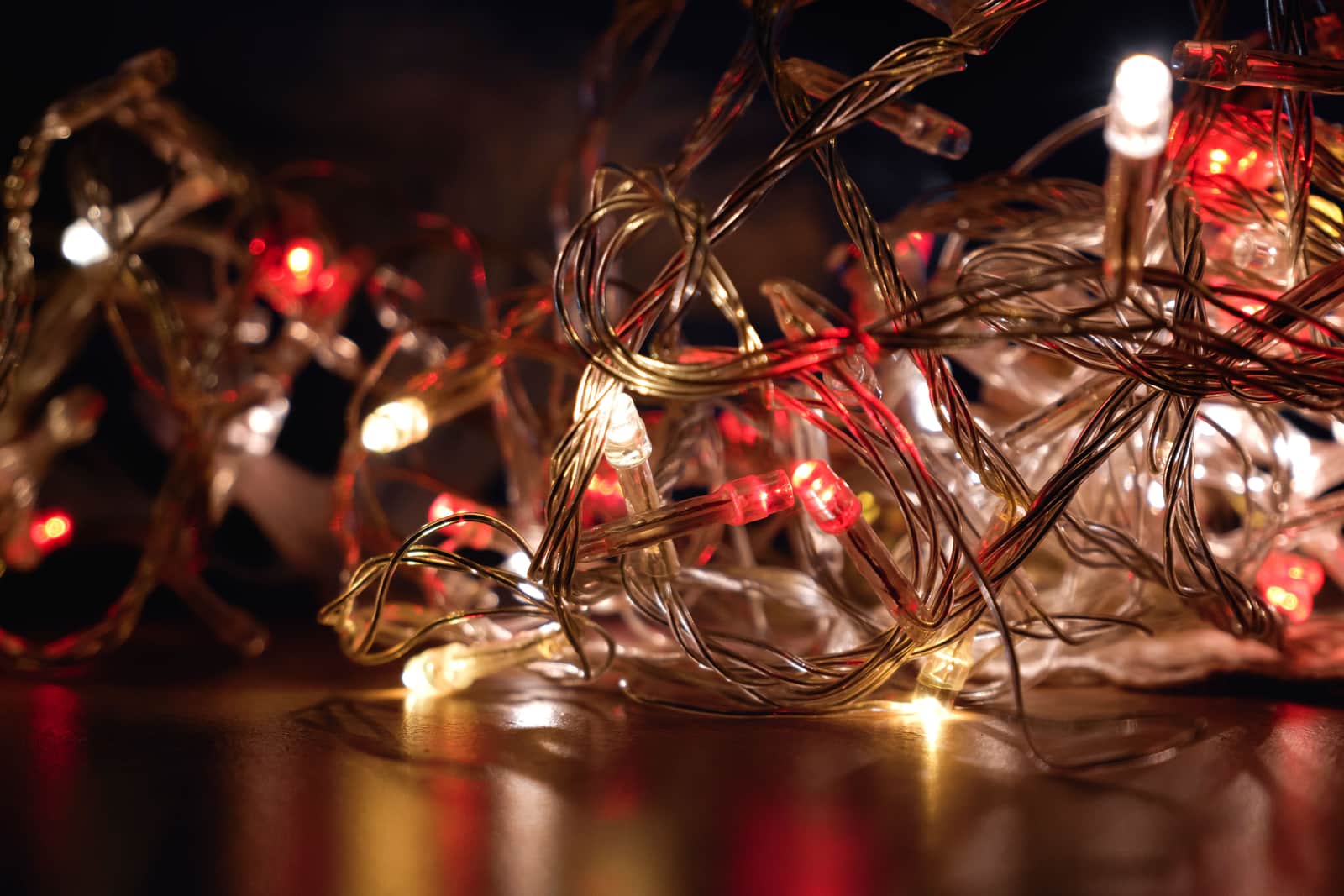
A string that is half dark is the most common complaint in this entire category, and it is usually treated as a mystery. It is not. There are four things that can be wrong, they fail in recognisable ways, and three of them are checkable in about two minutes without a meter.
What follows is that check, in the order that finds the fault fastest, and then the harder question underneath it: whether the set you are holding was ever designed to be repaired. That one is answerable from the listing before you buy, which is the part worth knowing in advance.
Wreath & Watt earns a commission on qualifying purchases made through the Amazon links on this page. It costs you nothing and it does not change the order of the picks — here is exactly how we are funded.
The four things that can be wrong
Work down this list in order. It is arranged by how quickly each one can be ruled out, not by how likely it is.
| What you see | Most likely cause | Check | Fixable? |
|---|---|---|---|
| Nothing lights at all | Supply, not the string | Try the outlet with something else | Yes — it is not the lights |
| One continuous section dark, rest fine | A break in that section | Look for a missing or loose bulb at the start of the dark run | On a serviceable set, yes |
| Whole string dark, others on the same run fine | The fuses in that string's plug | Slide the plug cover open | Usually yes |
| Random single bulbs out | Individual bulb failure | Look along the run in daylight | Only on a replaceable-bulb set |
A whole string dark while its neighbours work almost always points at the plug rather than the wire. It is the fastest check on the list and the one most people skip.
Source: Our own diagnostic ordering, built from the way these sets are constructed. It is guidance, not a manufacturer procedure.
The fuses nobody knows are there
Most plug-in light sets carry two small fuses inside the male plug, behind a sliding cover. They protect the string rather than the circuit, and they are the reason a single string can go completely dark while everything else on the same cord carries on working normally.
Replacements are usually supplied in the original packaging, taped to the strand or in a small bag, which is a good argument for keeping one box per set type rather than discarding all of them. If a fresh fuse blows immediately, stop: something downstream is drawing more than the string is built for, and that is a different problem from a tired fuse.
The specification that decides repair or replace
Here is the part that matters before the failure rather than after it. Some sets are built so that a bulb is a bulb; others are built so that a bulb is the whole string. The listings tell you which, and almost nobody reads for it.
The Wintergreen C9 OptiCore set publishes replaceable, individually unscrewing bulbs on an 18 AWG commercial stringer. That single line is the difference between a five-minute fix and a bin bag. Its multicolor twin is identical hardware, which also means a spare bulb from one works in the other — a real advantage if you run both on the same house.
At the other end, a sealed LED mini string like the 100-count Northlight is not designed around field repair, and neither is a 400-LED icicle set with 80 drops. That is not a criticism — they are inexpensive, they publish their counts and lengths honestly, and they are meant to be replaced rather than serviced. It is simply a different ownership model, and it should be a conscious choice.
Why a section goes rather than a single bulb
Mini-light strings are wired in series in groups. When one bulb in a group fails open, the circuit through that whole group is broken and the entire group goes dark while the rest of the string carries on. That is why the failure presents as a continuous dark section starting at a particular point rather than as scattered single bulbs.
The practical consequence is that the fault is at or just before the start of the dark run. Check the first bulb in the dark section first — a bulb that has worked loose in its socket produces exactly the same symptom as one that has failed, and it is the single most common cause on a set that was fine last year.
The arithmetic
- A 100-count mini string, wired in series groups
- One bulb fails open in a group
- That entire group goes dark; the other groups stay lit
- Fault location = the start of the dark run, not the middle
A dark section is a location clue. Start at its first bulb and work forward, not from the plug.
The three habits that prevent most of this
- Test on the ground, every year, before anything goes up. Ten minutes on a garage floor beats an hour on a ladder, and it is the only chance you get to fail a set before it is fastened to a roofline.
- Store on reels rather than in a heap. Most bulbs that work loose do so in the box, not on the house. The reel picks are on the best light storage reels and the method is on how to store Christmas lights.
- Keep one spare set of bulbs and fuses per set type. They arrive in the box, and they are worthless in a drawer you cannot find in December.
When it stops being worth fixing
Replace rather than repair when the strand insulation is cracked or brittle, when a socket is discoloured or deformed, when the plug is scorched, or when you are on the third fault in one season on the same set. None of those is a bulb problem, and none of them gets better.
If the answer is replacement, the buying question is on the best outdoor Christmas lights, the serviceability argument is laid out in full on commercial versus retail sets, and the realistic lifespan question — which is not the one the rated-hours figure answers — is on how long Christmas lights last.
Our picks for this
| # | Product | Best for | Score | Price |
|---|---|---|---|---|
| 1 |  Wintergreen Lighting C9 OptiCore LED, 25 bulbs / 25 ft, warm white18 AWG SPT-1 stringer, 12 in spacing Wintergreen Lighting C9 OptiCore LED, 25 bulbs / 25 ft, warm white18 AWG SPT-1 stringer, 12 in spacing | Rooflines you want to look the same in year five | 8.3/ 10 | |
| 2 |  Wintergreen Lighting C9 OptiCore LED, 25 ft, multicolorSame 18 AWG stringer, multicolor smooth/opaque bulbs Wintergreen Lighting C9 OptiCore LED, 25 ft, multicolorSame 18 AWG stringer, multicolor smooth/opaque bulbs | A multicolor run on the same commercial hardware | 8.3/ 10 | |
| 3 |  Northlight LED mini lights, 100 count, 33 ft, warm white on brown wire100 LEDs, 4 in spacing, 33 ft lighted length Northlight LED mini lights, 100 count, 33 ft, warm white on brown wire100 LEDs, 4 in spacing, 33 ft lighted length | Trees, shrubs and wrapping — the workhorse string | 6.5/ 10 | |
| 4 |  GTSYDING icicle lights, 400 LED over 32.8 ft, 80 drops80 drops over 32.8 ft — one drop every 4.9 in GTSYDING icicle lights, 400 LED over 32.8 ft, 80 drops80 drops over 32.8 ft — one drop every 4.9 in | A full eave line of icicles | 7.0/ 10 | $25.99Amazon #ad · Price as of October 22, 2026 · Disclosure |
| 5 |  Holiday Wonderland 300-count clear icicle light set300 clear incandescent bulbsSkip this Holiday Wonderland 300-count clear icicle light set300 clear incandescent bulbsSkip this | Traditional incandescent icicle look | 5.0/ 10 |
Scores are our own weighting of published manufacturer specifications, explained in full on how we research. They are not test results. We have not tested these products.
The picks, in detail
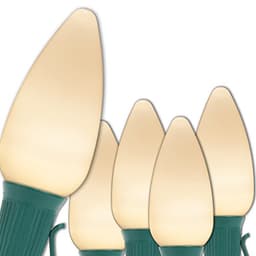
#1 — Rooflines you want to look the same in year five
Wintergreen Lighting C9 OptiCore LED, 25 bulbs / 25 ft, warm white
18 AWG SPT-1 stringer, 12 in spacing
8.3
/ 10
The C9 set built like an installer's stock: heavy stringer, replaceable bulbs, drained sockets. Buy it once for the roofline you re-hang every year.
Published specifications
- Bulb
- C9 OptiCore LED, faceted, replaceable
- Stringer
- 18 AWG SPT-1 commercial wire, green
- Spacing
- 12 in — 25 bulbs over 25 ft
- Socket drainage
- Weep holes for wet-weather use
- Rated wattage per string
- Not published by the manufacturer
Our scoring
- Build
- 9 / 10
- Weather tolerance
- 9 / 10
- Serviceability
- 9 / 10
- Published specs
- 6 / 10
Good
- Commercial 18 AWG stringer instead of the 22 AWG most retail sets use
- Bulbs unscrew individually, so one dead bulb is a bulb, not a string
- Weep-holed sockets are the detail that decides whether a set survives an ice storm
Watch out
- Costs meaningfully more per foot than a big-box set
- Wattage per string is not published, so you cannot pre-compute load from the listing alone
Specs from the Wintergreen Lighting Amazon listing (ASIN B0776ZCHFX), retrieved 2026-09-04.
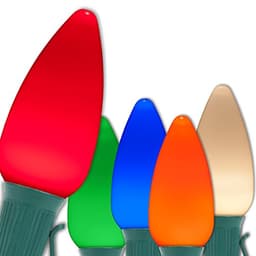
#2 — A multicolor run on the same commercial hardware
Wintergreen Lighting C9 OptiCore LED, 25 ft, multicolor
Same 18 AWG stringer, multicolor smooth/opaque bulbs
8.3
/ 10
The multicolor twin of our top pick. Choose it for the color, not for any difference in build.
Published specifications
- Bulb
- C9 OptiCore LED, smooth/opaque, multicolor
- Stringer
- 18 AWG SPT-1 commercial wire, green
- Spacing
- 12 in — 25 bulbs over 25 ft
- Rated wattage per string
- Not published by the manufacturer
Our scoring
- Build
- 9 / 10
- Weather tolerance
- 9 / 10
- Serviceability
- 9 / 10
- Published specs
- 6 / 10
Good
- Identical hardware to the warm-white set, so you can mix runs without mixing quality
- Opaque bulbs hold color at a distance instead of washing out
Watch out
- Multicolor reads busier on brick than it does in the product photo
- Wattage per string is not published
Specs from the Amazon listing (ASIN B076N8W5NK), retrieved 2026-09-04.
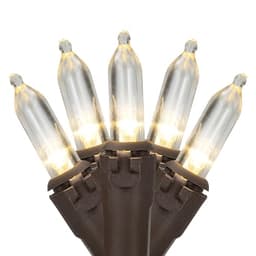
#3 — Trees, shrubs and wrapping — the workhorse string
Northlight LED mini lights, 100 count, 33 ft, warm white on brown wire
100 LEDs, 4 in spacing, 33 ft lighted length
6.5
/ 10
The default mini string. Buy the count you need for the tree, not the count that was on sale.
Published specifications
- Count
- 100 LED mini bulbs
- Spacing
- 4 in
- Lighted length
- 33 ft
- Bulb color
- Warm white
- Wire
- Brown
- Rated wattage per string
- Not published by the manufacturer
Our scoring
- Build
- 7 / 10
- Weather tolerance
- 7 / 10
- Serviceability
- 5 / 10
- Published specs
- 7 / 10
Good
- 4-inch spacing over 33 feet is the density most tree-wrapping guidance assumes
- Brown wire disappears against bark and trunk wraps, where white wire draws a line
- LED draw means you can run many strings on one circuit — see our amp guide
Watch out
- Wattage is not printed on the listing, so you have to read the tag on the string itself
- Brown reads as a visible line against a white railing — that is what the white-wire set is for
Specs from the Amazon listing (ASIN B073WK2J4Z), verified via the Creators API 2026-09-24. Replaces the discontinued green-wire version (B073WJBKPX) from the same Northlight line.
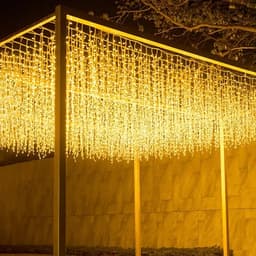
#4 — A full eave line of icicles
GTSYDING icicle lights, 400 LED over 32.8 ft, 80 drops
80 drops over 32.8 ft — one drop every 4.9 in
7.0
/ 10
The icicle set that tells you its drop count. That is the number that decides how it looks, and almost nobody publishes it.
Published specifications
- LEDs
- 400, warm white
- Length
- 32.8 ft (10 m)
- Drops
- 80
- Modes
- 8
- Connectable
- Yes, no set limit published
- Weather
- Waterproof, per the listing
Our scoring
- Published specs
- 8 / 10
- Coverage
- 9 / 10
- Weather tolerance
- 6 / 10
- Serviceability
- 5 / 10
Good
- Drop count and length are both published, so drop spacing is computable before you buy
- 80 drops over 32.8 ft is twice the density of a 60-drop set at the same length
Watch out
- Connectable, but the listing does not say how many sets can join — the figure that plans a long eave
- Drop lengths vary within the set by design, which reads as untidy on a straight fascia
#ad · Price as of October 22, 2026 · How we are funded
Specs from the Amazon listing (ASIN B0FCSLLG51), verified via the Creators API 2026-10-03. Replaces the discontinued 300 LED / 60 drop icicle set (B08JQ6G4R8), whose published three-set connection limit this listing does not state.

#5 — skip this
Holiday Wonderland 300-count clear icicle light set
300 clear incandescent bulbs
5.0
/ 10
Skip this here. On the repairability question specifically, this is the wrong set to own: the listing publishes neither a lighted length nor a per-bulb rating, so when a section fails there is nothing published to diagnose it against.
The traditional look, sold with none of the numbers you need to plan the run. Buy it knowing that.
Published specifications
- Count
- 300 clear bulbs
- Type
- Incandescent
- Drop count
- Not published by the manufacturer
- Lighted length
- Not published by the manufacturer
Our scoring
- Published specs
- 3 / 10
- Coverage
- 6 / 10
- Weather tolerance
- 6 / 10
- Serviceability
- 5 / 10
Good
- The warm incandescent icicle look, which LED sets still render coolly
Watch out
- Neither drop count nor lighted length is published, so you cannot plan coverage
- 300 incandescent bulbs is a real load — check it against your circuit budget
Count from the Amazon listing (ASIN B000VBCV5K), retrieved 2026-09-04.
Questions
›Why is half my Christmas light string out?
Mini strings are wired in series groups, so one failed or loose bulb takes its whole group dark while the rest of the string stays lit. The fault is at the start of the dark section, which is where to look first.
›Where is the fuse on Christmas lights?
Inside the male plug, behind a small sliding cover, usually as a pair. A string that is completely dark while its neighbours work is nearly always a blown fuse rather than a wiring fault. Replace only with the type the manufacturer specifies.
›Can you replace a single bulb on LED Christmas lights?
Only on a set built for it. Commercial C9 sets publish individually replaceable bulbs; most sealed LED mini and icicle strings do not, and are designed to be replaced rather than serviced. The listing tells you before you buy.
›When should I throw a light set away?
Cracked or brittle insulation, a discoloured or deformed socket, a scorched plug, or a third fault in one season. None of those is a bulb problem and none improves. Do not splice or tape a damaged strand back into service.
Sources
- Wintergreen Lighting C9 OptiCore listing (ASIN B0776ZCHFX) — individually replaceable bulbs, 18 AWG stringer
- Wintergreen Lighting C9 multicolor listing (ASIN B076N8W5NK) — identical hardware, multicolor bulbs
- Northlight LED mini listing (ASIN B073WK2J4Z) — 100 count, 33 ft lighted length
- GTSYDING icicle light listing (ASIN B0FCSLLG51) — 400 LEDs, 80 drops, 32.8 ft
- Holiday Wonderland icicle listing (ASIN B000VBCV5K) — 300 clear incandescent bulbs; no length or per-bulb rating published
- Series-group behaviour — Our explanation of how these strings are constructed, not a manufacturer specification
We have not tested these products. Every figure above comes from a published manufacturer specification or from arithmetic shown on this page, and anything a maker does not publish is printed as unavailable rather than estimated. How that works, and what we will not claim, is set out on how we research.