What Christmas lights cost to run, worked out per season
Watts, hours and a stated rate per kilowatt-hour. Three inputs, one number, and the arithmetic printed so you can substitute your own.
By Sawyer V. · Published
“Christmas lights barely cost anything to run” is true of one kind of display and badly wrong about another, and the difference is a factor of eight. The calculation itself is three inputs long: how many watts, for how many hours, at what rate per kilowatt-hour.
This page does that arithmetic in full, for a realistic display, and prints every input so you can swap in your own rate and your own hours. It also covers the two changes that move the number most — and only one of them is buying different lights.
Wreath & Watt earns a commission on qualifying purchases made through the Amazon links on this page. It costs you nothing and it does not change the order of the picks — here is exactly how we are funded.
The whole formula
Energy cost is watts multiplied by hours, divided by a thousand to convert to kilowatt-hours, multiplied by your rate. Every figure below is that one line applied to different hardware. The rate is the input you must supply yourself: it is on your bill, it varies by a factor of three or more across the country, and any page that quotes a national average as if it were your rate is telling you about somebody else’s house.
The arithmetic
- Cost = (watts x hours / 1,000) x rate per kWh
- Worked example: 200 W display, 6 hours a night, 40 nights
- 200 W x 6 h x 40 nights = 48,000 Wh
- 48,000 Wh / 1,000 = 48 kWh for the season
- At $0.15 per kWh: 48 x 0.15 = $7.20
- At $0.30 per kWh: 48 x 0.30 = $14.40
A 200 W display running 6 hours a night for 40 nights costs 48 kWh — between $7 and $15 depending entirely on your rate.
Watts, by set type
The first input is the only one that is a property of what you bought. These are the standard published ratings for each bulb type; the tag on your own set is what actually governs, and where a maker publishes a figure we use theirs.
| Set | Watts | kWh for the season | Cost at $0.20 |
|---|---|---|---|
| LED mini, 100 count | 5 | 1.2 | $0.24 |
| Incandescent mini, 100 count | 40 | 9.6 | $1.92 |
| C9 LED, 25 bulbs | 25 | 6.0 | $1.20 |
| C9 incandescent, 25 bulbs | 175 | 42.0 | $8.40 |
| Ten LED mini strings | 50 | 12.0 | $2.40 |
| Ten incandescent mini strings | 400 | 96.0 | $19.20 |
The rate is an illustration, not a claim about your bill. Substitute the number printed on your own statement — the arithmetic above shows exactly where it goes.
Source: Watts = volts x amps at 120 V. The 80 percent ceiling is the standard continuous-load convention for a load running three hours or more. Per-string wattages are the published figures for those bulb types; the tag on your own string is what governs.
The bottom two rows are the honest version of the question most people are actually asking. A modest ten-string display is a rounding error on an LED set and a real, noticeable line on an incandescent one. That ratio is the entire argument, and it is worked through in more detail on LED vs incandescent.
The input you control for free
Watts are fixed once you have bought the set. Hours are not, and they are a straight multiplier — halving the hours halves the cost of every row in that table without changing a single bulb.
A display left on all night runs roughly twice the hours of one that switches off at midnight, and nobody is looking at your roofline at four in the morning. A dusk-to-dawn timer is the cheap version of this control; it publishes a 15 A / 1/2 HP ETL-listed rating and two grounded weatherproof outlets, which is enough capacity to sit in front of most single- circuit displays. Our full timer ranking is on outdoor Christmas light timers.
The arithmetic
- Same 200 W display, dusk to dawn: about 14 hours a night
- 200 W x 14 h x 40 nights / 1,000 = 112 kWh
- Same display, 5 pm to 11 pm: 6 hours a night
- 200 W x 6 h x 40 nights / 1,000 = 48 kWh
- 112 kWh - 48 kWh = 64 kWh saved, for the price of a timer
Switching the same display off at 11 pm cuts its seasonal energy by 57 percent. No bulb changed.
Where app-controlled systems land
Permanently installed track systems draw very little on their own, and the ones worth buying publish enough to plan around. The 100-foot Govee Permanent 2 carries an IP67 rating and app scheduling, which folds the timer job into the light itself — the hours input is set once in software instead of by a dial on the wall. What it does not do is change the formula: watts times hours divided by a thousand, times your rate.
One thing no smart system removes is the standby draw of the controller, which runs year round rather than for forty nights. Manufacturers do not generally publish a standby figure, so we do not print one; where a spec is not published we say so rather than carry across a number from a similar product. That practice is set out on how we research.
The short version
If you are buying now, buy LED and the running cost stops being a question worth asking — our ranked sets are on the best outdoor Christmas lights. If you already own incandescent strings that work, the cheapest change available to you is not replacing them; it is a timer, because hours are half the formula and they cost nothing to change. And if you want to know whether the display will run at all before you worry about what it costs, that is a different question and it is on the load calculator.
Our picks for this
| # | Product | Best for | Score | Price |
|---|---|---|---|---|
| 1 |  Northlight LED mini lights, 100 count, 33 ft, warm white on brown wire100 LEDs, 4 in spacing, 33 ft lighted length Northlight LED mini lights, 100 count, 33 ft, warm white on brown wire100 LEDs, 4 in spacing, 33 ft lighted length | Trees, shrubs and wrapping — the workhorse string | 6.5/ 10 | |
| 2 |  Wintergreen Lighting C9 OptiCore LED, 25 bulbs / 25 ft, warm white18 AWG SPT-1 stringer, 12 in spacing Wintergreen Lighting C9 OptiCore LED, 25 bulbs / 25 ft, warm white18 AWG SPT-1 stringer, 12 in spacing | Rooflines you want to look the same in year five | 8.3/ 10 | |
| 3 |  Govee Permanent Outdoor Lights 2, 100 ft RGBIC100 ft, IP67, 100 scene modes Govee Permanent Outdoor Lights 2, 100 ft RGBIC100 ft, IP67, 100 scene modes | A single-story front elevation | 7.5/ 10 | |
| 4 |  BN-LINK outdoor light timer, dusk-to-dawn, dual grounded outlets15 A / 1/2 HP, ETL listed, two grounded outlets BN-LINK outdoor light timer, dusk-to-dawn, dual grounded outlets15 A / 1/2 HP, ETL listed, two grounded outlets | Set it in October, forget it until January | 8.0/ 10 | |
| 5 |  Incandescent mini lights, 100 count, 21 ft, green wire, UL certified100 incandescent mini bulbs over 21 ft, UL certifiedSkip this Incandescent mini lights, 100 count, 21 ft, green wire, UL certified100 incandescent mini bulbs over 21 ft, UL certifiedSkip this | People who genuinely want the old warm glow | 5.5/ 10 | $9.99Amazon #ad · Price as of October 20, 2026 · Disclosure |
Scores are our own weighting of published manufacturer specifications, explained in full on how we research. They are not test results. We have not tested these products.
The picks, in detail
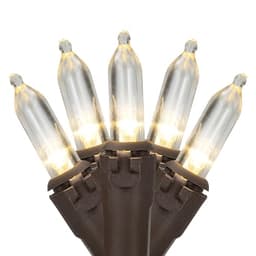
#1 — Trees, shrubs and wrapping — the workhorse string
Northlight LED mini lights, 100 count, 33 ft, warm white on brown wire
100 LEDs, 4 in spacing, 33 ft lighted length
6.5
/ 10
The default mini string. Buy the count you need for the tree, not the count that was on sale.
Published specifications
- Count
- 100 LED mini bulbs
- Spacing
- 4 in
- Lighted length
- 33 ft
- Bulb color
- Warm white
- Wire
- Brown
- Rated wattage per string
- Not published by the manufacturer
Our scoring
- Build
- 7 / 10
- Weather tolerance
- 7 / 10
- Serviceability
- 5 / 10
- Published specs
- 7 / 10
Good
- 4-inch spacing over 33 feet is the density most tree-wrapping guidance assumes
- Brown wire disappears against bark and trunk wraps, where white wire draws a line
- LED draw means you can run many strings on one circuit — see our amp guide
Watch out
- Wattage is not printed on the listing, so you have to read the tag on the string itself
- Brown reads as a visible line against a white railing — that is what the white-wire set is for
Specs from the Amazon listing (ASIN B073WK2J4Z), verified via the Creators API 2026-09-24. Replaces the discontinued green-wire version (B073WJBKPX) from the same Northlight line.
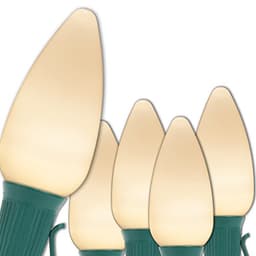
#2 — Rooflines you want to look the same in year five
Wintergreen Lighting C9 OptiCore LED, 25 bulbs / 25 ft, warm white
18 AWG SPT-1 stringer, 12 in spacing
8.3
/ 10
The C9 set built like an installer's stock: heavy stringer, replaceable bulbs, drained sockets. Buy it once for the roofline you re-hang every year.
Published specifications
- Bulb
- C9 OptiCore LED, faceted, replaceable
- Stringer
- 18 AWG SPT-1 commercial wire, green
- Spacing
- 12 in — 25 bulbs over 25 ft
- Socket drainage
- Weep holes for wet-weather use
- Rated wattage per string
- Not published by the manufacturer
Our scoring
- Build
- 9 / 10
- Weather tolerance
- 9 / 10
- Serviceability
- 9 / 10
- Published specs
- 6 / 10
Good
- Commercial 18 AWG stringer instead of the 22 AWG most retail sets use
- Bulbs unscrew individually, so one dead bulb is a bulb, not a string
- Weep-holed sockets are the detail that decides whether a set survives an ice storm
Watch out
- Costs meaningfully more per foot than a big-box set
- Wattage per string is not published, so you cannot pre-compute load from the listing alone
Specs from the Wintergreen Lighting Amazon listing (ASIN B0776ZCHFX), retrieved 2026-09-04.
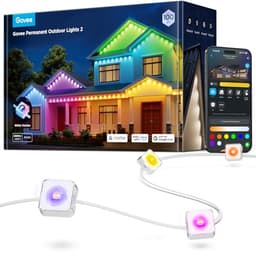
#3 — A single-story front elevation
Govee Permanent Outdoor Lights 2, 100 ft RGBIC
100 ft, IP67, 100 scene modes
7.5
/ 10
The entry point. Buy it if 100 feet covers your front elevation and you can live without Matter.
Published specifications
- Length
- 100 ft
- Ingress rating
- IP67
- Modes
- 100 scene modes, 16 million colors
- Control
- App, Alexa, Google Assistant
- LED count
- Not published by the manufacturer for this SKU in the listing title
Our scoring
- Published specs
- 7 / 10
- Weather tolerance
- 9 / 10
- Control
- 8 / 10
- Density
- 6 / 10
Good
- The cheapest honest entry into permanent lighting with a published IP67 rating
- 100 ft covers most single-story front elevations with slack to spare
Watch out
- The listing title does not state the LED count, so pitch cannot be computed before purchase
- No Matter support on this line
Specs from the Govee Amazon listing (ASIN B0D14WP9TB), retrieved 2026-09-04.
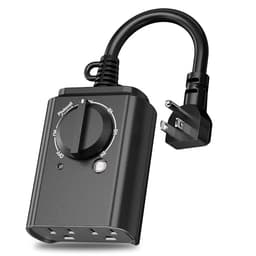
#4 — Set it in October, forget it until January
BN-LINK outdoor light timer, dusk-to-dawn, dual grounded outlets
15 A / 1/2 HP, ETL listed, two grounded outlets
8.0
/ 10
The no-fuss choice. If you never want to think about the timer again, buy this one instead of the remote model.
Published specifications
- Rating
- 15 A, 1/2 HP, ETL listed
- Outlets
- Two grounded, weatherproof
- Control
- Dusk-to-dawn photocell
Our scoring
- Published rating
- 9 / 10
- Safety listing
- 9 / 10
- Weather tolerance
- 8 / 10
- Control
- 6 / 10
Good
- Two outlets means the roofline and the yard can share one timer without a splitter
- Photocell only — nothing to reprogram when the clocks change
Watch out
- No remote, so changes mean going outside
Rating and features from the Amazon listing (ASIN B01MAWA81Q), retrieved 2026-09-04.
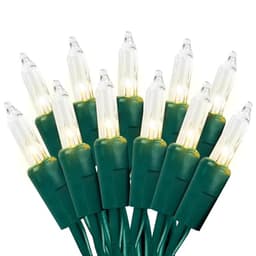
#5 — skip this
Incandescent mini lights, 100 count, 21 ft, green wire, UL certified
100 incandescent mini bulbs over 21 ft, UL certified
5.5
/ 10
Skip this here. On the running-cost question specifically, this is the wrong buy: the same lit length costs roughly eight times as much in electricity as the LED equivalent, every season, forever.
The honest incandescent option: buy one string for the glow, not forty for a roofline.
Published specifications
- Count
- 100 incandescent mini bulbs
- Length
- 21 ft
- Spacing
- 2.5 in (21 ft over 100 bulbs — our arithmetic)
- Wire
- Green
- Listing
- UL certified
- Rated wattage per string
- Not published by the manufacturer
Our scoring
- Build
- 5 / 10
- Weather tolerance
- 5 / 10
- Serviceability
- 7 / 10
- Published specs
- 5 / 10
Good
- Filament light has a warmth and a color rendering that LED still approximates rather than matches
- UL certified, published, which on an incandescent string matters more than on an LED one
- The cheapest way to light a small tree, if you ignore what it costs to run
Watch out
- No rated wattage published — our cost arithmetic uses a stated estimate, not a manufacturer figure
- Draws roughly an order of magnitude more current than an LED string of the same count, so few can share a circuit
- Bulbs fail individually and the glass is brittle in the cold
#ad · Price as of October 20, 2026 · How we are funded
Specs from the Amazon listing (ASIN B0DCK2DJK6), verified via the Creators API 2026-10-02. Replaces the discontinued 100-count 20 ft incandescent string (B08BJW25WK); the published length changes from 20 ft to 21 ft.
Questions
›How much does it cost to run Christmas lights for a month?
Multiply the display’s watts by the hours per night, multiply by the nights, divide by 1,000, and multiply by your rate per kilowatt-hour. A 200 W display at 6 hours a night for 30 nights is 36 kWh — about $7.20 at $0.20 per kWh. Substitute your own rate; it is the input that varies most.
›Do LED Christmas lights really save that much?
On a per-string basis the published ratings are about 5 W for a 100-count LED mini string against about 40 W for the incandescent equivalent. That is an eight-fold difference in energy for the same lit length, every hour the display is on.
›Does leaving lights on all night cost much more?
Yes, and it is the largest single lever you have. Dusk to dawn is roughly 14 hours in midwinter against 6 hours for an evening display — the same hardware using more than twice the energy. A timer changes that input for the price of one accessory.
›Why do you not just tell me the average electricity rate?
Because residential rates vary by more than a factor of three across the country, and an average would be a number about somebody else’s house presented as a fact about yours. The rate is printed on your statement, and the arithmetic above shows exactly where to put it.
Sources
- Northlight LED mini listing (ASIN B073WK2J4Z) — 100 count, 33 ft lighted length
- Incandescent mini listing (ASIN B0DCK2DJK6) — 100 count, 21 ft, UL certified
- Wintergreen Lighting C9 OptiCore listing (ASIN B0776ZCHFX) — bulb type and spacing
- Govee Permanent Outdoor Lights 2 listing (ASIN B0D14WP9TB) — IP67, app scheduling
- BN-LINK dusk-to-dawn timer listing (ASIN B01MAWA81Q) — 15 A / 1/2 HP, ETL listed
- Energy arithmetic — kWh = watts x hours / 1,000. Per-string and per-bulb wattages are the standard published ratings for those bulb types.
We have not tested these products. Every figure above comes from a published manufacturer specification or from arithmetic shown on this page, and anything a maker does not publish is printed as unavailable rather than estimated. How that works, and what we will not claim, is set out on how we research.