How many amps do Christmas lights use?
A draw table by bulb type, the circuit budget worked out in full, and the two limits that apply at the same time.
By Sawyer V. · Published

The short answer, for the common case: a 100-count incandescent mini string draws about 40 W, which is 0.33 A at 120 V. An equivalent LED string draws about 5 W, which is 0.04 A. A 15 A household circuit gives you a working budget of 1,440 W, which is roughly 36 incandescent strings or 288 LED strings.
Below is the full table, the arithmetic behind it, and the second limit that catches people out.
Wreath & Watt earns a commission on qualifying purchases made through the Amazon links on this page. It costs you nothing and it does not change the order of the picks — here is exactly how we are funded.
Draw by bulb type
| Bulb type | Watts | Amps at 120 V | Per 15 A budget |
|---|---|---|---|
| Incandescent mini, per 100-count string | 40 W | 0.33 A | 36 strings |
| LED mini, per 100-count string | 5 W | 0.04 A | 288 strings |
| C7 incandescent, per bulb | 5 W | 0.04 A | 288 bulbs |
| C9 incandescent, per bulb | 7 W | 0.06 A | 205 bulbs |
| C9 LED, per bulb | 1 W | 0.008 A | 1,440 bulbs |
Amps and per-budget counts are computed by us from the watt figures using a 1,440 W continuous-load budget. Watt figures are the standard published ratings for those bulb types; the tag on your own string is what governs.
Source: Watts = volts x amps at 120 V. The 80 percent ceiling is the standard continuous-load convention for a load running three hours or more. Per-string wattages are the figures published for those bulb types; the tag on your own string is what actually governs.
Where 1,440 watts comes from
A 15 A circuit at 120 V can carry 1,800 W. You do not get to use all of it. Anything running three hours or more is treated as a continuous load and is limited to 80 percent of the breaker rating — a convention that exists because a breaker carrying its full rating for hours runs hot.
The arithmetic
- 15 A x 120 V = 1,800 W
- 1,800 W x 0.8 = 1,440 W usable, continuous
- 20 A x 120 V = 2,400 W
- 2,400 W x 0.8 = 1,920 W usable, continuous
15 A circuit: 1,440 W. 20 A circuit: 1,920 W. Everything already on that circuit comes out of the same budget.
That last sentence is the one people skip. An outdoor outlet is very often on the same circuit as a garage, a bathroom, or a set of exterior lights. Whatever those are drawing comes out of your 1,440 W before the first string is plugged in.
Two limits apply at the same time
This is the single most common confusion in the category, and it is worth being precise about:
- The circuit limit is about the breaker. It is the 1,440 W budget above, and it covers everything plugged into that circuit no matter how it is arranged.
- The series limit is about the first plug in a chain. Every set publishes a maximum number of sets you may connect end to end — commonly three to five for incandescent, often far more for LED. Exceeding it overloads the wire and the plug at the start of the chain, not the breaker.
You can be well inside the circuit budget and still be badly over the series limit, by running one very long chain from a single outlet. Split the display across several chains fed from the same outlet through a properly rated extension cord, and both limits stay satisfied.
A worked example
The arithmetic
- Display: 60 ft of C9 LED roofline at 12 in spacing = 60 bulbs x 1 W = 60 W
- Plus 8 LED mini strings on the shrubs: 8 x 5 W = 40 W
- Plus one inflatable blower from its tag: 60 W
- Total: 160 W
- 160 W / 1,440 W budget = 11 percent
A fairly complete front-of-house display on 11 percent of one 15 A circuit. LED changes what is possible, not just what it costs.
Swap that same display to incandescent and the picture changes completely: 60 C9 incandescent bulbs at 7 W is 420 W, eight incandescent mini strings is 320 W, and with the blower you are at 800 W — 56 percent of the budget, from a modest display. Run your own version through the load calculator.
Inflatables are the hidden load
The lights on an inflatable are trivial. The blower runs continuously the entire time the figure is up, and no manufacturer in the category publishes its wattage in the listing. The figure is usually on a tag on the unit or on the power supply. Find it, put it in the calculator, and treat any yard display with several inflatables as a real load rather than decoration.
Our picks for this
| # | Product | Best for | Score | Price |
|---|---|---|---|---|
| 1 |  Iron Forge Cable 14/3 outdoor extension cord, 25 ft, 3 outlets14 AWG, 15 A, 25 ft, 3 grounded outlets Iron Forge Cable 14/3 outdoor extension cord, 25 ft, 3 outlets14 AWG, 15 A, 25 ft, 3 grounded outlets | The main run from the outlet to the display | 9.0/ 10 | |
| 2 |  Fosmon outdoor light timer outlet with remote, 15 A15 A / 1/2 HP, UL listed, 100 ft remote Fosmon outdoor light timer outlet with remote, 15 A15 A / 1/2 HP, UL listed, 100 ft remote | One display, controlled from indoors | 8.8/ 10 | $15.99Amazon #ad · Price as of October 19, 2026 · Disclosure |
| 3 |  14/3 heavy-duty outdoor extension cord, 50 ft, 3 outlets14 AWG, 15 A / 1875 W, 50 ft 14/3 heavy-duty outdoor extension cord, 50 ft, 3 outlets14 AWG, 15 A / 1875 W, 50 ft | Reaching the far corner of the yard | 8.5/ 10 | $51.99Amazon #ad · Price as of October 19, 2026 · Disclosure |
| 4 |  BN-LINK outdoor light timer, dusk-to-dawn, dual grounded outlets15 A / 1/2 HP, ETL listed, two grounded outlets BN-LINK outdoor light timer, dusk-to-dawn, dual grounded outlets15 A / 1/2 HP, ETL listed, two grounded outlets | Set it in October, forget it until January | 8.0/ 10 | |
| 5 |  TiFFCOFiO outdoor power stake timer, 6 outlets, ETL listed6 grounded outlets, ETL listed TiFFCOFiO outdoor power stake timer, 6 outlets, ETL listed6 grounded outlets, ETL listed | The same job, with a safety listing stated up front | 8.0/ 10 |
Scores are our own weighting of published manufacturer specifications, explained in full on how we research. They are not test results. We have not tested these products.
The picks, in detail
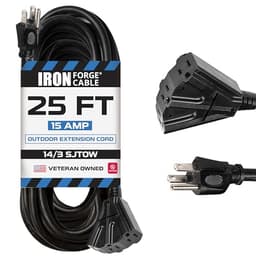
#1 — The main run from the outlet to the display
Iron Forge Cable 14/3 outdoor extension cord, 25 ft, 3 outlets
14 AWG, 15 A, 25 ft, 3 grounded outlets
9.0
/ 10
The cord to buy first. Gauge and amp rating are both published, which is the whole reason it is here.
Published specifications
- Gauge
- 14 AWG, 3 conductor (14/3)
- Jacket
- SJTW, outdoor rated
- Rating
- 15 A
- Length
- 25 ft
- Outlets
- 3 grounded, lighted end
Our scoring
- Published rating
- 10 / 10
- Capacity headroom
- 9 / 10
- Outdoor jacket
- 9 / 10
- Usability
- 8 / 10
Good
- 14 AWG at 25 ft is the combination that keeps voltage drop irrelevant for a holiday load
- A lighted end tells you the circuit is live without walking back to the breaker
- Three outlets removes the cube tap, which is the usual weak point
Watch out
- Heavier and stiffer than a 16-gauge cord, which matters when you are routing it
Gauge, jacket and rating from the Amazon listing (ASIN B078KG2ND4), retrieved 2026-09-04.
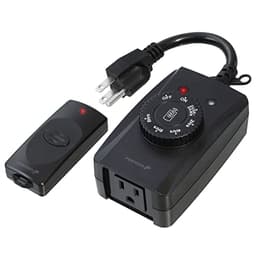
#2 — One display, controlled from indoors
Fosmon outdoor light timer outlet with remote, 15 A
15 A / 1/2 HP, UL listed, 100 ft remote
8.8
/ 10
Our default outdoor timer. It publishes its amp rating and carries a UL listing, and those two facts decide it.
Published specifications
- Rating
- 15 A, 1/2 HP, UL listed
- Control
- Dusk-to-dawn photocell plus wireless remote
- Remote range
- 100 ft
- Weather
- Weatherproof housing
Our scoring
- Published rating
- 9 / 10
- Safety listing
- 9 / 10
- Weather tolerance
- 8 / 10
- Control
- 9 / 10
Good
- The 15 A rating is published, which is the number you actually need before you plan a load
- UL listing, on a device that sits outdoors in wet weather all season
- Remote means nobody has to crouch behind a shrub in the cold
Watch out
- 15 A is the ceiling, not a budget — plan to about 12 A, per our load guide
#ad · Price as of October 19, 2026 · How we are funded
Rating and features from the Amazon listing (ASIN B0C8X5HW1H), retrieved 2026-09-04.
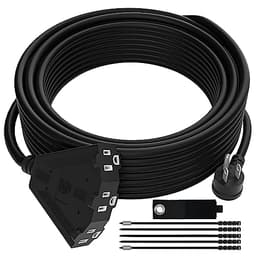
#3 — Reaching the far corner of the yard
14/3 heavy-duty outdoor extension cord, 50 ft, 3 outlets
14 AWG, 15 A / 1875 W, 50 ft
8.5
/ 10
Same gauge as our top cord, twice the reach. Buy it only if you need the distance.
Published specifications
- Gauge
- 14 AWG, 3 conductor
- Rating
- 15 A, 125 V, 1875 W, ETL listed
- Length
- 50 ft
- Plug
- 90-degree angled, 3 prong
Our scoring
- Published rating
- 10 / 10
- Capacity headroom
- 9 / 10
- Outdoor jacket
- 8 / 10
- Usability
- 7 / 10
Good
- The watt rating is printed, so it drops straight into the load arithmetic
- An angled plug sits flat against an exterior outlet cover instead of levering it open
Watch out
- 50 feet of 14 gauge is genuinely heavy to coil in January
#ad · Price as of October 19, 2026 · How we are funded
Rating from the Amazon listing (ASIN B0BG46K4QQ), retrieved 2026-09-04.
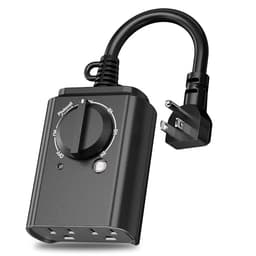
#4 — Set it in October, forget it until January
BN-LINK outdoor light timer, dusk-to-dawn, dual grounded outlets
15 A / 1/2 HP, ETL listed, two grounded outlets
8.0
/ 10
The no-fuss choice. If you never want to think about the timer again, buy this one instead of the remote model.
Published specifications
- Rating
- 15 A, 1/2 HP, ETL listed
- Outlets
- Two grounded, weatherproof
- Control
- Dusk-to-dawn photocell
Our scoring
- Published rating
- 9 / 10
- Safety listing
- 9 / 10
- Weather tolerance
- 8 / 10
- Control
- 6 / 10
Good
- Two outlets means the roofline and the yard can share one timer without a splitter
- Photocell only — nothing to reprogram when the clocks change
Watch out
- No remote, so changes mean going outside
Rating and features from the Amazon listing (ASIN B01MAWA81Q), retrieved 2026-09-04.
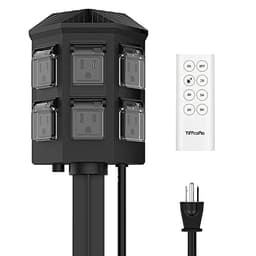
#5 — The same job, with a safety listing stated up front
TiFFCOFiO outdoor power stake timer, 6 outlets, ETL listed
6 grounded outlets, ETL listed
8.0
/ 10
Between two near-identical stake timers, take the one that publishes its safety listing.
Published specifications
- Outlets
- 6 grounded
- Lead
- 6 ft waterproof extension cord
- Control
- Dusk-to-dawn, countdown, 100 ft remote
- Listing
- ETL listed
Our scoring
- Published rating
- 6 / 10
- Safety listing
- 9 / 10
- Weather tolerance
- 8 / 10
- Control
- 9 / 10
Good
- ETL listing is stated in the listing title, which the competing stake timer does not do
Watch out
- Amp rating still is not in the title
Features from the Amazon listing (ASIN B0B4RQMMBR), retrieved 2026-09-04.
Questions
›How many amps does a string of Christmas lights use?
A 100-count incandescent mini string draws about 0.33 A at 120 V. The equivalent LED string draws about 0.04 A. Per bulb, a C9 incandescent is about 0.06 A and a C9 LED about 0.008 A.
›How many Christmas lights can I put on one outlet?
The outlet is not the limit; the circuit is. On a 15 A circuit you have a 1,440 W continuous budget shared with everything else on that circuit — roughly 36 incandescent 100-count strings or 288 LED ones. Your set's published end-to-end connection limit applies separately.
›Why do my Christmas lights keep tripping the breaker?
Either the total continuous load on that circuit exceeds the 80 percent budget, or something else on the same circuit switches on and pushes it over. Add up everything on the circuit, not just the lights. If the numbers say you are well inside budget and it still trips, that is an electrician's question, not an arithmetic one.
›Is a 20 amp circuit twice as good as a 15 amp one?
It gives you 1,920 W of continuous budget instead of 1,440 W, so about a third more, not double. The breaker rating is what it is; the 80 percent convention applies to both.
Sources
- Standard published wattages — 40 W per 100-count incandescent mini string, 5 W per 100-count LED string, C7 incandescent 5 W, C9 incandescent 7 W, C9 LED about 1 W
- Continuous-load convention — 80 percent of breaker rating for loads running three hours or more
- Ohm's law at 120 V — watts = volts x amps; all amp figures on this page are derived this way
We have not tested these products. Every figure above comes from a published manufacturer specification or from arithmetic shown on this page, and anything a maker does not publish is printed as unavailable rather than estimated. How that works, and what we will not claim, is set out on how we research.