LED vs incandescent Christmas lights, with the arithmetic shown
Watts, amps, kilowatt-hours and dollars for the same display, with every assumption stated so you can substitute your own.
By Sawyer V. · Published
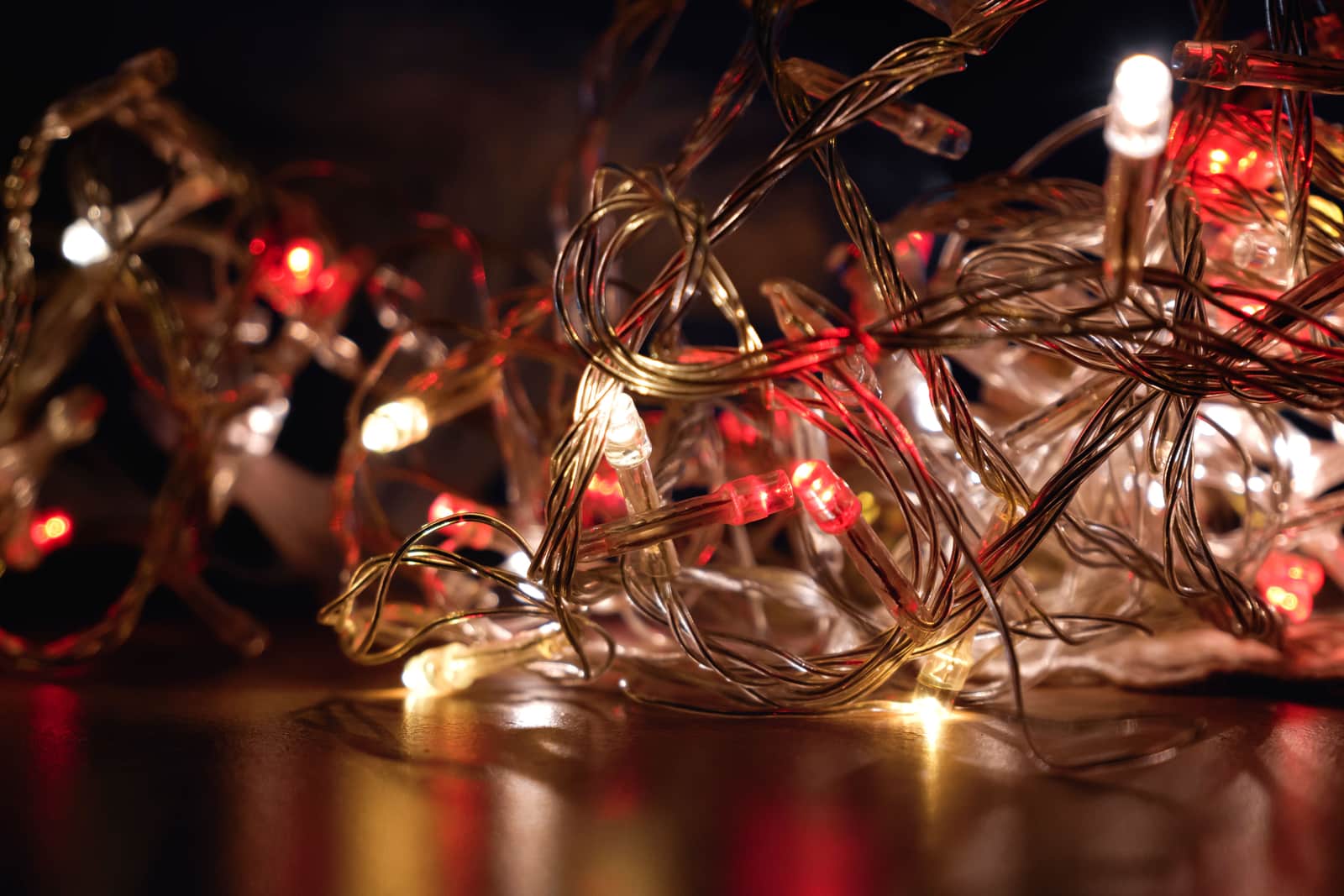
Everyone knows LED costs less to run. Almost nobody publishes the number, and the number is the interesting part — because it turns out the running cost is the smaller half of the argument. The bigger half is how many strings you can put on one circuit.
Here is the whole thing worked out, with the assumptions printed so you can change them.
Wreath & Watt earns a commission on qualifying purchases made through the Amazon links on this page. It costs you nothing and it does not change the order of the picks — here is exactly how we are funded.
Our assumptions, stated
The numbers
| Incandescent | LED | |
|---|---|---|
| Watts per string | 40 W | 5 W |
| Total watts | 800 W | 100 W |
| Amps at 120 V | 6.67 A | 0.83 A |
| Kilowatt-hours per season | 216 kWh | 27 kWh |
| Cost at 17 cents/kWh | $36.72 | $4.59 |
| Strings on one 15 A circuit | 36 | 288 |
Every figure in the table is computed from the assumptions above. Nothing here is a quoted price or a measured result.
Source: Watts = volts x amps at 120 V. The 80 percent ceiling is the standard continuous-load convention for a load running three hours or more. Per-string wattages are the figures published for those bulb types; the tag on your own string is what actually governs.
The arithmetic
- Incandescent: 20 strings x 40 W = 800 W
- 800 W x 6 h x 45 nights = 216,000 Wh = 216 kWh
- 216 kWh x $0.17 = $36.72 per season
- LED: 20 strings x 5 W = 100 W
- 100 W x 6 h x 45 nights = 27,000 Wh = 27 kWh
- 27 kWh x $0.17 = $4.59 per season
About $32 of difference per season on a 20-string display.
The running cost is not the real argument
Thirty-two dollars a season is real money but it is not decisive, and anyone telling you LED pays for itself immediately is selling something. Over five seasons the energy saving on this display is around $160, which will cover the conversion for a modest display and will not for a large one.
The decisive number is the last row of the table. On a single 15 A circuit you can run 36 incandescent strings or 288 LED strings. If your display has ever tripped a breaker, or if you have ever run a second cord across the lawn to a different outlet, that is the row that matters. LED does not save you money so much as it removes the ceiling.
What you actually lose with LED
Two things, and both are real:
- Color rendering. An incandescent filament produces a continuous warm spectrum. LEDs approximate it, and cheaper warm-white LEDs land slightly green or slightly pink in a way that shows most against snow. Better sets are close enough that most people would not pick them out; the difference has not gone away.
- Serviceability, sometimes. Many LED mini strings are sealed. A C9 LED set with screw-in bulbs keeps the advantage; a sealed LED mini string does not, and neither does an incandescent one.
There is also a genuine argument for keeping incandescent on one small feature — a single wreath, a doorway — where the warmth is at close range and the load is trivial. Nothing about the arithmetic forbids that.
Can you mix them?
On the same circuit, yes, and the calculator handles it: add a row for each type. On the same run, no — do not connect LED and incandescent sets end to end. Beyond the connection limits published on each set, the visible difference in color temperature along one continuous line looks like a fault.
Our picks for this
| # | Product | Best for | Score | Price |
|---|---|---|---|---|
| 1 |  Northlight LED mini lights, 100 count, 33 ft, warm white on brown wire100 LEDs, 4 in spacing, 33 ft lighted length Northlight LED mini lights, 100 count, 33 ft, warm white on brown wire100 LEDs, 4 in spacing, 33 ft lighted length | Trees, shrubs and wrapping — the workhorse string | 6.5/ 10 | |
| 2 |  Incandescent mini lights, 100 count, 21 ft, green wire, UL certified100 incandescent mini bulbs over 21 ft, UL certified Incandescent mini lights, 100 count, 21 ft, green wire, UL certified100 incandescent mini bulbs over 21 ft, UL certified | People who genuinely want the old warm glow | 5.5/ 10 | $9.99Amazon #ad · Price as of October 19, 2026 · Disclosure |
| 3 |  Wintergreen Lighting C9 OptiCore LED, 25 bulbs / 25 ft, warm white18 AWG SPT-1 stringer, 12 in spacing Wintergreen Lighting C9 OptiCore LED, 25 bulbs / 25 ft, warm white18 AWG SPT-1 stringer, 12 in spacing | Rooflines you want to look the same in year five | 8.3/ 10 | |
| 4 |  Holiday Wonderland 300-count clear icicle light set300 clear incandescent bulbs Holiday Wonderland 300-count clear icicle light set300 clear incandescent bulbs | Traditional incandescent icicle look | 5.0/ 10 | |
| 5 |  Northlight LED mini lights, 100 count, 33 ft, white wireSame string, white wire Northlight LED mini lights, 100 count, 33 ft, white wireSame string, white wire | White railings, columns and flocked trees | 6.3/ 10 | $21.99Amazon #ad · Price as of October 19, 2026 · Disclosure |
Scores are our own weighting of published manufacturer specifications, explained in full on how we research. They are not test results. We have not tested these products.
The picks, in detail
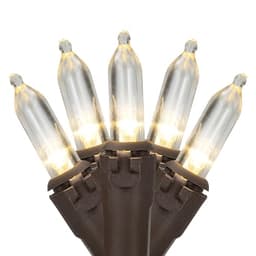
#1 — Trees, shrubs and wrapping — the workhorse string
Northlight LED mini lights, 100 count, 33 ft, warm white on brown wire
100 LEDs, 4 in spacing, 33 ft lighted length
6.5
/ 10
The default mini string. Buy the count you need for the tree, not the count that was on sale.
Published specifications
- Count
- 100 LED mini bulbs
- Spacing
- 4 in
- Lighted length
- 33 ft
- Bulb color
- Warm white
- Wire
- Brown
- Rated wattage per string
- Not published by the manufacturer
Our scoring
- Build
- 7 / 10
- Weather tolerance
- 7 / 10
- Serviceability
- 5 / 10
- Published specs
- 7 / 10
Good
- 4-inch spacing over 33 feet is the density most tree-wrapping guidance assumes
- Brown wire disappears against bark and trunk wraps, where white wire draws a line
- LED draw means you can run many strings on one circuit — see our amp guide
Watch out
- Wattage is not printed on the listing, so you have to read the tag on the string itself
- Brown reads as a visible line against a white railing — that is what the white-wire set is for
Specs from the Amazon listing (ASIN B073WK2J4Z), verified via the Creators API 2026-09-24. Replaces the discontinued green-wire version (B073WJBKPX) from the same Northlight line.
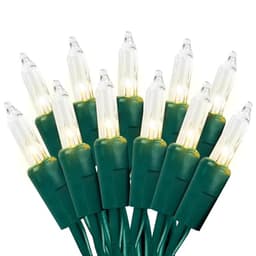
#2 — People who genuinely want the old warm glow
Incandescent mini lights, 100 count, 21 ft, green wire, UL certified
100 incandescent mini bulbs over 21 ft, UL certified
5.5
/ 10
The honest incandescent option: buy one string for the glow, not forty for a roofline.
Published specifications
- Count
- 100 incandescent mini bulbs
- Length
- 21 ft
- Spacing
- 2.5 in (21 ft over 100 bulbs — our arithmetic)
- Wire
- Green
- Listing
- UL certified
- Rated wattage per string
- Not published by the manufacturer
Our scoring
- Build
- 5 / 10
- Weather tolerance
- 5 / 10
- Serviceability
- 7 / 10
- Published specs
- 5 / 10
Good
- Filament light has a warmth and a color rendering that LED still approximates rather than matches
- UL certified, published, which on an incandescent string matters more than on an LED one
- The cheapest way to light a small tree, if you ignore what it costs to run
Watch out
- No rated wattage published — our cost arithmetic uses a stated estimate, not a manufacturer figure
- Draws roughly an order of magnitude more current than an LED string of the same count, so few can share a circuit
- Bulbs fail individually and the glass is brittle in the cold
#ad · Price as of October 19, 2026 · How we are funded
Specs from the Amazon listing (ASIN B0DCK2DJK6), verified via the Creators API 2026-10-02. Replaces the discontinued 100-count 20 ft incandescent string (B08BJW25WK); the published length changes from 20 ft to 21 ft.
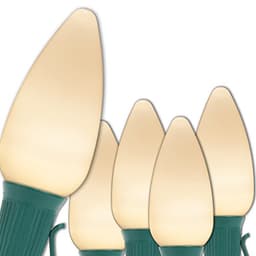
#3 — Rooflines you want to look the same in year five
Wintergreen Lighting C9 OptiCore LED, 25 bulbs / 25 ft, warm white
18 AWG SPT-1 stringer, 12 in spacing
8.3
/ 10
The C9 set built like an installer's stock: heavy stringer, replaceable bulbs, drained sockets. Buy it once for the roofline you re-hang every year.
Published specifications
- Bulb
- C9 OptiCore LED, faceted, replaceable
- Stringer
- 18 AWG SPT-1 commercial wire, green
- Spacing
- 12 in — 25 bulbs over 25 ft
- Socket drainage
- Weep holes for wet-weather use
- Rated wattage per string
- Not published by the manufacturer
Our scoring
- Build
- 9 / 10
- Weather tolerance
- 9 / 10
- Serviceability
- 9 / 10
- Published specs
- 6 / 10
Good
- Commercial 18 AWG stringer instead of the 22 AWG most retail sets use
- Bulbs unscrew individually, so one dead bulb is a bulb, not a string
- Weep-holed sockets are the detail that decides whether a set survives an ice storm
Watch out
- Costs meaningfully more per foot than a big-box set
- Wattage per string is not published, so you cannot pre-compute load from the listing alone
Specs from the Wintergreen Lighting Amazon listing (ASIN B0776ZCHFX), retrieved 2026-09-04.
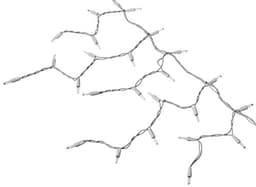
#4 — Traditional incandescent icicle look
Holiday Wonderland 300-count clear icicle light set
300 clear incandescent bulbs
5.0
/ 10
The traditional look, sold with none of the numbers you need to plan the run. Buy it knowing that.
Published specifications
- Count
- 300 clear bulbs
- Type
- Incandescent
- Drop count
- Not published by the manufacturer
- Lighted length
- Not published by the manufacturer
Our scoring
- Published specs
- 3 / 10
- Coverage
- 6 / 10
- Weather tolerance
- 6 / 10
- Serviceability
- 5 / 10
Good
- The warm incandescent icicle look, which LED sets still render coolly
Watch out
- Neither drop count nor lighted length is published, so you cannot plan coverage
- 300 incandescent bulbs is a real load — check it against your circuit budget
Count from the Amazon listing (ASIN B000VBCV5K), retrieved 2026-09-04.
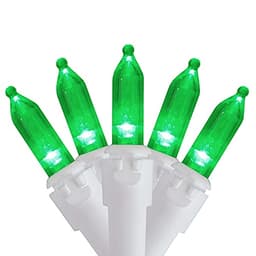
#5 — White railings, columns and flocked trees
Northlight LED mini lights, 100 count, 33 ft, white wire
Same string, white wire
6.3
/ 10
Buy the wire color that matches what it is stapled to, not what matches the bulbs.
Published specifications
- Count
- 100 LED mini bulbs
- Spacing
- 4 in
- Lighted length
- 33 ft
- Wire
- White
Our scoring
- Build
- 7 / 10
- Weather tolerance
- 7 / 10
- Serviceability
- 5 / 10
- Published specs
- 6 / 10
Good
- Wire color is the single most-ignored decision in outdoor lighting and the easiest one to get right
- Identical spacing to the brown-wire set, so runs stay consistent
Watch out
- Reads as a visible line against dark siding or an unflocked tree
#ad · Price as of October 19, 2026 · How we are funded
Specs from the Amazon listing (ASIN B073WZL6KG), retrieved 2026-09-04.
Questions
›How much does it cost to run Christmas lights for a season?
For 20 strings of 100-count mini lights at 6 hours a night for 45 nights: about $37 for incandescent and about $5 for LED, at 17 cents per kilowatt-hour. Change the rate to your own and the arithmetic on this page still holds.
›Are LED Christmas lights brighter than incandescent?
Usually brighter and always cooler in tone, which is a different thing. The practical difference people notice is color rendering rather than raw output: incandescent produces a continuous warm spectrum that LEDs approximate.
›Can I mix LED and incandescent Christmas lights?
On the same circuit, yes. On the same connected run, no — the connection limits differ and the color mismatch along one continuous line reads as a fault.
Sources
- Northlight LED mini listing (ASIN B073WK2J4Z) — 100 count, 4 in spacing, 33 ft
- Incandescent mini listing (ASIN B0DCK2DJK6) — 100 count, 21 ft, UL certified
- Per-string wattages — 40 W incandescent and 5 W LED per 100-count mini string; the tag on the set governs
- Electricity rate assumption — 17 cents per kilowatt-hour, stated as an assumption and substitutable
We have not tested these products. Every figure above comes from a published manufacturer specification or from arithmetic shown on this page, and anything a maker does not publish is printed as unavailable rather than estimated. How that works, and what we will not claim, is set out on how we research.