Warm white vs cool white Christmas lights
A Kelvin range, what each one does against brick, painted siding and snow, and the one situation where mixing them works.
By Sawyer V. · Published
This is the decision people spend the least time on and regret the most, because it cannot be undone once 300 feet of strand is on the roof. It comes down to color temperature, measured in kelvin, and to what your house is made of.
Warm white sits roughly in the 2,200 to 3,000 K range and reads as candle-like and traditional. Cool white sits roughly at 5,000 K and above and reads as bright, crisp and blue-leaning. Neither is correct in the abstract.
Wreath & Watt earns a commission on qualifying purchases made through the Amazon links on this page. It costs you nothing and it does not change the order of the picks — here is exactly how we are funded.
The range
| Description | Approximate range | Reads as |
|---|---|---|
| Warm white / soft white | 2,200 to 3,000 K | Candle-like, traditional, yellow-leaning |
| Neutral white | 3,500 to 4,100 K | Clean, neither warm nor cold |
| Cool white / daylight | 5,000 K and above | Crisp, bright, blue-leaning |
These are the conventional lighting-industry bands. Individual sets rarely publish a kelvin figure at all, which is why buying by eye from a product photo is unreliable.
Source: Standard lighting color-temperature bands. Manufacturers of holiday string lights seldom publish a kelvin figure; where a set does, it governs.
It depends on the house, not on taste
- Red brick. Warm white, almost always. Cool white against warm brick produces a color clash that reads as slightly institutional, and the brick wins because there is more of it.
- White or light gray siding. Either works. Cool white looks deliberately modern; warm white looks softer against a pale wall.
- Dark siding, black trim. Warm white gives contrast and looks expensive. Cool white can look stark, though it is the right choice if the rest of your exterior lighting is already cool.
- Snow. This is the case for cool white. On snow, cool white reads as clean and bright, while warm white can look yellowish by comparison.
- Evergreens and wreaths. Warm white. Cool white flattens green foliage and makes an artificial tree look more artificial.
Can you mix them?
On the same continuous run, no. Along a single roofline, a change of color temperature partway looks like a fault rather than a design choice, and everyone who sees it will assume you ran out of one kind.
Across separate elements, yes, and it can be very effective: cool white on the roofline where it reads against sky and snow, warm white on the wreath, the doorway and the shrubs where people stand close. The rule is that each visually distinct element is consistent within itself.
The one product that removes the decision
Tunable-white smart sets run from warm to cool in software. It is the only way to change your mind after the lights are up, and if you have argued about this in your household before, it is worth more than any other smart feature. The picks are in smart Christmas lights.
Buying advice that survives the aisle
If a listing says only “white,” assume cool white — it is the cheaper LED to produce and the more common default. If it says “warm white” or “soft white,” you are in the 2,700 K neighborhood. And buy all of one season’s strand at once, from one product line: two “warm white” sets from different makers are frequently a visible mismatch on the same eave.
Our picks for this
| # | Product | Best for | Score | Price |
|---|---|---|---|---|
| 1 |  Twinkly Strings, 250 white LEDs, 65 ft, black wire250 AWW LEDs, warm-to-cool tunable, IP44 Twinkly Strings, 250 white LEDs, 65 ft, black wire250 AWW LEDs, warm-to-cool tunable, IP44 | Tunable white without the color circus | 7.3/ 10 | $129.99Amazon #ad · Price as of October 19, 2026 · Disclosure |
| 2 |  Northlight LED mini lights, 100 count, 33 ft, warm white on brown wire100 LEDs, 4 in spacing, 33 ft lighted length Northlight LED mini lights, 100 count, 33 ft, warm white on brown wire100 LEDs, 4 in spacing, 33 ft lighted length | Trees, shrubs and wrapping — the workhorse string | 6.5/ 10 | |
| 3 |  Twinkly Strings, 250 RGB+W LEDs, 65.6 ft, app mapped250 mappable RGB+W LEDs over 65.6 ft, IP44 Twinkly Strings, 250 RGB+W LEDs, 65.6 ft, app mapped250 mappable RGB+W LEDs over 65.6 ft, IP44 | A tree you want mapped, not just lit | 7.5/ 10 | $149.99Amazon #ad · Price as of October 19, 2026 · Disclosure |
| 4 |  Govee Permanent Outdoor Lights 2, 100 ft RGBIC100 ft, IP67, 100 scene modes Govee Permanent Outdoor Lights 2, 100 ft RGBIC100 ft, IP67, 100 scene modes | A single-story front elevation | 7.5/ 10 | |
| 5 |  Wintergreen Lighting C9 OptiCore LED, 25 bulbs / 25 ft, warm white18 AWG SPT-1 stringer, 12 in spacing Wintergreen Lighting C9 OptiCore LED, 25 bulbs / 25 ft, warm white18 AWG SPT-1 stringer, 12 in spacing | Rooflines you want to look the same in year five | 8.3/ 10 |
Scores are our own weighting of published manufacturer specifications, explained in full on how we research. They are not test results. We have not tested these products.
The picks, in detail
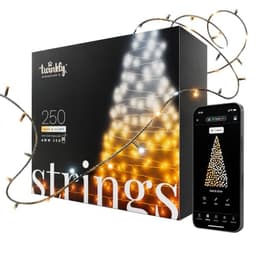
#1 — Tunable white without the color circus
Twinkly Strings, 250 white LEDs, 65 ft, black wire
250 AWW LEDs, warm-to-cool tunable, IP44
7.3
/ 10
Buy this if you cannot decide between warm and cool white. It is the one product that lets you change your mind later.
Published specifications
- LEDs
- 250 AWW (warm white to cool white)
- Length
- 65 ft
- Wire
- Black
- Ingress rating
- IP44
Our scoring
- Published specs
- 9 / 10
- Weather tolerance
- 6 / 10
- Control
- 9 / 10
- Serviceability
- 5 / 10
Good
- Tunable white settles the warm-vs-cool argument in software instead of at the checkout
- Black wire vanishes against dark siding and bare branches
Watch out
- Costs smart-lighting money for an effect most people set once and never change
#ad · Price as of October 19, 2026 · How we are funded
Specs from the Twinkly Amazon listing (ASIN B07XQFC4Z7), retrieved 2026-09-04.
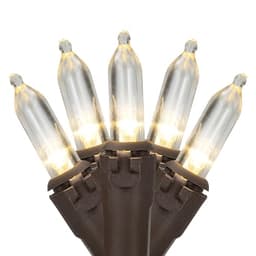
#2 — Trees, shrubs and wrapping — the workhorse string
Northlight LED mini lights, 100 count, 33 ft, warm white on brown wire
100 LEDs, 4 in spacing, 33 ft lighted length
6.5
/ 10
The default mini string. Buy the count you need for the tree, not the count that was on sale.
Published specifications
- Count
- 100 LED mini bulbs
- Spacing
- 4 in
- Lighted length
- 33 ft
- Bulb color
- Warm white
- Wire
- Brown
- Rated wattage per string
- Not published by the manufacturer
Our scoring
- Build
- 7 / 10
- Weather tolerance
- 7 / 10
- Serviceability
- 5 / 10
- Published specs
- 7 / 10
Good
- 4-inch spacing over 33 feet is the density most tree-wrapping guidance assumes
- Brown wire disappears against bark and trunk wraps, where white wire draws a line
- LED draw means you can run many strings on one circuit — see our amp guide
Watch out
- Wattage is not printed on the listing, so you have to read the tag on the string itself
- Brown reads as a visible line against a white railing — that is what the white-wire set is for
Specs from the Amazon listing (ASIN B073WK2J4Z), verified via the Creators API 2026-09-24. Replaces the discontinued green-wire version (B073WJBKPX) from the same Northlight line.
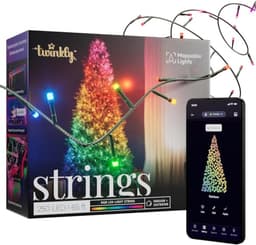
#3 — A tree you want mapped, not just lit
Twinkly Strings, 250 RGB+W LEDs, 65.6 ft, app mapped
250 mappable RGB+W LEDs over 65.6 ft, IP44
7.5
/ 10
The mapped pick, and a better one than the listing it replaces: same 250 LEDs, a real white channel and a published IP44. Buy it for one tree you look at closely, not for distance.
Published specifications
- LEDs
- 250, RGB plus warm white
- Length
- 65.6 ft
- Spacing
- 3.1 in (65.6 ft over 250 LEDs — our arithmetic)
- Wire
- Green
- Control
- App, individually addressable
- Use
- Indoor and outdoor
- Ingress rating
- IP44
Our scoring
- Control
- 10 / 10
- Published specs
- 9 / 10
- Weather tolerance
- 8 / 10
- Value per foot
- 3 / 10
Good
- Individually addressable LEDs are what make mapped effects possible — no ordinary string does this
- A dedicated warm white channel alongside the RGB, so the whites are a real white rather than a mixed approximation — the version of this string we used to rank had no white channel at all
- Publishes IP44, which puts it on the same honest footing as the rest of the Twinkly line here and makes it usable outdoors under an eave or around a trunk
Watch out
- Green wire rather than black, which shows more against dark bark and dark siding than the version this replaces
- IP44 is splash-rated and nothing more — it is still the wrong string for a gutter line or anywhere snowmelt pools
- Several times the price per foot of an ordinary LED string, and the app is doing the work
#ad · Price as of October 19, 2026 · How we are funded
Specs from the Amazon listing (ASIN B07WG2MFYS), verified via the Creators API 2026-10-16. Third listing in this slot: the 400 RGB+W / 105 ft (B086XJFXZH) was discontinued, then the 250 RGB / 66.5 ft (B086XJ17XV) which Amazon now shows as currently unavailable. This is Twinkly's own 250 RGB+Warm White at 65.6 ft, so the LED count holds and two things the previous listing had lost come back: the dedicated warm white channel and a published IP44 rating. The 66.5 ft length and the black wire are NOT on this listing — it is 65.6 ft on green wire — and the "no ingress rating" caveat carried on three pages has been withdrawn.
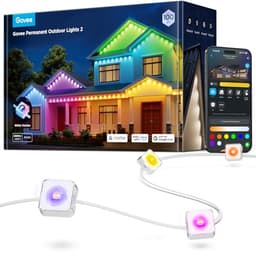
#4 — A single-story front elevation
Govee Permanent Outdoor Lights 2, 100 ft RGBIC
100 ft, IP67, 100 scene modes
7.5
/ 10
The entry point. Buy it if 100 feet covers your front elevation and you can live without Matter.
Published specifications
- Length
- 100 ft
- Ingress rating
- IP67
- Modes
- 100 scene modes, 16 million colors
- Control
- App, Alexa, Google Assistant
- LED count
- Not published by the manufacturer for this SKU in the listing title
Our scoring
- Published specs
- 7 / 10
- Weather tolerance
- 9 / 10
- Control
- 8 / 10
- Density
- 6 / 10
Good
- The cheapest honest entry into permanent lighting with a published IP67 rating
- 100 ft covers most single-story front elevations with slack to spare
Watch out
- The listing title does not state the LED count, so pitch cannot be computed before purchase
- No Matter support on this line
Specs from the Govee Amazon listing (ASIN B0D14WP9TB), retrieved 2026-09-04.
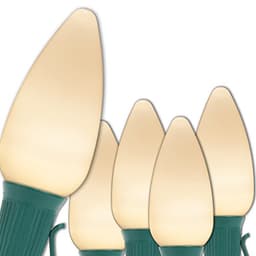
#5 — Rooflines you want to look the same in year five
Wintergreen Lighting C9 OptiCore LED, 25 bulbs / 25 ft, warm white
18 AWG SPT-1 stringer, 12 in spacing
8.3
/ 10
The C9 set built like an installer's stock: heavy stringer, replaceable bulbs, drained sockets. Buy it once for the roofline you re-hang every year.
Published specifications
- Bulb
- C9 OptiCore LED, faceted, replaceable
- Stringer
- 18 AWG SPT-1 commercial wire, green
- Spacing
- 12 in — 25 bulbs over 25 ft
- Socket drainage
- Weep holes for wet-weather use
- Rated wattage per string
- Not published by the manufacturer
Our scoring
- Build
- 9 / 10
- Weather tolerance
- 9 / 10
- Serviceability
- 9 / 10
- Published specs
- 6 / 10
Good
- Commercial 18 AWG stringer instead of the 22 AWG most retail sets use
- Bulbs unscrew individually, so one dead bulb is a bulb, not a string
- Weep-holed sockets are the detail that decides whether a set survives an ice storm
Watch out
- Costs meaningfully more per foot than a big-box set
- Wattage per string is not published, so you cannot pre-compute load from the listing alone
Specs from the Wintergreen Lighting Amazon listing (ASIN B0776ZCHFX), retrieved 2026-09-04.
Questions
›What kelvin is warm white Christmas lights?
Warm white generally falls between about 2,200 K and 3,000 K, with most holiday sets sitting near 2,700 K. Cool white starts around 5,000 K. Very few sets publish a figure, so the description is usually all you get.
›Can you mix warm white and cool white Christmas lights?
Not on the same continuous run — a color change partway along a roofline looks like a fault. Across separate elements it works well: cool white on the roof, warm white on the wreath and the shrubs.
›Which looks better on a brick house?
Warm white. Cool white against warm red brick produces a clash, and there is far more brick than there is light.
Sources
- Twinkly Strings 250 white listing (ASIN B07XQFC4Z7) — AWW tunable warm-to-cool white, 250 LEDs, 65 ft, IP44
- Northlight LED mini listing (ASIN B073WK2J4Z) — 100 count, 33 ft, warm white, brown wire
- Color-temperature bands — standard lighting-industry ranges, used to describe categories rather than to rate any specific product
We have not tested these products. Every figure above comes from a published manufacturer specification or from arithmetic shown on this page, and anything a maker does not publish is printed as unavailable rather than estimated. How that works, and what we will not claim, is set out on how we research.