Light timer or smart plug: what each one actually controls
A timer publishes an amp rating and switches on a photocell. A smart plug publishes a socket count and switches on your phone. Only one of them publishes the number that keeps a circuit safe.
By Sawyer V. · Published

Nobody wants to walk out to a cold porch twice a day to plug the display in and out, so everything eventually gets switched by something. The two candidates are a mechanical or photocell timer, and a Wi-Fi smart plug.
They are usually compared on convenience, which is the least interesting axis. Compare them on what the listings publish instead, and one column is conspicuously empty.
Wreath & Watt earns a commission on qualifying purchases made through the Amazon links on this page. It costs you nothing and it does not change the order of the picks — here is exactly how we are funded.
How we compared them
Published amp rating first, because that is the figure that decides whether the thing can carry your display at all. Then outlet count. Then how it switches, and what happens when the part it depends on is missing — daylight for a photocell, Wi-Fi for a plug.
| Product | Type | Outlets | Rating | Control |
|---|---|---|---|---|
| BN-LINK timer | Timer | 2 grounded | 15 A, 1/2 HP, ETL | Dusk-to-dawn photocell |
| TiFFCOFiO stake | Timer | 6 grounded | ETL listed | Dusk-to-dawn, countdown, remote |
| Kasa EP40 | Smart plug | 2 | Not stated | Wi-Fi app |
| HBN smart plug | Smart plug | 2 | Not stated | Wi-Fi app plus timer |
Both timers publish a safety listing and one publishes 15 A. Neither smart plug publishes an amp rating or a weather rating in its listing text — the figures are on the box, not on the page.
Source: Manufacturer listings on Amazon.com, verified September 2026.
The amp figure is the one that matters
A switch is a bottleneck. Everything the display draws passes through it, so its rating has to exceed the total load, and the total load is arithmetic you can do before buying anything.
The arithmetic
- Example display: 12 LED mini strings at about 4.8 W each = 58 W
- Plus two 8 ft inflatables at about 40 W each = 80 W
- Total: about 138 W
- 138 W / 120 V = 1.2 A
- A 15 A timer carries that with a factor of twelve to spare
An all-LED display barely troubles a 15 A switch. Add anything with a motor or a heater — an inflatable blower, a fog machine, an incandescent run — and the headroom is what stops a nuisance trip. Our wattage assumptions are stated; substitute the figures on your own tags.
The full amp arithmetic, including how many strings can share a circuit, is on how many amps a display draws. Do it once before you buy the switch, not after the first trip.
Photocell, schedule, or phone
A dusk-to-dawn photocell is the simplest thing that works: it turns on when the light level drops and off when it rises, all season, with no clock to set and nothing to reset after a power cut. Its weakness is that dusk-to-dawn is a long time — roughly fourteen hours in late December — and nobody is looking at the display at 3 am.
A countdown or a schedule fixes that. The stake timer here publishes a countdown as well as a photocell, which is the combination worth having: on at dusk, off after six hours. A smart plug does the same thing through an app, and adds the one genuinely useful trick neither timer has — changing the schedule from indoors, in slippers, in December.
The arithmetic
- Dusk-to-dawn in late December: about 14 hours a night
- Dusk plus a 6 hour countdown: 6 hours a night
- Over a 40-night season: 560 hours against 240 hours
- 560 / 240 = 2.3
Switching on a countdown rather than dawn cuts run hours by more than half. That is the single biggest lever on what a display costs to run, and it is worth more than any efficiency claim on the box.
Outlet count decides how many switches you need
Two outlets covers a roofline and a yard. Six covers a roofline, a yard, two trees, a wreath and a spare, which is why the stake timer is the one that actually finishes a display — and it sits in the bed rather than dangling off the wall outlet, with a published 6 ft waterproof lead. Smart plugs stop at two sockets here, so a large display needs two plugs and two schedules.
Whatever switches the display, the cord that feeds it has its own rules: extension cords covers gauge against run length, and outdoor Christmas light safety covers GFCI and drip loops.
Who should buy which
Buy a timer if you want the display to behave the same way every night with no app, no account and no network — and if you want a published amp rating on the thing carrying your load. The six-outlet stake is the one for a display with several runs.
Buy a smart plug if you change the schedule often, want the lights on before you get home, or run two zones that should not switch together. Prefer one that publishes an on-board timer so a dropped network does not mean a dark house. Full smart-lighting options, including addressable strings, are on smart Christmas lights, and the plain timer field is ranked on outdoor light timers.
Our picks for this
| # | Product | Best for | Score | Price |
|---|---|---|---|---|
| 1 |  BN-LINK outdoor light timer, dusk-to-dawn, dual grounded outlets15 A / 1/2 HP, ETL listed, two grounded outlets BN-LINK outdoor light timer, dusk-to-dawn, dual grounded outlets15 A / 1/2 HP, ETL listed, two grounded outlets | Set it in October, forget it until January | 8.0/ 10 | $12.99Amazon #ad · Price as of October 10, 2026 · Disclosure |
| 2 |  TiFFCOFiO outdoor power stake timer, 6 outlets, ETL listed6 grounded outlets, ETL listed TiFFCOFiO outdoor power stake timer, 6 outlets, ETL listed6 grounded outlets, ETL listed | The same job, with a safety listing stated up front | 8.0/ 10 | |
| 3 |  Kasa outdoor smart plug EP40, Wi-Fi, 2 sockets2 independently controlled sockets, Wi-Fi Kasa outdoor smart plug EP40, Wi-Fi, 2 sockets2 independently controlled sockets, Wi-Fi | Two circuits on one plug, from a phone | 5.5/ 10 | |
| 4 | 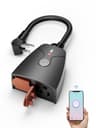 HBN outdoor smart plug, Wi-Fi, 2 outlets, timer2 outlets, Wi-Fi with a timer, 2.4 GHz HBN outdoor smart plug, Wi-Fi, 2 outlets, timer2 outlets, Wi-Fi with a timer, 2.4 GHz | A published timer as well as an app | 5.5/ 10 | $19.99Amazon #ad · Price as of October 10, 2026 · Disclosure |
Scores are our own weighting of published manufacturer specifications, explained in full on how we research. They are not test results. We have not tested these products.
The picks, in detail
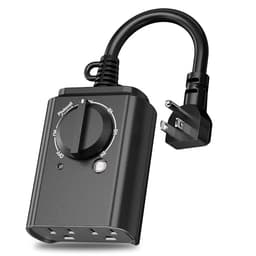
#1 — Set it in October, forget it until January
BN-LINK outdoor light timer, dusk-to-dawn, dual grounded outlets
15 A / 1/2 HP, ETL listed, two grounded outlets
8.0
/ 10
The no-fuss choice. If you never want to think about the timer again, buy this one instead of the remote model.
Published specifications
- Rating
- 15 A, 1/2 HP, ETL listed
- Outlets
- Two grounded, weatherproof
- Control
- Dusk-to-dawn photocell
Our scoring
- Published rating
- 9 / 10
- Safety listing
- 9 / 10
- Weather tolerance
- 8 / 10
- Control
- 6 / 10
Good
- Two outlets means the roofline and the yard can share one timer without a splitter
- Photocell only — nothing to reprogram when the clocks change
Watch out
- No remote, so changes mean going outside
#ad · Price as of October 10, 2026 · How we are funded
Rating and features from the Amazon listing (ASIN B01MAWA81Q), retrieved 2026-09-04.
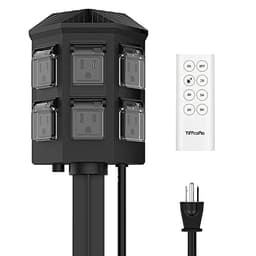
#2 — The same job, with a safety listing stated up front
TiFFCOFiO outdoor power stake timer, 6 outlets, ETL listed
6 grounded outlets, ETL listed
8.0
/ 10
Between two near-identical stake timers, take the one that publishes its safety listing.
Published specifications
- Outlets
- 6 grounded
- Lead
- 6 ft waterproof extension cord
- Control
- Dusk-to-dawn, countdown, 100 ft remote
- Listing
- ETL listed
Our scoring
- Published rating
- 6 / 10
- Safety listing
- 9 / 10
- Weather tolerance
- 8 / 10
- Control
- 9 / 10
Good
- ETL listing is stated in the listing title, which the competing stake timer does not do
Watch out
- Amp rating still is not in the title
Features from the Amazon listing (ASIN B0B4RQMMBR), retrieved 2026-09-04.
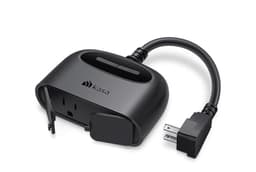
#3 — Two circuits on one plug, from a phone
Kasa outdoor smart plug EP40, Wi-Fi, 2 sockets
2 independently controlled sockets, Wi-Fi
5.5
/ 10
The smart option worth buying: two independent sockets and a schedule you can change without going outside.
Published specifications
- Sockets
- 2
- Control
- Wi-Fi, app
- Model
- EP40
- Weather rating
- Not stated in the listing
- Amp rating
- Not stated in the listing
- Timer
- Not stated in the listing
Our scoring
- Scheduling
- 9 / 10
- Weather detail
- 3 / 10
- Setup simplicity
- 5 / 10
- Published detail
- 5 / 10
Good
- Two sockets that switch independently, so the roofline and the yard do not have to come on together
- App control means you change the schedule from indoors in December, not from a crouch behind a shrub
- A named brand with a model number, which is more than most outdoor plugs publish
Watch out
- No published weather rating or amp rating in the listing text
- A Wi-Fi plug is dead weight if the router does not reach the porch
- Needs an app and an account to do the one thing a mechanical timer does with a dial
Specs from the Amazon listing (ASIN B091FXH2FR), verified via the Creators API 2026-09-27.
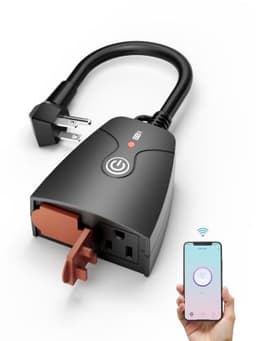
#4 — A published timer as well as an app
HBN outdoor smart plug, Wi-Fi, 2 outlets, timer
2 outlets, Wi-Fi with a timer, 2.4 GHz
5.5
/ 10
The value smart plug. The published timer is the part that matters when the Wi-Fi is not cooperating.
Published specifications
- Outlets
- 2
- Control
- Wi-Fi 2.4 GHz, app, with a timer
- Build
- Heavy duty, per the listing
- Weather rating
- Not stated in the listing
- Amp rating
- Not stated in the listing
Our scoring
- Scheduling
- 8 / 10
- Weather detail
- 3 / 10
- Setup simplicity
- 6 / 10
- Published detail
- 5 / 10
Good
- Publishes a timer as well as app control, so it still runs a schedule when the internet drops
- 2.4 GHz stated, which is the band that actually reaches the far side of a house
- Two outlets at the lowest outlay of the smart plugs here
Watch out
- No published weather rating, on a plug sold to sit in the rain
- No amp rating published, so the load has to be worked out from the strings themselves
#ad · Price as of October 10, 2026 · How we are funded
Specs from the Amazon listing (ASIN B082TT98GB), verified via the Creators API 2026-09-27.
Questions
›Is a smart plug better than a timer for Christmas lights?
For flexibility, yes; for published safety figures, no. Both timers here publish an ETL listing and one publishes 15 A. Neither smart plug publishes an amp rating in its listing text, and a plug without an on-board timer stops working when the Wi-Fi does.
›What amp rating do I need for Christmas lights?
Work out the load: an all-LED display of a dozen strings is around 1 A at 120 V, so a 15 A switch has plenty of headroom. Inflatable blowers and incandescent runs are what eat it.
›Does dusk-to-dawn waste electricity?
It runs about 14 hours a night in late December against 6 on a countdown — more than twice the hours for the same display. A timer with both a photocell and a countdown is the way to avoid it.
›How many outlets do I need on an outdoor timer?
Two is enough for a roofline plus a yard. Six is what a display with several runs actually uses, and a stake-mounted six-outlet timer keeps the joins out of the flowerbed mud.
Sources
- BN-LINK dusk-to-dawn timer listing (ASIN B01MAWA81Q) — 15 A / 1/2 HP, ETL listed, two grounded weatherproof outlets, photocell
- TiFFCOFiO power stake timer listing (ASIN B0B4RQMMBR) — 6 grounded outlets, 6 ft waterproof lead, dusk-to-dawn, countdown, 100 ft remote, ETL listed
- Kasa EP40 outdoor smart plug listing (ASIN B091FXH2FR) — 2 independently controlled sockets, Wi-Fi; no amp or weather rating published
- HBN outdoor smart plug listing (ASIN B082TT98GB) — 2 outlets, Wi-Fi 2.4 GHz with timer, heavy duty; no amp or weather rating published
- Load and run-hour arithmetic — Watts for an assumed 12-string LED display plus two inflatables, converted at 120 V, and 14 h against 6 h over a 40-night season — our arithmetic, assumptions stated
We have not tested these products. Every figure above comes from a published manufacturer specification or from arithmetic shown on this page, and anything a maker does not publish is printed as unavailable rather than estimated. How that works, and what we will not claim, is set out on how we research.