Extension cords for Christmas lights: gauge, length and amps
The cheapest way to bottleneck a display is the cord. Here is the gauge table, five outdoor cords compared, and where 16 gauge stops being enough.
By Sawyer V. · Published
Cord gauge is a number people ignore until something gets warm. It is a simple idea: a lower AWG number means a thicker conductor, which carries more current over a longer distance without heating or losing voltage. A 16-gauge cord is perfectly correct for a string of LEDs and completely wrong for a run of incandescent sets.
Below is the gauge table, then five outdoor cords ranked on what they publish.
Wreath & Watt earns a commission on qualifying purchases made through the Amazon links on this page. It costs you nothing and it does not change the order of the picks — here is exactly how we are funded.
Quick picks
| # | Product | Best for | Score | Price |
|---|---|---|---|---|
| 1 |  Iron Forge Cable 14/3 outdoor extension cord, 25 ft, 3 outlets14 AWG, 15 A, 25 ft, 3 grounded outlets Iron Forge Cable 14/3 outdoor extension cord, 25 ft, 3 outlets14 AWG, 15 A, 25 ft, 3 grounded outlets | The main run from the outlet to the display | 9.0/ 10 | |
| 2 |  14/3 heavy-duty outdoor extension cord, 50 ft, 3 outlets14 AWG, 15 A / 1875 W, 50 ft 14/3 heavy-duty outdoor extension cord, 50 ft, 3 outlets14 AWG, 15 A / 1875 W, 50 ft | Reaching the far corner of the yard | 8.5/ 10 | $51.99Amazon #ad · Price as of October 19, 2026 · Disclosure |
| 3 |  PLUGTUL 14 AWG outdoor extension cord, 25 ft, 3 outlets14 AWG, 15 A / 1875 W, ETL listed PLUGTUL 14 AWG outdoor extension cord, 25 ft, 3 outlets14 AWG, 15 A / 1875 W, ETL listed | A second 14-gauge run | 8.8/ 10 | $29.99Amazon #ad · Price as of October 19, 2026 · Disclosure |
| 4 |  Iron Forge Cable 16/3 outdoor extension cord, 50 ft, green16 AWG, 13 A, 50 ft Iron Forge Cable 16/3 outdoor extension cord, 50 ft, green16 AWG, 13 A, 50 ft | Light runs you would rather not see | 8.5/ 10 | $32.99Amazon #ad · Price as of October 19, 2026 · Disclosure |
| 5 |  16/3 outdoor extension cord, 20 ft, 13 A16 AWG, 13 A / 1625 W, 20 ftSkip this 16/3 outdoor extension cord, 20 ft, 13 A16 AWG, 13 A / 1625 W, 20 ftSkip this | One string on a porch | 7.5/ 10 | $15.99Amazon #ad · Price as of October 19, 2026 · Disclosure |
Scores are our own weighting of published manufacturer specifications, explained in full on how we research. They are not test results. We have not tested these products.
The picks in full
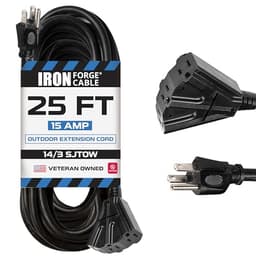
#1 — The main run from the outlet to the display
Iron Forge Cable 14/3 outdoor extension cord, 25 ft, 3 outlets
14 AWG, 15 A, 25 ft, 3 grounded outlets
9.0
/ 10
The cord to buy first. Gauge and amp rating are both published, which is the whole reason it is here.
Published specifications
- Gauge
- 14 AWG, 3 conductor (14/3)
- Jacket
- SJTW, outdoor rated
- Rating
- 15 A
- Length
- 25 ft
- Outlets
- 3 grounded, lighted end
Our scoring
- Published rating
- 10 / 10
- Capacity headroom
- 9 / 10
- Outdoor jacket
- 9 / 10
- Usability
- 8 / 10
Good
- 14 AWG at 25 ft is the combination that keeps voltage drop irrelevant for a holiday load
- A lighted end tells you the circuit is live without walking back to the breaker
- Three outlets removes the cube tap, which is the usual weak point
Watch out
- Heavier and stiffer than a 16-gauge cord, which matters when you are routing it
Gauge, jacket and rating from the Amazon listing (ASIN B078KG2ND4), retrieved 2026-09-04.
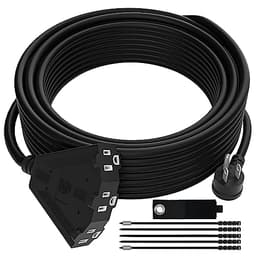
#2 — Reaching the far corner of the yard
14/3 heavy-duty outdoor extension cord, 50 ft, 3 outlets
14 AWG, 15 A / 1875 W, 50 ft
8.5
/ 10
Same gauge as our top cord, twice the reach. Buy it only if you need the distance.
Published specifications
- Gauge
- 14 AWG, 3 conductor
- Rating
- 15 A, 125 V, 1875 W, ETL listed
- Length
- 50 ft
- Plug
- 90-degree angled, 3 prong
Our scoring
- Published rating
- 10 / 10
- Capacity headroom
- 9 / 10
- Outdoor jacket
- 8 / 10
- Usability
- 7 / 10
Good
- The watt rating is printed, so it drops straight into the load arithmetic
- An angled plug sits flat against an exterior outlet cover instead of levering it open
Watch out
- 50 feet of 14 gauge is genuinely heavy to coil in January
#ad · Price as of October 19, 2026 · How we are funded
Rating from the Amazon listing (ASIN B0BG46K4QQ), retrieved 2026-09-04.
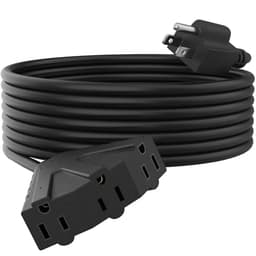
#3 — A second 14-gauge run
PLUGTUL 14 AWG outdoor extension cord, 25 ft, 3 outlets
14 AWG, 15 A / 1875 W, ETL listed
8.8
/ 10
A well-documented alternate to our top cord. Pick on price and jacket color.
Published specifications
- Gauge
- 14 AWG (about 2.08 mm²)
- Rating
- 125 V, 15 A, 1875 W, ETL listed
- Length
- 25 ft
- Outlets
- 3
- Jacket
- SJTW, water-resistant PVC
- Conductors
- 3 pure copper
- Plugs
- NEMA 5-15P to NEMA 5-15R
- Color
- Black
Our scoring
- Published rating
- 10 / 10
- Capacity headroom
- 9 / 10
- Outdoor jacket
- 8 / 10
- Usability
- 8 / 10
Good
- Publishes gauge, amps and watts together, which is unusually complete for the price
- Ships with a hook-and-loop strap, so it coils back for storage instead of into a knot
- Nickel-plated brass blades, published as corrosion resistant
Watch out
- A black jacket disappears against grass and mulch, so flag the run where people walk
- Rated water resistant, not for standing water
#ad · Price as of October 19, 2026 · How we are funded
Rating from the Amazon listing (ASIN B0DCDQW27V), verified via the Creators API 2026-10-06. Replaces B0DCFSZ526, the same PLUGTUL 25 ft 14 AWG 3-outlet cord, which Amazon now shows as currently unavailable; this listing is black rather than yellow and publishes the voltage, conductors and plug types the old one did not.
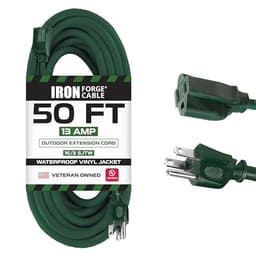
#4 — Light runs you would rather not see
Iron Forge Cable 16/3 outdoor extension cord, 50 ft, green
16 AWG, 13 A, 50 ft
8.5
/ 10
The right cord for LED strings and the wrong cord for incandescent ones. The gauge is the whole decision.
Published specifications
- Gauge
- 16 AWG, 3 conductor
- Jacket
- SJTW, outdoor rated
- Rating
- 13 A
- Length
- 50 ft
- Color
- Green
Our scoring
- Published rating
- 10 / 10
- Capacity headroom
- 6 / 10
- Outdoor jacket
- 9 / 10
- Usability
- 9 / 10
Good
- Green disappears across a lawn in a way orange never will
- 13 A published, so you know exactly where the ceiling is
Watch out
- 16 gauge is a smaller conductor: fine for LED strings, wrong for a run of incandescent sets
#ad · Price as of October 19, 2026 · How we are funded
Gauge and rating from the Amazon listing (ASIN B01JN1JRXW), retrieved 2026-09-04.
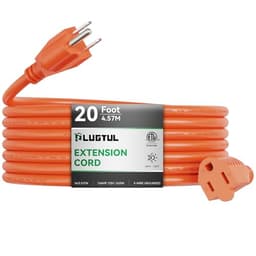
#5 — skip this
16/3 outdoor extension cord, 20 ft, 13 A
16 AWG, 13 A / 1625 W, 20 ft
7.5
/ 10
Skip this for a whole-house display. It is a one-string cord, and displays never stay one string.
Published specifications
- Gauge
- 16 AWG, 3 conductor
- Rating
- 13 A, 1625 W, ETL listed
- Length
- 20 ft
Our scoring
- Published rating
- 9 / 10
- Capacity headroom
- 4 / 10
- Outdoor jacket
- 8 / 10
- Usability
- 9 / 10
Good
- Cheap, light, and correctly rated for a single LED string
Watch out
- 13 A on a 16-gauge cord is the smallest budget in this list — it is the first thing to become the bottleneck when the display grows
#ad · Price as of October 19, 2026 · How we are funded
Rating from the Amazon listing (ASIN B0D7VZC8VG), retrieved 2026-09-04.
The gauge table
| Cord | Gauge | Length | Amps | Watts at 120 V |
|---|---|---|---|---|
| Iron Forge 14/3 | 14 AWG | 25 ft | 15 A | 1,800 W |
| Heavy-duty 14/3 | 14 AWG | 50 ft | 15 A | 1,875 W (published) |
| PLUGTUL 14 AWG | 14 AWG | 25 ft | 15 A | 1,875 W (published) |
| Iron Forge 16/3 | 16 AWG | 50 ft | 13 A | 1,560 W |
| 16/3 short run | 16 AWG | 20 ft | 13 A | 1,625 W (published) |
Where the maker publishes a watt figure we print theirs. Where they publish only amps, the watts column is amps x 120 V, computed by us. Note that a cord's rating is its ceiling, not your budget — the continuous-load convention still applies to the whole display.
Source: Manufacturer listings on Amazon.com, retrieved 2026-09-04.
Which gauge for which display
The decision is not really about the cord. It is about what is on the end of it.
The arithmetic
- 10 LED mini strings at 5 W = 50 W = 0.42 A
- 10 incandescent mini strings at 40 W = 400 W = 3.33 A
- 60 ft of incandescent C9 at 12 in spacing = 60 bulbs x 7 W = 420 W = 3.5 A
- A yard with three inflatable blowers at 60 W = 180 W = 1.5 A
LED displays rarely trouble a 16-gauge cord. Incandescent runs and blower loads add up fast, and 14 gauge is the honest default.
Our rule: 14 gauge for the main run from the house, and 16 gauge only for a short branch feeding LED strings. It costs a few dollars more and removes the cord from the list of things that can be the problem.
Length is not free
Longer cords lose more voltage over their length, which is why the same gauge is rated conservatively at greater lengths and why daisy-chaining three cords is worse than running one long one. If you need 50 feet, buy a 50-foot cord rather than joining two 25s: you halve the number of connections, and connections are where water gets in.
The join, which is where water gets in
A correctly gauged outdoor cord still has a plug-to-socket join lying on wet grass at every coupling, and that is the point water gets into a display. The weatherproof boxes and per-join sleeves that cover them — including the only sleeve that publishes which gauges it fits — are on outdoor cord covers.
What makes a cord an outdoor cord
The jacket. SJTW is the marking to look for: thermoplastic, weather and water-resistant, rated for outdoor use. An indoor cord run outside is not a shortcut, it is the failure. Also useful, and genuinely worth the small premium:
- A lighted end, so you can see from the window that the circuit is live without walking out to check.
- Three grounded outlets at the far end, which removes the cube tap — the usual weak point in a yard display.
- An angled plug, which sits flat against an exterior outlet cover instead of levering it open in the rain.
Questions
›What gauge extension cord do I need for Christmas lights?
14 gauge for the main run from the house, 16 gauge only for a short branch feeding LED strings. The deciding factor is the load on the end of it: LED displays draw very little, while incandescent runs and inflatable blowers add up quickly.
›Can I connect two extension cords together?
You can, but prefer one longer cord. Every join is a connection that can pull apart or admit water, and the voltage loss over the total length is the same either way.
›What does SJTW mean on an extension cord?
It is the jacket marking for a thermoplastic, weather and water-resistant cord rated for outdoor use. It is the marking to look for on anything that is going to sit outside for six weeks.
Sources
- Iron Forge Cable 14/3 listing (ASIN B078KG2ND4) — 14 AWG, SJTW, 15 A, three grounded outlets, lighted end
- Heavy-duty 14/3 50 ft listing (ASIN B0BG46K4QQ) — 15 A, 125 V, 1875 W, ETL listed, angled plug
- PLUGTUL 14 AWG listing (ASIN B0DCDQW27V) — 25 ft, 14 AWG, 3 outlets, 125 V, 15 A, 1875 W, SJTW, ETL listed, black
- Iron Forge Cable 16/3 listing (ASIN B01JN1JRXW) — 16 AWG, SJTW, 13 A
- 16/3 20 ft listing (ASIN B0D7VZC8VG) — 13 A, 1625 W, ETL listed
We have not tested these products. Every figure above comes from a published manufacturer specification or from arithmetic shown on this page, and anything a maker does not publish is printed as unavailable rather than estimated. How that works, and what we will not claim, is set out on how we research.