Wreath care: keeping a fresh one alive and an artificial one in shape
Two different problems. A fresh wreath is a water problem; an artificial one is a compression problem. Both have simple answers.
By Sawyer V. · Published
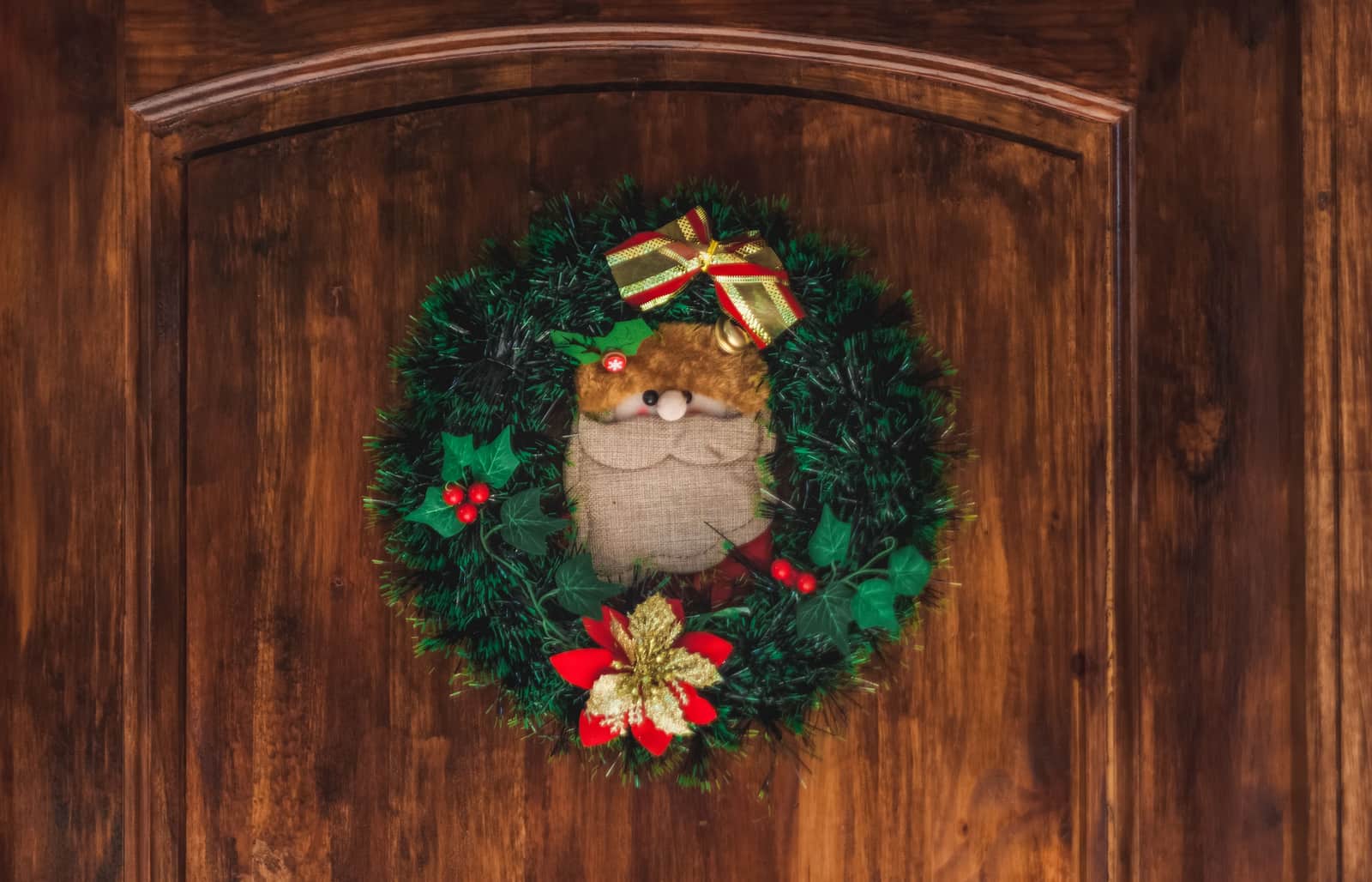
“How do I keep my wreath fresh?” is really two questions asked by two different people. One has a real evergreen wreath drying out in a warm doorway. The other has an artificial wreath that came out of the attic flat.
Both are answered below, starting with the fresh one because it is the one with a clock on it.
Wreath & Watt earns a commission on qualifying purchases made through the Amazon links on this page. It costs you nothing and it does not change the order of the picks — here is exactly how we are funded.
Keeping a fresh evergreen wreath alive
A cut evergreen wreath has no root system. It is running on the water already in its needles, and everything you do either slows that loss or speeds it up. Realistic expectations first:
| Where it hangs | Typical life | Why |
|---|---|---|
| Outdoors, shaded, cold | 4 to 6 weeks | Cool air holds moisture in the needles |
| Outdoors, direct sun | 2 to 3 weeks | Sun drives moisture out fast |
| Between a storm door and a front door | 1 to 2 weeks | That gap gets very hot in daylight |
| Indoors, heated room | 1 to 2 weeks | Dry heated air pulls moisture continuously |
These are working ranges, not measurements, and they depend heavily on species and on your climate. Fir and cedar generally hold needles longer than spruce.
Source: Our own working guidance, stated as an estimate rather than a measured result.
Three things genuinely extend it:
- Soak it before hanging. Submerge the wreath in cool water overnight, or as long as you can manage, and let it drip dry. This is the single biggest intervention and it happens once.
- Mist it every few days. A spray bottle of plain water on the needles, in the evening rather than in the sun. It slows the loss.
- Keep it out of direct sun and away from heat. A north-facing door is the best position; the gap behind a glass storm door is the worst place in the house.
Artificial wreaths: shape is the whole problem
An artificial wreath does not dry out. What it does is take a set: eleven months of a tote resting on it and the branches learn the flattened position and stay there.
The prevention is entirely about the container and the stack, and it comes down to four rules: flat not on edge, bow upward, one wreath per box, and always the top of the stack. Sizing the box is a chart in wreath storage containers and the full method is in how to store a wreath.
Reshaping and refreshing
If it is already flat, it is usually recoverable. Let it warm to room temperature first — cold PVC resists bending — then work around the ring a hand’s width at a time, bending each tip outward and slightly up. Do a second pass angling alternate branches forward and back so it has depth rather than sitting in one plane.
Two more things worth doing every few years:
- Dust it. A wreath that lives in a garage collects a gray film that reads as age. A soft brush or a hairdryer on cool takes it off.
- Re-bow it. Ribbon is cheap and a crushed wired bow is the thing that most makes a wreath look tired. A new bow on an eight-year-old wreath buys several more seasons.
Hanging it so it survives six weeks
A wreath on a storm door takes a slam several times a day. An over-the-door hanger sized to the actual door thickness stops it rocking, and a short length of clear line tying the bottom loosely to the hanger stops it swinging. Both are invisible and both stop the wreath drifting off-center by mid-December.
If the wreath is pre-lit and battery powered, take the batteries out at the end of the season before it is boxed. A cell that leaks inside a sealed container over eleven months does damage that no storage box prevents.
The same wreath, next season
A fall wreath and a Christmas wreath have the same storage problem and the fall one usually has it worse, because its trim is bulkier and more fragile. If you keep both, they need their own containers — not a shared one. See the best fall wreaths.
Our picks for this
| # | Product | Best for | Score | Price |
|---|---|---|---|---|
| 1 |  National Tree Company Crestwood Spruce wreath, 24 in, pre-lit160 tips, 50 warm white LEDs, built-in timer National Tree Company Crestwood Spruce wreath, 24 in, pre-lit160 tips, 50 warm white LEDs, built-in timer | The densest published tip count at 24 in | 8.5/ 10 | $43.36Amazon #ad · Price as of October 19, 2026 · Disclosure |
| 2 |  Hearth & Harbor hard-shell wreath storage container, 30 in30 in nominal, extra-rigid walls Hearth & Harbor hard-shell wreath storage container, 30 in30 in nominal, extra-rigid walls | Large door wreaths and anything with a deep bow | 7.8/ 10 | $19.99Amazon #ad · Price as of October 19, 2026 · Disclosure |
| 3 |  National Tree Company Wintry Pine flocked wreath, 24 in, pre-lit113 tips, 50 clear LEDs, flocked National Tree Company Wintry Pine flocked wreath, 24 in, pre-lit113 tips, 50 clear LEDs, flocked | A flocked look with the numbers published | 8.0/ 10 | |
| 4 | Hearth & Harbor hard-shell wreath storage container, 24 in24 in nominal, hard shell, interior pockets | A wreath up to about 22 in across | 6.0/ 10 | |
| 5 |  Valery Madelyn collapsible fall wreath, 24 in, lighted24 in, collapsible for storage Valery Madelyn collapsible fall wreath, 24 in, lighted24 in, collapsible for storage | People who dread the storage box | 7.5/ 10 | $34.79Amazon #ad · Price as of October 19, 2026 · Disclosure |
Scores are our own weighting of published manufacturer specifications, explained in full on how we research. They are not test results. We have not tested these products.
The picks, in detail

#1 — The densest published tip count at 24 in
National Tree Company Crestwood Spruce wreath, 24 in, pre-lit
160 tips, 50 warm white LEDs, built-in timer
8.5
/ 10
Our top 24-inch wreath. Dense, warm-white, timed — and then measure it across the berries before you buy the box.
Published specifications
- Diameter
- 24 in
- Branch tips
- 160
- Lights
- 50 warm white LED
- Timer
- Built in
- Trim
- Glitter, pinecones, red berries
- Depth with trim
- Not published by the manufacturer
Our scoring
- Published tip count
- 9 / 10
- Light quality
- 9 / 10
- Convenience
- 9 / 10
- Spec completeness
- 7 / 10
Good
- 160 tips on a 24-inch frame is dense enough that the wire ring does not show
- A built-in timer on a battery wreath is the difference between using it and forgetting it
- Warm white LED reads correctly against a painted door; cool white does not
Watch out
- Trim adds depth that no listing publishes, and that depth is what decides your storage box size
#ad · Price as of October 19, 2026 · How we are funded
Tip count, lighting and timer from the Amazon listing (ASIN B00LKRMNWK), retrieved 2026-09-04.
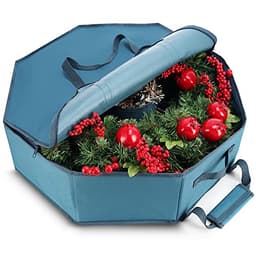
#2 — Large door wreaths and anything with a deep bow
Hearth & Harbor hard-shell wreath storage container, 30 in
30 in nominal, extra-rigid walls
7.8
/ 10
The honest answer to 'my 24-inch wreath does not fit a 24-inch box'. Go one size up and stop fighting it.
Published specifications
- Nominal size
- 30 in
- Structure
- Extra hard shell walls, reinforced base board
- Closure
- Dual zipper, handles, interior pockets
- Interior diameter
- Not published by the manufacturer
Our scoring
- Published dimensions
- 7 / 10
- Structure
- 9 / 10
- Clearance for trim
- 9 / 10
- Damp tolerance
- 6 / 10
Good
- The size to buy if your wreath is 24 to 27 inches — the nominal 24 in box will crush it
- A stiffened base board is what stops the bottom bowing when it is carried full
Watch out
- Takes a full shelf depth
- Interior diameter still is not published
#ad · Price as of October 19, 2026 · How we are funded
Construction from the Amazon listing (ASIN B09KFBMLPG), retrieved 2026-09-04.

#3 — A flocked look with the numbers published
National Tree Company Wintry Pine flocked wreath, 24 in, pre-lit
113 tips, 50 clear LEDs, flocked
8.0
/ 10
Buy it for the flocked look with your eyes open: it is a third less dense than our top pick, and it will shed into the box.
Published specifications
- Diameter
- 24 in
- Branch tips
- 113
- Lights
- 50 clear LED
- Timer
- Built in
- Trim
- Pinecones, red berries, flocking
Our scoring
- Published tip count
- 8 / 10
- Light quality
- 7 / 10
- Convenience
- 9 / 10
- Spec completeness
- 8 / 10
Good
- Flocking reads well against a dark door where plain green disappears
- Tip count published, which flocked wreaths often skip
Watch out
- 113 tips is materially sparser than the Crestwood's 160 at the same diameter
- Flocking sheds, and it sheds worst in storage
Tip count and lighting from the Amazon listing (ASIN B00EJ2DAX4), retrieved 2026-09-04.
#4 — A wreath up to about 22 in across
Hearth & Harbor hard-shell wreath storage container, 24 in
24 in nominal, hard shell, interior pockets
6.0
/ 10
The right box for a genuine 22-inch wreath, not a 24-inch one. Measure your wreath across the widest greenery before you buy.
Published specifications
- Nominal size
- 24 in
- Structure
- Hard shell
- Closure
- Dual zipper, carry handles
- Extra
- Interior pockets
- Height
- Not published by the manufacturer
- Interior diameter
- Not published by the manufacturer
Our scoring
- Published dimensions
- 5 / 10
- Structure
- 8 / 10
- Clearance for trim
- 5 / 10
- Damp tolerance
- 6 / 10
Good
- The same hard shell as the 30 in box above, in the size most store-bought wreaths actually are
- Interior pockets take the hooks and the spare berries that otherwise rattle around loose
Watch out
- No published interior height, which is the dimension that decides whether a bow survives
- The 24 in figure is the box, not the opening — plan on a wreath of about 22 in or less
Dimensions from the Amazon listing (ASIN B09KFC9G95), verified via the Creators API 2026-10-05. Replaces the discontinued homyfort 24 in container (B0CGHV96K4), whose published 7 in interior height this listing does not state.

#5 — People who dread the storage box
Valery Madelyn collapsible fall wreath, 24 in, lighted
24 in, collapsible for storage
7.5
/ 10
The one fall wreath designed around its own storage. If the box in the attic is what you dread, start here.
Published specifications
- Diameter
- 24 in
- Storage
- Collapsible
- Lighting
- Integrated light
- Materials
- Autumn maple foliage, owl detail
Our scoring
- Published dimensions
- 7 / 10
- Weather tolerance
- 6 / 10
- Storage friendliness
- 10 / 10
- Materials
- 7 / 10
Good
- Collapsible is the only genuine answer to the storage problem in this whole category
- A lit wreath extends the porch's useful hours in a season when it gets dark at five
Watch out
- Collapsing and re-fluffing costs shape over a few seasons
- The owl detail is a strong style commitment
#ad · Price as of October 19, 2026 · How we are funded
Diameter, collapsibility and lighting from the Amazon listing (ASIN B0CQYCYP7Q), retrieved 2026-09-04.
Questions
›How do you keep a fresh Christmas wreath from drying out?
Soak it in cool water overnight before hanging, mist it every few days in the evening, and keep it out of direct sun and away from heat. A shaded outdoor door gives you four to six weeks; the gap behind a glass storm door gives you one or two.
›How long does a real evergreen wreath last outside?
Roughly four to six weeks in cold shade, two to three in direct sun. Fir and cedar generally hold their needles longer than spruce.
›How do you fix an artificial wreath that has gone flat?
Let it reach room temperature, then work around it a hand's width at a time, bending each tip outward and up. A second pass angling alternate branches forward and back restores the depth. A fresh bow does the rest.
Sources
- National Tree Company Crestwood wreath listing (ASIN B00LKRMNWK) — 24 in, 160 tips, 50 warm white LED, timer
- Hearth & Harbor 30 in wreath container listing (ASIN B09KFBMLPG) — hard shell, reinforced base
- Fresh-wreath care guidance — our own working guidance and estimated ranges, stated as such; we have not tested any anti-transpirant product and name none
We have not tested these products. Every figure above comes from a published manufacturer specification or from arithmetic shown on this page, and anything a maker does not publish is printed as unavailable rather than estimated. How that works, and what we will not claim, is set out on how we research.