What gets into stored decorations, and what actually keeps it out
Cardboard, concrete and an unsealed lid account for most losses. Here is what each container feature genuinely does, and what none of them claim.
By Sawyer V. · Published

A collection is rarely lost all at once. It is lost gradually, to three things that all work the same way: something got in, and nobody looked for eleven months.
None of this needs specialist equipment. It needs the right container material, the box not touching the floor, and cardboard out of the room. Here is why each of those matters and, just as importantly, what the containers we rank do not claim.
Wreath & Watt earns a commission on qualifying purchases made through the Amazon links on this page. It costs you nothing and it does not change the order of the picks — here is exactly how we are funded.
Cardboard is the problem, not the room
Most advice frames this as attic versus garage versus basement. That matters, and it is covered on attic, garage or basement. But the single largest variable is not the room — it is whether the collection is in cardboard.
Cardboard absorbs moisture from the air, loses rigidity as it does, and is nesting material. A rigid plastic container is none of those things. Swapping the original product cartons for plastic is the cheapest and largest improvement available to most collections, and it also fixes the stacking problem, since mismatched cartons transfer load unevenly and crush what is underneath.
| Feature | Genuinely helps with | Does not claim | Example |
|---|---|---|---|
| Rigid plastic shell | Crush, chewing, moisture absorption | A watertight seal | HDX Strong Box |
| Snap-on lid | Dust, casual ingress, stacking | A gasket seal | HDX Tough Tote |
| Rigid interior dividers | Contact damage between items | Anything environmental | Hearth & Harbor box |
| 600D Oxford fabric | Tearing, handling, dust | Waterproofing | ProPik bag |
The third column is the point of this table. No mainstream container in this category claims to be watertight, and where a listing describes a fabric as 'waterproof' we treat that as a fabric description rather than an ingress rating.
Source: Manufacturer listings on Amazon.com, retrieved 2026-09-04.
Nothing on the floor. Everything else is secondary
Concrete moves moisture whatever the room is called, and the floor is also where a leak, a spill or an overflow arrives first. It is where pests travel. And it is the level a box gets kicked, dragged and stacked on.
A shelf, a rack, or even a pallet removes the most common single way a collection is lost, and it costs almost nothing. If you take one thing from this page, take this one rather than any container recommendation.
The arithmetic
- A 27 gal tote is 3.6 cu ft
- A shelf bay 48 x 18 in with 24 in of clear height = 12 cu ft
- 12 / 3.6 = 3.3 totes per bay by volume
- Two bays lifts a typical general-storage set entirely off the floor
Getting the whole general-storage set off the floor is usually two shelf bays. That is the highest-value purchase in this category.
What pests are actually after
Not the decorations. They are after nesting material and anything organic, and a collection provides both without anyone intending it: cardboard, tissue paper, dried natural trim on wreaths, pinecones, ribbon, and food left in a box from a party.
- Rigid plastic with a snap-on lid. Not a seal, but a far less attractive proposition than an open carton.
- Nothing organic in with the collection. Real pinecones, dried arrangements and anything edible go in a separate container or not into storage at all.
- No paper packing where you can avoid it. Where you do need it for ornaments, a rigid ornament box with adjustable dividers reduces how much loose paper the collection needs in the first place.
- Look once, mid-year. A five-minute check in June is the difference between one damaged box and a shelf of them.
Where fabric containers still make sense
Fabric bags exist because some shapes have no rigid equivalent. A 600D Oxford tree bag is the only practical way to store a disassembled nine-foot tree, and its published fabric grade and dual zipper are real handling advantages.
Treat it as protection against dust and tearing rather than against water, keep it off the floor like everything else, and put it in the driest space available rather than the most convenient. The bag comparison is on the best tree storage bags, and the format argument more broadly is on bins vs bags vs totes.
Allocating by vulnerability
The overall rule holds: the least tolerant items get the best space. Painted, gilded and inherited ornaments to an interior shelf; paper, textiles and gift wrap to the driest of whatever remains; trees and general decor to sealed rigid containers off the floor; outdoor lighting and cords to the garage, where they are in a gentler environment than the job they do six weeks a year.
The full allocation is on attic, garage or basement, and once the boxes are right, finding them again is on labeling and inventory.
Our picks for this
| # | Product | Best for | Score | Price |
|---|---|---|---|---|
| 1 |  HDX Strong Box 27 gal storage tote, single27 gal, sold as a single tote HDX Strong Box 27 gal storage tote, single27 gal, sold as a single tote | A single heavy box | 6.3/ 10 | $37.99Amazon #ad · Price as of October 22, 2026 · Disclosure |
| 2 |  HDX Tough 27 gal storage tote, 4 pack27 gal, snap-on lid, stackable HDX Tough 27 gal storage tote, 4 pack27 gal, snap-on lid, stackable | The bulk of the collection, stacked | 7.5/ 10 | $66.00Amazon #ad · Price as of October 22, 2026 · Disclosure |
| 3 |  Sterilite industrial storage tote, 27 gal, 12 pack27 gal x 12, heavy duty, stackable Sterilite industrial storage tote, 27 gal, 12 pack27 gal x 12, heavy duty, stackable | Re-basing the whole attic in one order | 7.3/ 10 | |
| 4 |  Hearth & Harbor ornament storage box, adjustable dividers, 128 ornaments128 ornaments, adjustable dividers, rigid plastic Hearth & Harbor ornament storage box, adjustable dividers, 128 ornaments128 ornaments, adjustable dividers, rigid plastic | The biggest published capacity here | 7.5/ 10 | $47.95Amazon #ad · Price as of October 22, 2026 · Disclosure |
| 5 |  ProPik rolling tree storage bag, 9 ft, 28 x 16 x 60 in28 x 16 x 60 in published, with wheels ProPik rolling tree storage bag, 9 ft, 28 x 16 x 60 in28 x 16 x 60 in published, with wheels | Moving a loaded bag on a concrete floor | 7.0/ 10 | $44.99Amazon #ad · Price as of October 22, 2026 · Disclosure |
Scores are our own weighting of published manufacturer specifications, explained in full on how we research. They are not test results. We have not tested these products.
The picks, in detail
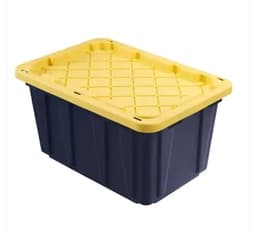
#1 — A single heavy box
HDX Strong Box 27 gal storage tote, single
27 gal, sold as a single tote
6.3
/ 10
The sample size. Useful for checking shelf fit, poor value once you know it fits.
Published specifications
- Volume
- 27 gal
- Quantity
- 1
- Color
- Black with a yellow lid
- Construction
- Not published by the manufacturer in this listing
- External dimensions
- Not published by the manufacturer in the listing
Our scoring
- Published capacity
- 8 / 10
- Crush resistance
- 5 / 10
- Stackability
- 8 / 10
- Seal
- 4 / 10
Good
- Buy one to try the size before committing to a four or twelve pack
Watch out
- Single-unit pricing is the worst per-tote value here
- This listing publishes the volume and nothing about the shell, so the crush claim has to come off the box
#ad · Price as of October 22, 2026 · How we are funded
Volume from the Amazon listing (ASIN B0CPWK41WQ), verified via the Creators API 2026-09-24. Replaces the discontinued HDX Strong Box listing (B00NZ18594).
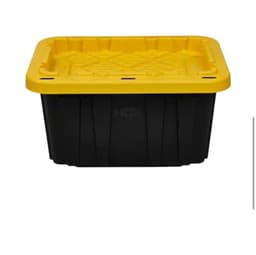
#2 — The bulk of the collection, stacked
HDX Tough 27 gal storage tote, 4 pack
27 gal, snap-on lid, stackable
7.5
/ 10
The right default tote for everything that is not fragile. Buy in fours so the stack is even.
Published specifications
- Volume
- 27 gal each
- Material
- 100 percent polypropylene resin
- Lid
- Snap-on
- Stacking
- Designed for stacking
- External dimensions
- Not published by the manufacturer in the listing
Our scoring
- Published capacity
- 8 / 10
- Crush resistance
- 9 / 10
- Stackability
- 9 / 10
- Seal
- 4 / 10
Good
- A stated volume in gallons, which lets you plan capacity before you buy
- Solid resin holds shape under a stack, which is the whole job
Watch out
- Snap-on lids are not gasketed, so an unheated garage will still let dust and damp in
- External dimensions are not published, so shelf planning needs a tape measure at the store
#ad · Price as of October 22, 2026 · How we are funded
Volume and material from the Amazon listing (ASIN B07B9KYS1W), retrieved 2026-09-04.
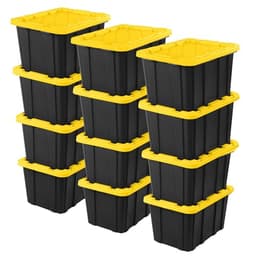
#3 — Re-basing the whole attic in one order
Sterilite industrial storage tote, 27 gal, 12 pack
27 gal x 12, heavy duty, stackable
7.3
/ 10
The bulk answer. Identical totes are worth more than the sum of their volumes because the stack becomes predictable.
Published specifications
- Volume
- 27 gal each
- Quantity
- 12
- Use
- Garage, basement, utility
- External dimensions
- Not published by the manufacturer in the listing
Our scoring
- Published capacity
- 8 / 10
- Crush resistance
- 8 / 10
- Stackability
- 9 / 10
- Seal
- 4 / 10
Good
- Twelve identical totes stack and label better than twelve mismatched ones, which is most people's actual attic
Watch out
- Twelve totes is a real commitment of floor space
- No published external dimensions
Volume and pack size from the Amazon listing (ASIN B0D92YJ4VZ), retrieved 2026-09-04.
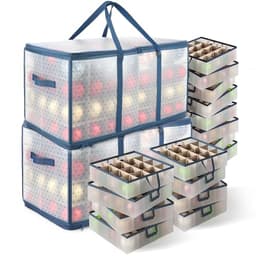
#4 — The biggest published capacity here
Hearth & Harbor ornament storage box, adjustable dividers, 128 ornaments
128 ornaments, adjustable dividers, rigid plastic
7.5
/ 10
The capacity leader, and the dividers actually move. Confirm your largest ornament fits one cell before committing the whole collection.
Published specifications
- Published capacity
- 128 ornaments
- Dividers
- Adjustable
- Shell
- Rigid plastic
- Maximum ornament diameter
- Not published by the manufacturer
Our scoring
- Published capacity
- 8 / 10
- Adjustability
- 9 / 10
- Crush resistance
- 9 / 10
- Stated size limits
- 4 / 10
Good
- Adjustable dividers are the difference between a box that fits your ornaments and one that fits the catalog's
- A rigid plastic shell survives a stack in a way a fabric box does not
Watch out
- Capacity assumes a standard ornament — no maximum diameter is published, so oversized baubles may not fit the grid
#ad · Price as of October 22, 2026 · How we are funded
Capacity and construction from the Amazon listing (ASIN B0BNJWSC1Y), verified via the Creators API 2026-10-04. Replaces the discontinued listing for the same Hearth & Harbor box (B09K9C332F); the published specification is unchanged.
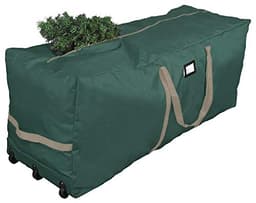
#5 — Moving a loaded bag on a concrete floor
ProPik rolling tree storage bag, 9 ft, 28 x 16 x 60 in
28 x 16 x 60 in published, with wheels
7.0
/ 10
The measurable pick. Dimensions and handles are published; the fabric is not, which is the trade.
Published specifications
- Fits
- Disassembled artificial trees up to 9 ft
- Dimensions
- 28 x 16 x 60 in
- Wheels
- Yes
- Handles
- Front and side
- Color
- Green
- Fabric
- Not published by the manufacturer
Our scoring
- Published dimensions
- 10 / 10
- Fabric grade
- 3 / 10
- Mobility
- 9 / 10
- Closure
- 6 / 10
Good
- The only tree bag here that publishes all three dimensions, so you can check the shelf before you buy
- Front and side handles mean two people can lift it without fighting over one strap
- Wheels for the floor and handles for the step
Watch out
- No published fabric grade, where the bags it sits beside publish 600D or 900D Oxford
- 60 in tall needs a 5 ft clear shelf; measure before ordering
#ad · Price as of October 22, 2026 · How we are funded
Specs from the Amazon listing (ASIN B07KQMWWNM), verified via the Creators API 2026-10-04. Replaces the discontinued StorageWorks bag (B0CCXV7MNB), whose published 600D Oxford fabric and three wheels this listing does not state.
Questions
›Are plastic bins better than cardboard for Christmas decorations?
Substantially. Cardboard absorbs moisture from the air, loses rigidity as it does, and is nesting material. Rigid plastic is none of those and stacks squarely, which also stops mismatched boxes crushing what is underneath.
›Are storage totes waterproof?
No mainstream tote in this class claims to be. A snap-on lid handles dust and casual ingress, not standing water. Where damp is a real risk the answer is to get the box off the floor rather than to expect more from the lid.
›How do I keep mice out of stored decorations?
Remove what attracts them: cardboard, loose tissue, dried natural trim, pinecones and anything edible. Then use rigid containers with lids on, keep everything off the floor, and check once mid-year rather than only in November.
›Is it safe to store decorations in a damp basement?
Not on the floor, and not the vulnerable end of the collection. Rigid sealed containers on shelving are workable for general decor; ornaments, paper and textiles belong somewhere drier.
Sources
- HDX Strong Box listing (ASIN B0CPWK41WQ) — 27 gal, single tote, black with a yellow lid
- HDX Tough Tote 4-pack listing (ASIN B07B9KYS1W) — 27 gal, snap-on lid, stackable
- Sterilite industrial tote listing (ASIN B0D92YJ4VZ) — 27 gal each, garage and utility use
- Hearth & Harbor ornament box listing (ASIN B0BNJWSC1Y) — rigid plastic, adjustable dividers
- ProPik rolling tree bag listing (ASIN B07KQMWWNM) — 28 x 16 x 60 in, wheels, front and side handles
- Ingress ratings — Not published by any container in this category; none is claimed here
We have not tested these products. Every figure above comes from a published manufacturer specification or from arithmetic shown on this page, and anything a maker does not publish is printed as unavailable rather than estimated. How that works, and what we will not claim, is set out on how we research.