Solar or plug-in: where each one actually belongs
Solar is not a cheaper mains light. It is a different product with one hard condition attached, and the condition is where the panel sits at noon.
By Sawyer V. · Published
Solar outdoor lighting is sold as the version with no wiring, and that is true. What gets left out is that it is also the version with a condition attached, and the condition is not negotiable: the panel needs direct daylight, in the place where the light is going to live.
Get that right and solar is genuinely the better answer for a whole class of placements. Get it wrong and you have bought a decoration that lights for twenty minutes. Here is how to tell which you are about to do.
Wreath & Watt earns a commission on qualifying purchases made through the Amazon links on this page. It costs you nothing and it does not change the order of the picks — here is exactly how we are funded.
The one condition
A solar light generates during the day and discharges at night, and the size of the first determines the length of the second. The panel therefore has to be somewhere that gets real, direct daylight — not ambient brightness, not reflected light from a wall, and definitely not under a porch roof.
The test is simple and worth doing before you order: stand where the light will go, at noon, and see whether the sun is on that spot. If it is not, the piece belongs on mains and no amount of comparison shopping changes that.
Side by side
| Solar | Plug-in | |
|---|---|---|
| Needs | Direct daylight on the panel | A route to an outdoor outlet |
| Brightness | Limited by the cell | Limited by the circuit |
| Switching | Automatic, dusk to whenever the charge runs out | Automatic with a timer, otherwise manual |
| Seasonal behaviour | Weaker as days shorten | Identical all year |
| Placement freedom | Anywhere sunlit | Anywhere a cord reaches |
| Published run time | Rarely, and under unstated conditions | Not applicable |
The seasonal row is the one that catches people out. A solar path light bought in June is a different product in November, and nothing about it has changed except the sun.
Source: Our editorial comparison of the two formats. Product-specific figures are the manufacturers' published specifications.
Where solar is genuinely the right answer
Ground-level pieces along an open path, on a lawn edge, or on an uncovered step — anywhere a cord would have to cross something people walk on. Running a cable across a path is the thing solar exists to avoid, and it is worth accepting a dimmer light to avoid it.
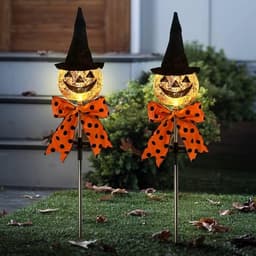
The solar pumpkin stakes are a straightforward example: a set of two, solar powered, in a material that tolerates weather. As a path marker on an open frontage that is exactly the right product, and its seasonal use is covered on lighting a fall porch. Under a covered porch it is the wrong product, and the listing cannot tell you which situation you have.
Where mains is not really optional
Anything overhead, anything that has to be reliably on at a set time, and anything bright. A patio span, a pergola, a set of lights people will sit under — those are mains jobs, because the brightness and the reliability both come from the circuit rather than from a cell that spent the day under a roof.
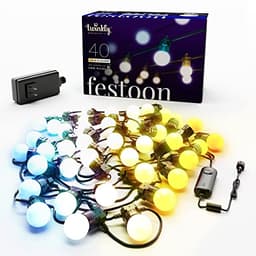
The Twinkly Festoon at 40 bulbs over 65.6 feet, and the 100-LED mini string at 33 feet, are both examples of what mains buys: a published length, a published count, and the same output in November as in July. Our patio ranking is on patio string lights.
The arrangement most gardens end up with
Solar for the ground and the far edges, mains for the structure and anything overhead. That split follows the wiring problem rather than a preference, and it is why most gardens that look properly lit are running both.
Where mains reaches, two accessories make it work. A short outdoor cord — the 20-foot 16 AWG publishes 13 A / 1625 W with an ETL listing — is the right length for a porch or a near-patio run, where a 50-foot cord is just 30 feet of coil to trip over. And a dusk-to-dawn timer gives the mains half the one genuine advantage solar has: switching itself on without anybody thinking about it.
The arithmetic
- Solar: charges by day, runs until the cell is flat
- Mains with a photocell timer: on at dusk, off at a set point, every night
- Same automatic behaviour, no charge dependency
- Cost of that behaviour on mains: one timer, once
A photocell timer gives a mains run the automatic switching that is usually cited as solar's advantage.
The short version
Choose solar when the alternative is a cord across a path and the spot gets real sun. Choose mains when the light has to be bright, overhead, or dependable through winter. And do not choose solar because it seems like the cheaper option — it is a different product with a condition attached, not a discounted version of the same one.
Our picks for this
| # | Product | Best for | Score | Price |
|---|---|---|---|---|
| 1 |  Solar lighted pumpkin stakes, set of 2Solar powered, 2 pack, garden stakes Solar lighted pumpkin stakes, set of 2Solar powered, 2 pack, garden stakes | Path edges with no outlet | 5.5/ 10 | |
| 2 |  Twinkly Festoon, 40 AWW bulbs, 65.6 ft40 tunable-white bulbs over 65.6 ft Twinkly Festoon, 40 AWW bulbs, 65.6 ft40 tunable-white bulbs over 65.6 ft | Patios and pergolas that stay lit past Christmas | 7.8/ 10 | $67.87Amazon #ad · Price as of October 20, 2026 · Disclosure |
| 3 |  Northlight LED mini lights, 100 count, 33 ft, warm white on brown wire100 LEDs, 4 in spacing, 33 ft lighted length Northlight LED mini lights, 100 count, 33 ft, warm white on brown wire100 LEDs, 4 in spacing, 33 ft lighted length | Trees, shrubs and wrapping — the workhorse string | 6.5/ 10 | |
| 4 |  16/3 outdoor extension cord, 20 ft, 13 A16 AWG, 13 A / 1625 W, 20 ftSkip this 16/3 outdoor extension cord, 20 ft, 13 A16 AWG, 13 A / 1625 W, 20 ftSkip this | One string on a porch | 7.5/ 10 | $15.99Amazon #ad · Price as of October 20, 2026 · Disclosure |
| 5 |  BN-LINK outdoor light timer, dusk-to-dawn, dual grounded outlets15 A / 1/2 HP, ETL listed, two grounded outlets BN-LINK outdoor light timer, dusk-to-dawn, dual grounded outlets15 A / 1/2 HP, ETL listed, two grounded outlets | Set it in October, forget it until January | 8.0/ 10 |
Scores are our own weighting of published manufacturer specifications, explained in full on how we research. They are not test results. We have not tested these products.
The picks, in detail
#1 — Path edges with no outlet
Solar lighted pumpkin stakes, set of 2
Solar powered, 2 pack, garden stakes
5.5
/ 10
The no-cord option, now on stakes. Nobody publishes run time in this category, so treat evening brightness as an unknown.
Published specifications
- Quantity
- 2
- Power
- Solar
- Mounting
- Garden stakes
- Design
- Jack-o'-lantern
- Material
- Not published by the manufacturer
- Run time per charge
- Not published by the manufacturer
Our scoring
- Published dimensions
- 4 / 10
- Weather tolerance
- 7 / 10
- Storage friendliness
- 7 / 10
- Lighting control
- 4 / 10
Good
- Solar means they work at the end of a path where no cord reaches
- Published garden stakes, which is what this job actually needs — a stake sets the height and holds the pumpkin upright in a bed, where a free-standing figure sits in the mulch
Watch out
- No published run time per charge, and October daylight is short — this is the figure that decides whether they are still lit at 9pm
- No published material, where the pair they replace stated resin; thin plastic is the usual default in this category
Power, count and mounting from the Amazon listing (ASIN B0FGQDG1NV), verified via the Creators API 2026-10-10. Replaces B0GXGBYBLP, which Amazon now shows as currently unavailable. The set of two and the solar power carry over and this listing additionally publishes garden stakes and a jack-o'-lantern design; the resin material is NOT published on it and has been removed here and on every page that described these as resin.
#2 — Patios and pergolas that stay lit past Christmas
Twinkly Festoon, 40 AWW bulbs, 65.6 ft
40 tunable-white bulbs over 65.6 ft
7.8
/ 10
The one set here that has a job in July. Buy it as patio lighting that also does December.
Published specifications
- Bulbs
- 40 AWW (warm to cool white)
- Length
- 65.6 ft
- Spacing
- 19.7 in (65.6 ft over 40 bulbs — our arithmetic)
- Cable
- Black
- Use
- Indoor and outdoor
Our scoring
- Published specs
- 8 / 10
- Weather tolerance
- 7 / 10
- Control
- 9 / 10
- Serviceability
- 7 / 10
Good
- Reads as patio lighting in January rather than as leftover Christmas lights
- Tunable white covers both the party setting and the quiet setting
- 65.6 ft is two spans of a normal pergola, where the 33 ft version did one
Watch out
- 40 bulbs over 66 feet is still a sparse canopy; the spacing is festoon, not fairy
#ad · Price as of October 20, 2026 · How we are funded
Specs from the Twinkly Amazon listing (ASIN B09SHM72JK), verified via the Creators API 2026-10-04. Replaces the discontinued 20-bulb / 32.8 ft Festoon (B09SHKS6Z2); the count and length both double.
#3 — Trees, shrubs and wrapping — the workhorse string
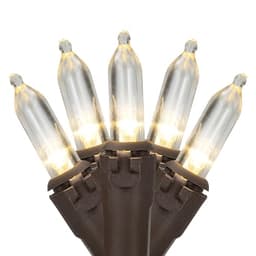
Northlight LED mini lights, 100 count, 33 ft, warm white on brown wire
100 LEDs, 4 in spacing, 33 ft lighted length
6.5
/ 10
The default mini string. Buy the count you need for the tree, not the count that was on sale.
Published specifications
- Count
- 100 LED mini bulbs
- Spacing
- 4 in
- Lighted length
- 33 ft
- Bulb color
- Warm white
- Wire
- Brown
- Rated wattage per string
- Not published by the manufacturer
Our scoring
- Build
- 7 / 10
- Weather tolerance
- 7 / 10
- Serviceability
- 5 / 10
- Published specs
- 7 / 10
Good
- 4-inch spacing over 33 feet is the density most tree-wrapping guidance assumes
- Brown wire disappears against bark and trunk wraps, where white wire draws a line
- LED draw means you can run many strings on one circuit — see our amp guide
Watch out
- Wattage is not printed on the listing, so you have to read the tag on the string itself
- Brown reads as a visible line against a white railing — that is what the white-wire set is for
Specs from the Amazon listing (ASIN B073WK2J4Z), verified via the Creators API 2026-09-24. Replaces the discontinued green-wire version (B073WJBKPX) from the same Northlight line.
#4 — skip this
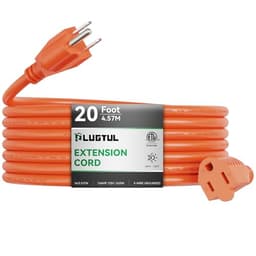
16/3 outdoor extension cord, 20 ft, 13 A
16 AWG, 13 A / 1625 W, 20 ft
7.5
/ 10
Skip this for a whole-house display. It is a one-string cord, and displays never stay one string.
Published specifications
- Gauge
- 16 AWG, 3 conductor
- Rating
- 13 A, 1625 W, ETL listed
- Length
- 20 ft
Our scoring
- Published rating
- 9 / 10
- Capacity headroom
- 4 / 10
- Outdoor jacket
- 8 / 10
- Usability
- 9 / 10
Good
- Cheap, light, and correctly rated for a single LED string
Watch out
- 13 A on a 16-gauge cord is the smallest budget in this list — it is the first thing to become the bottleneck when the display grows
#ad · Price as of October 20, 2026 · How we are funded
Rating from the Amazon listing (ASIN B0D7VZC8VG), retrieved 2026-09-04.
#5 — Set it in October, forget it until January
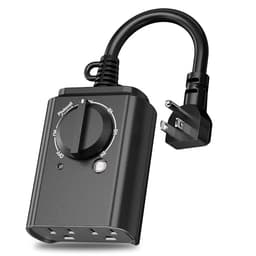
BN-LINK outdoor light timer, dusk-to-dawn, dual grounded outlets
15 A / 1/2 HP, ETL listed, two grounded outlets
8.0
/ 10
The no-fuss choice. If you never want to think about the timer again, buy this one instead of the remote model.
Published specifications
- Rating
- 15 A, 1/2 HP, ETL listed
- Outlets
- Two grounded, weatherproof
- Control
- Dusk-to-dawn photocell
Our scoring
- Published rating
- 9 / 10
- Safety listing
- 9 / 10
- Weather tolerance
- 8 / 10
- Control
- 6 / 10
Good
- Two outlets means the roofline and the yard can share one timer without a splitter
- Photocell only — nothing to reprogram when the clocks change
Watch out
- No remote, so changes mean going outside
Rating and features from the Amazon listing (ASIN B01MAWA81Q), retrieved 2026-09-04.
Questions
›Are solar outdoor lights bright enough?
For path markers and ground-level accents, yes. For anything overhead or anything people will sit under, no — the brightness is limited by the cell rather than by the circuit, and that ceiling is much lower.
›Why do my solar lights stop working in winter?
Shorter days and a lower sun angle mean less charge going in, so less run time coming out. Nothing about the light has changed. This is the reason a solar piece bought in June can disappoint in November.
›Can solar lights work on a covered porch?
Not well, because the panel needs direct daylight rather than ambient brightness. Under a roof, battery LED candles or a mains piece are the honest answers.
›How long do solar lights stay on at night?
It depends on how much charge went in that day, and no manufacturer publishes a useful figure against stated conditions — so we do not print one. Treat any quoted run time as a best case under unstated conditions.
Sources
- Solar pumpkin stakes listing (ASIN B0FGQDG1NV) — 2 pack, solar, garden stakes, jack-o-lantern; material and run time not published
- Twinkly Festoon listing (ASIN B09SHM72JK) — 40 AWW bulbs, 65.6 ft
- Northlight LED mini listing (ASIN B073WK2J4Z) — 100 LEDs, 33 ft
- 16/3 outdoor cord, 20 ft listing (ASIN B0D7VZC8VG) — 13 A / 1625 W, ETL listed
- BN-LINK dusk-to-dawn timer listing (ASIN B01MAWA81Q) — 15 A / 1/2 HP, ETL listed
- Solar run time — Not published against stated charging conditions by any manufacturer here; no figure is printed
We have not tested these products. Every figure above comes from a published manufacturer specification or from arithmetic shown on this page, and anything a maker does not publish is printed as unavailable rather than estimated. How that works, and what we will not claim, is set out on how we research.