How many Christmas lights do I need?
Two tables and two formulas: one for a tree by height and density, one for a run of railing or roofline by bulb spacing.
By Sawyer V. · Published
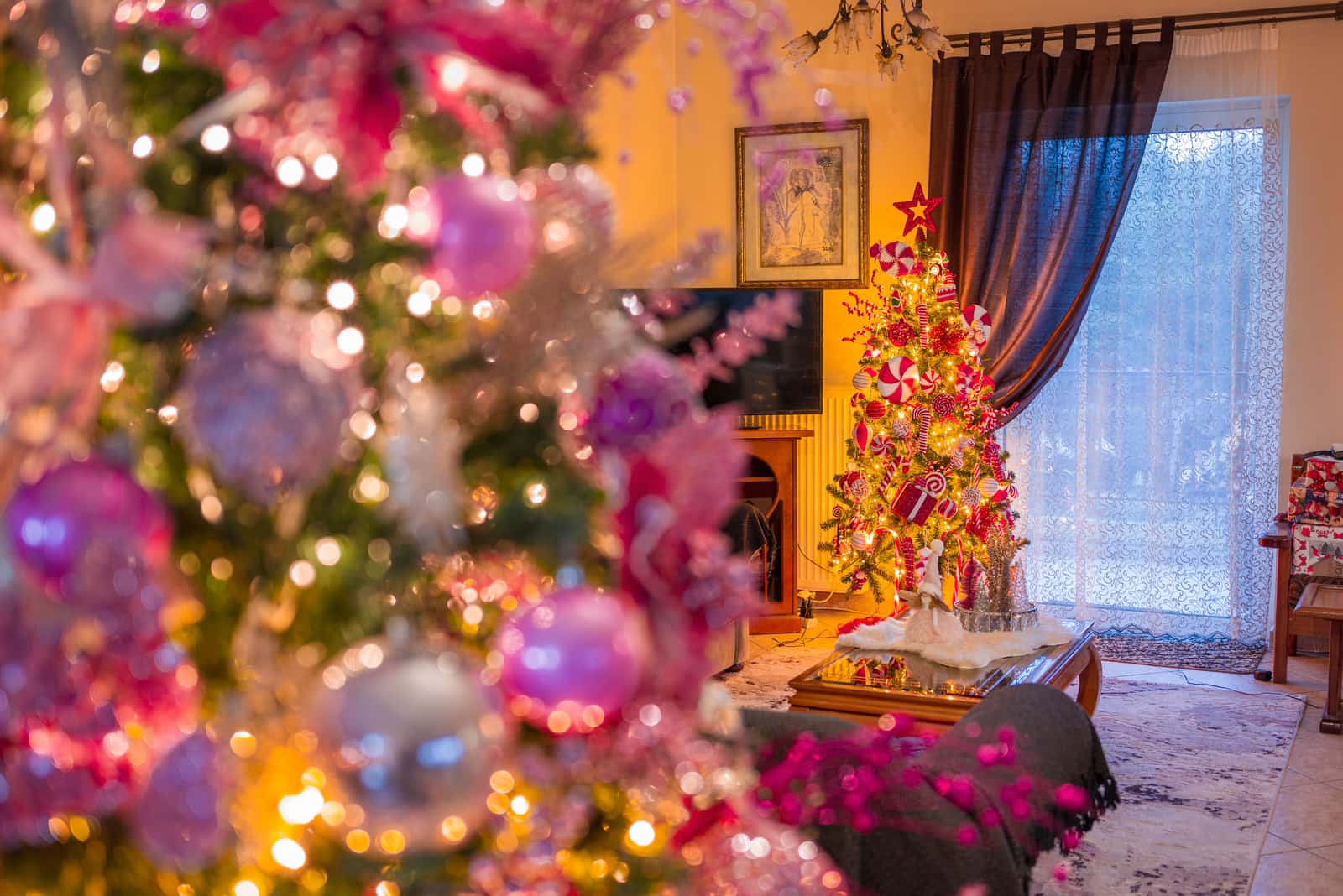
The short answer for a tree: 100 lights per vertical foot for a classic look, 150 for a full one, 200 for a showpiece. A 7.5-foot tree at classic density needs about 750 bulbs, which is eight 100-count strings.
For a railing or a roofline the question is different, and it is answered by spacing rather than by density. Both tables are below.
Wreath & Watt earns a commission on qualifying purchases made through the Amazon links on this page. It costs you nothing and it does not change the order of the picks — here is exactly how we are funded.
Trees, by height and density
| Tree height | Classic (100/ft) | Full (150/ft) | Showpiece (200/ft) |
|---|---|---|---|
| 4.5 ft | 450 | 675 | 900 |
| 6 ft | 600 | 900 | 1,200 |
| 7 ft | 700 | 1,050 | 1,400 |
| 7.5 ft | 750 | 1,125 | 1,500 |
| 9 ft | 900 | 1,350 | 1,800 |
| 12 ft | 1,200 | 1,800 | 2,400 |
Lights-per-foot figures are the retail rule of thumb, not a physical constant. Every number in the body of this table is height multiplied by density, computed by us.
Source: The 100-lights-per-foot convention is the standard retail guideline for a full-profile tree. Denser trees with higher tip counts absorb more light; a sparse tree needs less.
The arithmetic
- 7.5 ft tree x 100 lights/ft = 750 bulbs
- 750 / 100 bulbs per string = 7.5 strings
- Round up: 8 strings
- Check the series limit on the string before connecting all 8 end to end
A 7.5-foot tree at classic density: 750 bulbs, 8 strings of 100.
Adjust for tip count
The per-foot rule assumes a full-profile tree. It does not survive contact with a sparse one. A tree with 1,878 tips at 7.5 feet has far more surface to absorb light than a deliberately sparse tree of the same height, and the same 750 bulbs will read very differently on each.
Published tip counts are one of the few genuinely comparable numbers in the artificial-tree category, and we list them for every pick in the best artificial Christmas trees and explain what they mean in tree size and tip count. As a working adjustment: on a dense tree above roughly 250 tips per foot, move up a density band.
Railings and rooflines, by spacing
A run is a different problem. You are not filling a volume, you are covering a line, so what matters is how far apart the bulbs sit on the string.
| Bulb spacing | Lighted ft per 100 bulbs | Strings for a 60 ft run |
|---|---|---|
| 2.5 in | 20.8 ft | 3 |
| 4 in | 33.3 ft | 2 |
| 6 in | 50.0 ft | 2 |
| 8 in | 66.7 ft | 1 |
| 12 in | 100.0 ft | 1 |
Lighted length is bulb count multiplied by spacing, divided by 12. String counts are rounded up. All computed by us.
Source: Watts = volts x amps at 120 V. The 80 percent ceiling is the standard continuous-load convention for a load running three hours or more. Per-string wattages are the figures published for those bulb types; the tag on your own string is what actually governs.
The arithmetic
- 100 bulbs x 4 in spacing = 400 in
- 400 in / 12 = 33.3 lighted ft per string
- 60 ft run / 33.3 ft = 1.8 strings
- Round up: 2 strings
A 60-foot railing wrapped with 4-inch-spaced mini strings: 2 strings of 100.
One caution: wrapping a railing or a trunk uses far more strand than the straight length suggests, because the strand spirals. A rule that works: for a spiral wrap around a post or a trunk, budget roughly three times the straight-line length.
Do it with your own numbers
The how many lights calculator runs both of these, takes your own spacing and string size, and prints the arithmetic so you can check it. Once you know the bulb count, run it through the load calculator to confirm the circuit will carry it — a 12-foot showpiece tree at 2,400 incandescent bulbs is not a trivial load.
Our picks for this
| # | Product | Best for | Score | Price |
|---|---|---|---|---|
| 1 |  Northlight LED mini lights, 100 count, 33 ft, warm white on brown wire100 LEDs, 4 in spacing, 33 ft lighted length Northlight LED mini lights, 100 count, 33 ft, warm white on brown wire100 LEDs, 4 in spacing, 33 ft lighted length | Trees, shrubs and wrapping — the workhorse string | 6.5/ 10 | |
| 2 |  Wintergreen Lighting C9 OptiCore LED, 25 bulbs / 25 ft, warm white18 AWG SPT-1 stringer, 12 in spacing Wintergreen Lighting C9 OptiCore LED, 25 bulbs / 25 ft, warm white18 AWG SPT-1 stringer, 12 in spacing | Rooflines you want to look the same in year five | 8.3/ 10 | |
| 3 |  Northlight LED mini lights, 100 count, 33 ft, white wireSame string, white wire Northlight LED mini lights, 100 count, 33 ft, white wireSame string, white wire | White railings, columns and flocked trees | 6.3/ 10 | $21.99Amazon #ad · Price as of October 19, 2026 · Disclosure |
| 4 |  GTSYDING icicle lights, 400 LED over 32.8 ft, 80 drops80 drops over 32.8 ft — one drop every 4.9 in GTSYDING icicle lights, 400 LED over 32.8 ft, 80 drops80 drops over 32.8 ft — one drop every 4.9 in | A full eave line of icicles | 7.0/ 10 | |
| 5 |  Net lights, 300 LED, 15 ft x 5 ft mesh, warm white15 ft x 5 ft mesh, 300 LEDs Net lights, 300 LED, 15 ft x 5 ft mesh, warm white15 ft x 5 ft mesh, 300 LEDs | Hedges and long bush runs | 6.8/ 10 | $24.99Amazon #ad · Price as of October 19, 2026 · Disclosure |
Scores are our own weighting of published manufacturer specifications, explained in full on how we research. They are not test results. We have not tested these products.
The picks, in detail
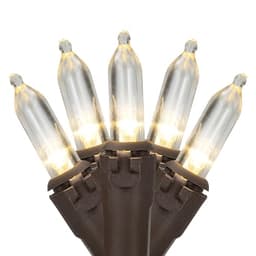
#1 — Trees, shrubs and wrapping — the workhorse string
Northlight LED mini lights, 100 count, 33 ft, warm white on brown wire
100 LEDs, 4 in spacing, 33 ft lighted length
6.5
/ 10
The default mini string. Buy the count you need for the tree, not the count that was on sale.
Published specifications
- Count
- 100 LED mini bulbs
- Spacing
- 4 in
- Lighted length
- 33 ft
- Bulb color
- Warm white
- Wire
- Brown
- Rated wattage per string
- Not published by the manufacturer
Our scoring
- Build
- 7 / 10
- Weather tolerance
- 7 / 10
- Serviceability
- 5 / 10
- Published specs
- 7 / 10
Good
- 4-inch spacing over 33 feet is the density most tree-wrapping guidance assumes
- Brown wire disappears against bark and trunk wraps, where white wire draws a line
- LED draw means you can run many strings on one circuit — see our amp guide
Watch out
- Wattage is not printed on the listing, so you have to read the tag on the string itself
- Brown reads as a visible line against a white railing — that is what the white-wire set is for
Specs from the Amazon listing (ASIN B073WK2J4Z), verified via the Creators API 2026-09-24. Replaces the discontinued green-wire version (B073WJBKPX) from the same Northlight line.
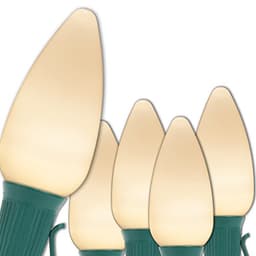
#2 — Rooflines you want to look the same in year five
Wintergreen Lighting C9 OptiCore LED, 25 bulbs / 25 ft, warm white
18 AWG SPT-1 stringer, 12 in spacing
8.3
/ 10
The C9 set built like an installer's stock: heavy stringer, replaceable bulbs, drained sockets. Buy it once for the roofline you re-hang every year.
Published specifications
- Bulb
- C9 OptiCore LED, faceted, replaceable
- Stringer
- 18 AWG SPT-1 commercial wire, green
- Spacing
- 12 in — 25 bulbs over 25 ft
- Socket drainage
- Weep holes for wet-weather use
- Rated wattage per string
- Not published by the manufacturer
Our scoring
- Build
- 9 / 10
- Weather tolerance
- 9 / 10
- Serviceability
- 9 / 10
- Published specs
- 6 / 10
Good
- Commercial 18 AWG stringer instead of the 22 AWG most retail sets use
- Bulbs unscrew individually, so one dead bulb is a bulb, not a string
- Weep-holed sockets are the detail that decides whether a set survives an ice storm
Watch out
- Costs meaningfully more per foot than a big-box set
- Wattage per string is not published, so you cannot pre-compute load from the listing alone
Specs from the Wintergreen Lighting Amazon listing (ASIN B0776ZCHFX), retrieved 2026-09-04.
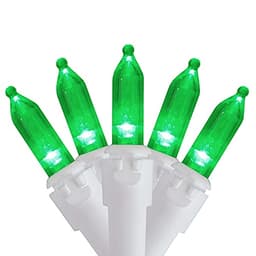
#3 — White railings, columns and flocked trees
Northlight LED mini lights, 100 count, 33 ft, white wire
Same string, white wire
6.3
/ 10
Buy the wire color that matches what it is stapled to, not what matches the bulbs.
Published specifications
- Count
- 100 LED mini bulbs
- Spacing
- 4 in
- Lighted length
- 33 ft
- Wire
- White
Our scoring
- Build
- 7 / 10
- Weather tolerance
- 7 / 10
- Serviceability
- 5 / 10
- Published specs
- 6 / 10
Good
- Wire color is the single most-ignored decision in outdoor lighting and the easiest one to get right
- Identical spacing to the brown-wire set, so runs stay consistent
Watch out
- Reads as a visible line against dark siding or an unflocked tree
#ad · Price as of October 19, 2026 · How we are funded
Specs from the Amazon listing (ASIN B073WZL6KG), retrieved 2026-09-04.
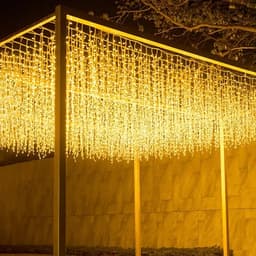
#4 — A full eave line of icicles
GTSYDING icicle lights, 400 LED over 32.8 ft, 80 drops
80 drops over 32.8 ft — one drop every 4.9 in
7.0
/ 10
The icicle set that tells you its drop count. That is the number that decides how it looks, and almost nobody publishes it.
Published specifications
- LEDs
- 400, warm white
- Length
- 32.8 ft (10 m)
- Drops
- 80
- Modes
- 8
- Connectable
- Yes, no set limit published
- Weather
- Waterproof, per the listing
Our scoring
- Published specs
- 8 / 10
- Coverage
- 9 / 10
- Weather tolerance
- 6 / 10
- Serviceability
- 5 / 10
Good
- Drop count and length are both published, so drop spacing is computable before you buy
- 80 drops over 32.8 ft is twice the density of a 60-drop set at the same length
Watch out
- Connectable, but the listing does not say how many sets can join — the figure that plans a long eave
- Drop lengths vary within the set by design, which reads as untidy on a straight fascia
Specs from the Amazon listing (ASIN B0FCSLLG51), verified via the Creators API 2026-10-03. Replaces the discontinued 300 LED / 60 drop icicle set (B08JQ6G4R8), whose published three-set connection limit this listing does not state.
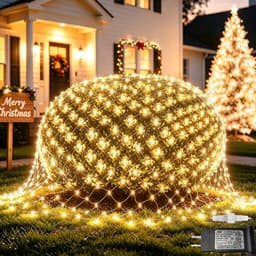
#5 — Hedges and long bush runs
Net lights, 300 LED, 15 ft x 5 ft mesh, warm white
15 ft x 5 ft mesh, 300 LEDs
6.8
/ 10
Measure the hedge, then buy the mesh. Net lights are the one product where the published dimensions are the whole decision.
Published specifications
- LEDs
- 300
- Mesh size
- 15 ft x 5 ft
- Modes
- 8
- Weather
- Listed as waterproof; IP rating not published by the manufacturer
Our scoring
- Published specs
- 8 / 10
- Coverage
- 9 / 10
- Weather tolerance
- 6 / 10
- Serviceability
- 4 / 10
Good
- Mesh dimensions are published, which is the only spec that tells you whether it covers your hedge
- One net does the work of wrapping three or four strings by hand
Watch out
- A 15 x 5 mesh drapes badly over a round shrub — it is built for a hedge line
#ad · Price as of October 19, 2026 · How we are funded
Specs from the Amazon listing (ASIN B0D7HLJW2M), retrieved 2026-09-04.
Questions
›How many lights for a 7.5 foot Christmas tree?
About 750 bulbs at the classic 100-per-foot rule, which is eight 100-count strings. For a full look use 1,125 and for a showpiece 1,500. A denser tree absorbs more light, so move up a band above roughly 250 tips per foot.
›How many lights for a 9 foot tree?
900 bulbs at classic density, 1,350 for full, 1,800 for a showpiece. That is nine, fourteen and eighteen 100-count strings respectively.
›How many lights do I need to wrap a tree trunk or a railing?
Budget about three times the straight-line length, because a spiral wrap covers far more distance than the object's length. A 6-foot post wrapped in a spiral uses roughly 18 feet of lighted strand.
Sources
- Lights-per-foot convention — 100 per vertical foot for a classic look; the standard retail guideline, stated here as a convention rather than a measurement
- Northlight LED mini listing (ASIN B073WK2J4Z) — 100 count, 4 in spacing, 33 ft lighted length
- Wintergreen C9 listing (ASIN B0776ZCHFX) — 25 bulbs at 12 in spacing over 25 ft
We have not tested these products. Every figure above comes from a published manufacturer specification or from arithmetic shown on this page, and anything a maker does not publish is printed as unavailable rather than estimated. How that works, and what we will not claim, is set out on how we research.