Tree size and tip count: how to read the specification
What tips per foot actually predicts, what height you can fit, and the two numbers that are not in any listing.
By Sawyer V. · Published
Artificial tree listings publish three numbers reliably: height, branch tip count, and light count if it is pre-lit. Of those, tip count is the one that predicts what the tree will look like, and it is the one people understand least.
Here is what it means, how to normalize it across heights, and what it does not tell you.
Wreath & Watt earns a commission on qualifying purchases made through the Amazon links on this page. It costs you nothing and it does not change the order of the picks — here is exactly how we are funded.
What a branch tip actually is
A branch tip is one individual piece of foliage at the end of a branchlet. A tree is built from a central pole, hinged branches, branchlets on the branches, and tips on the branchlets. The tip count is the total across the whole tree, and it is the closest thing this category has to a density measurement.
It is not a perfect measure. A tree can reach a high tip count with many short tips or fewer long ones, and the two look different. But it is comparable, it is published, and nothing else in the category is both.
Tips per foot bands
Raw tip count cannot be compared across heights: 1,500 tips is dense on a 6-foot tree and thin on a 12-foot one. Divide by height and the number travels.
| Tips per foot | Reads as | Example at 7.5 ft |
|---|---|---|
| Under 150 | Sparse; the pole is visible | Under 1,125 tips |
| 150 to 175 | Light; fine for a sparse style | 1,125 to 1,313 |
| 175 to 225 | Normal; the usual mid-market tree | 1,313 to 1,688 |
| 225 to 275 | Full; hides the pole completely | 1,688 to 2,063 |
| Over 275 | Very full; premium end | Over 2,063 |
These bands are our own working scale, offered so the published figures mean something. They are not an industry standard and no manufacturer uses them.
Source: Our own scale, derived from the published tip counts of the trees we compiled. Stated as guidance, not as a standard.
The arithmetic
- National Tiffany Fir: 1,878 tips / 7.5 ft = 250 per ft
- National Dunhill Fir: 1,600 / 7.5 = 213 per ft
- Best Choice unlit spruce: 1,346 / 7.5 = 179 per ft
- Puleo Aspen Fir: 1,319 / 7.5 = 176 per ft
Four trees of identical height spanning 176 to 250 tips per foot — from the bottom of 'normal' to solidly 'full'.
Choosing a height
The tree is not the only thing between the floor and the ceiling. A stand adds height and a topper adds more, and both are routinely forgotten at the point of purchase.
| Ceiling height | Allow for stand and topper | Buy this tree |
|---|---|---|
| 8 ft | About 12 in | 7 ft |
| 9 ft | About 12 in | 7.5 to 8 ft |
| 10 ft | About 14 in | 9 ft |
| 12 ft | About 16 in | 10 to 10.5 ft |
| Vaulted, over 14 ft | About 18 in | 12 ft |
The stand-and-topper allowance is our own working figure; measure your own topper, which is the variable one. A star or an angel can easily add 10 inches on its own.
Source: Our own working guidance, stated as such. Tree heights are the standard sold sizes.
The two numbers no listing gives you
Two dimensions matter enormously and are almost never published in a way you can rely on:
- Base diameter. How much floor the tree takes. A full-profile 7.5-foot tree is commonly 50 to 60 inches across; a slim one may be 30 to 40. The difference decides whether a room still has a walkway. Where a listing gives it, use it; where it does not, treat a full-profile tree as needing five feet of floor.
- Longest section length. Which decides what storage bag fits. Roughly 45 to 55 percent of tree height is a reasonable working figure, but the only reliable method is to measure the longest section the first time the tree comes apart. See tree storage bags.
Tip count sets the light count
A denser tree absorbs more light, because there is more foliage between the bulb and your eye. The 100-lights-per-foot convention assumes a normal-density tree; on a tree above roughly 250 tips per foot, move up a band. The tables are in how many Christmas lights do I need, and the calculator will do it for you.
Our picks for this
| # | Product | Best for | Score | Price |
|---|---|---|---|---|
| 1 |  National Tree Company Tiffany Fir slim, 7.5 ft, pre-lit1,878 tips, 600 clear lights, slim profile National Tree Company Tiffany Fir slim, 7.5 ft, pre-lit1,878 tips, 600 clear lights, slim profile | The highest published tip count on this list | 8.5/ 10 | $324.99Amazon #ad · Price as of October 19, 2026 · Disclosure |
| 2 |  Best Choice Products unlit spruce, 7.5 ft, 1,346 tips1,346 tips, unlit Best Choice Products unlit spruce, 7.5 ft, 1,346 tips1,346 tips, unlit | Anyone who wants to choose their own lights | 6.8/ 10 | |
| 3 |  National Tree Company Dunhill Fir slim, 7.5 ft, pre-lit1,600 tips, 600 clear lights, slim National Tree Company Dunhill Fir slim, 7.5 ft, pre-lit1,600 tips, 600 clear lights, slim | A slim tree with a longer-running shape | 8.0/ 10 | $151.00Amazon #ad · Price as of October 19, 2026 · Disclosure |
| 4 |  Puleo International Aspen Fir, 7.5 ft, pre-lit, 700 lights1,319 tips, 700 clear lights Puleo International Aspen Fir, 7.5 ft, pre-lit, 700 lights1,319 tips, 700 clear lights | The best light-to-tip ratio here | 8.5/ 10 | $259.00Amazon #ad · Price as of October 19, 2026 · Disclosure |
| 5 |  Best Choice Products sparse pine, 7.5 ft, 2-in-1 LEDSparse profile, white and multicolor LED in oneSkip this Best Choice Products sparse pine, 7.5 ft, 2-in-1 LEDSparse profile, white and multicolor LED in oneSkip this | The deliberately sparse, ornament-forward look | 4.8/ 10 |
Scores are our own weighting of published manufacturer specifications, explained in full on how we research. They are not test results. We have not tested these products.
The picks, in detail
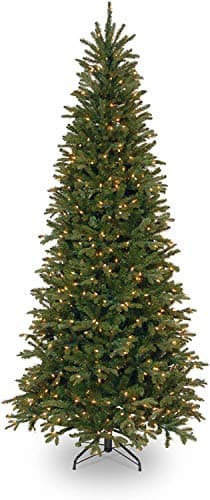
#1 — The highest published tip count on this list
National Tree Company Tiffany Fir slim, 7.5 ft, pre-lit
1,878 tips, 600 clear lights, slim profile
8.5
/ 10
Our top artificial tree on published numbers: the densest tip count here, in a profile that fits real rooms.
Published specifications
- Height
- 7.5 ft
- Branch tips
- 1,878
- Lights
- 600 clear
- Profile
- Slim
- Stand
- Included
- Tips per foot
- 250 (1,878 over 7.5 ft — our arithmetic)
Our scoring
- Published tip count
- 10 / 10
- Density per foot
- 9 / 10
- Light provision
- 6 / 10
- Spec completeness
- 9 / 10
Good
- 1,878 tips on a slim tree is unusually dense; tip count is the single best published proxy for how full a tree looks
- Slim profile fits a corner or a narrow hall without dropping to a pencil tree's sparseness
Watch out
- 600 lights across 7.5 ft is on the low side; plan on adding a string if you want a bright tree
- Pre-lit means the lights and the tree retire together
#ad · Price as of October 19, 2026 · How we are funded
Tip count, light count and height from the National Tree Company Amazon listing (ASIN B005CXFZLY), retrieved 2026-09-04.
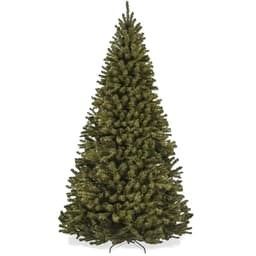
#2 — Anyone who wants to choose their own lights
Best Choice Products unlit spruce, 7.5 ft, 1,346 tips
1,346 tips, unlit
6.8
/ 10
The long-game choice. An unlit tree outlives every pre-lit one on this list, because the failure that kills them cannot happen.
Published specifications
- Height
- 7.5 ft
- Branch tips
- 1,346
- Lights
- None — unlit
- Base
- Metal
Our scoring
- Published tip count
- 9 / 10
- Density per foot
- 7 / 10
- Light provision
- 3 / 10
- Spec completeness
- 8 / 10
Good
- Unlit means a dead light section never retires the whole tree
- You pick the color temperature instead of inheriting it
Watch out
- You are buying and hanging 700-plus lights yourself, which is an hour you did not plan for
Tip count from the Amazon listing (ASIN B01L9X99GC), retrieved 2026-09-04.
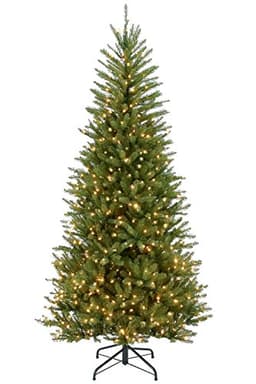
#3 — A slim tree with a longer-running shape
National Tree Company Dunhill Fir slim, 7.5 ft, pre-lit
1,600 tips, 600 clear lights, slim
8.0
/ 10
A solid slim tree that the Tiffany Fir beats on the one number that matters. Choose it on shape, not on specs.
Published specifications
- Height
- 7.5 ft
- Branch tips
- 1,600
- Lights
- 600 clear
- Profile
- Slim
- Stand
- Included
Our scoring
- Published tip count
- 9 / 10
- Density per foot
- 8 / 10
- Light provision
- 6 / 10
- Spec completeness
- 9 / 10
Good
- 1,600 tips is still dense for a slim tree
- A long-running model line, so replacement sections and matching wreaths are easier to find
Watch out
- Fewer tips than the Tiffany Fir at the same price band and the same light count
#ad · Price as of October 19, 2026 · How we are funded
Tip and light counts from the Amazon listing (ASIN B00MS7V40S), retrieved 2026-09-04.
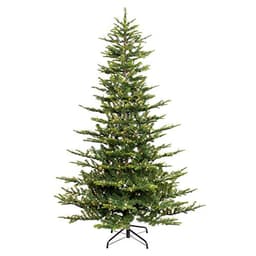
#4 — The best light-to-tip ratio here
Puleo International Aspen Fir, 7.5 ft, pre-lit, 700 lights
1,319 tips, 700 clear lights
8.5
/ 10
Buy this one if you want it bright out of the box. Buy the Tiffany Fir if you want it full and will add your own lights.
Published specifications
- Height
- 7.5 ft
- Branch tips
- 1,319
- Lights
- 700 clear
- Stand
- Sturdy metal, included
- Lights per 100 tips
- 53 (700 / 1,319 — our arithmetic)
Our scoring
- Published tip count
- 9 / 10
- Density per foot
- 7 / 10
- Light provision
- 9 / 10
- Spec completeness
- 9 / 10
Good
- 700 lights is the most on this list, and the lights-per-tip ratio is the highest
- Full profile rather than slim, so it reads as a traditional tree
Watch out
- 1,319 tips is noticeably less dense than the Tiffany Fir at the same height
#ad · Price as of October 19, 2026 · How we are funded
Tip and light counts from the Puleo Amazon listing (ASIN B01N3QFZHR), retrieved 2026-09-04.
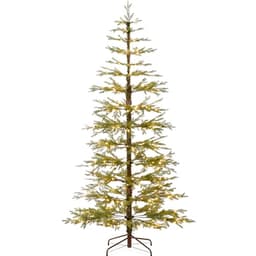
#5 — skip this
Best Choice Products sparse pine, 7.5 ft, 2-in-1 LED
Sparse profile, white and multicolor LED in one
4.8
/ 10
Skip this if you want a full tree — the sparse profile is deliberate, and there is no tip count published to check it against.
Published specifications
- Height
- 7.5 ft
- Profile
- Sparse by design
- Lights
- 2-in-1 white and multicolor LED
- Branch tips
- Not published by the manufacturer
Our scoring
- Published tip count
- 2 / 10
- Density per foot
- 4 / 10
- Light provision
- 8 / 10
- Spec completeness
- 5 / 10
Good
- A sparse tree shows ornaments instead of swallowing them, which is a real style choice
- Switchable white and multicolor settles a household argument in one purchase
Watch out
- No published tip count, so you cannot compare its fullness with anything else on this page
- Sparse is a look you either want or return
Profile and lighting from the Amazon listing (ASIN B0CJN156M9), retrieved 2026-09-04.
Questions
›What does branch tip count mean on an artificial tree?
It is the total number of individual pieces of foliage across the whole tree. Divided by the tree's height it gives tips per foot, which is the figure that makes trees of different sizes comparable.
›How many tips per foot is a full Christmas tree?
On our working scale, 225 to 275 tips per foot reads as full and above 275 as very full. Under 150 per foot the central pole is visible.
›What size Christmas tree fits a 9-foot ceiling?
A 7.5 to 8-foot tree. Allow roughly 12 inches for the stand and the topper combined, and measure your topper — a star or an angel can add 10 inches on its own.
Sources
- National Tree Company Tiffany Fir listing (ASIN B005CXFZLY) — 1,878 tips at 7.5 ft
- National Tree Company Dunhill Fir listing (ASIN B00MS7V40S) — 1,600 tips at 7.5 ft
- Puleo Aspen Fir listing (ASIN B01N3QFZHR) — 1,319 tips at 7.5 ft
- Best Choice Products unlit spruce listing (ASIN B01L9X99GC) — 1,346 tips at 7.5 ft
- Tips-per-foot bands and stand allowance — our own working scales, stated as guidance rather than industry standards
We have not tested these products. Every figure above comes from a published manufacturer specification or from arithmetic shown on this page, and anything a maker does not publish is printed as unavailable rather than estimated. How that works, and what we will not claim, is set out on how we research.