The best Christmas village sets, ranked on published scale
Piece count is the headline and height is the spec that decides whether a village reads as a scene or a row. Plus the shelf arithmetic.
By Sawyer V. · Published
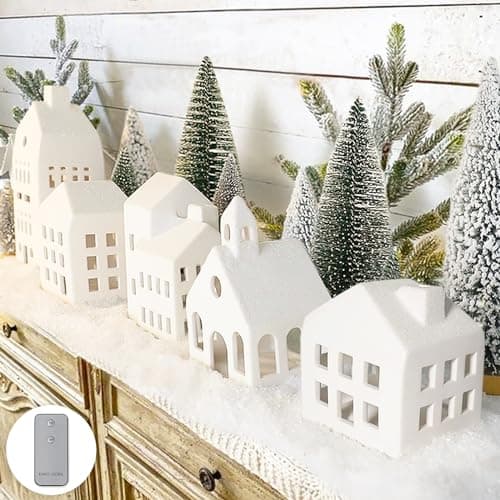
A Christmas village is the one decoration bought by piece count and displayed by shelf length, and those two numbers are rarely considered together. Fourteen ceramic pieces on a 48-inch mantel is a crowded row; the same fourteen on a sideboard is a scene.
Below are five lighted sets ranked on what they publish about scale and control, with the arithmetic for how much shelf each one actually needs.
Wreath & Watt earns a commission on qualifying purchases made through the Amazon links on this page. It costs you nothing and it does not change the order of the picks — here is exactly how we are funded.
Quick picks
| # | Product | Best for | Score | Price |
|---|---|---|---|---|
| 1 |  Christmas village set, 5 lighted ceramic houses and 9 trees, remote5 houses (4 to 8.6 in) plus 9 trees, remote Christmas village set, 5 lighted ceramic houses and 9 trees, remote5 houses (4 to 8.6 in) plus 9 trees, remote | A full mantel scene in one purchase | 8.3/ 10 | $46.99Amazon #ad · Price as of October 25, 2026 · Disclosure |
| 2 |  Peninpha Christmas village set, 3 lighted porcelain houses and 4 trees, remote7 pieces — 3 houses, 4 trees — porcelain, remote Peninpha Christmas village set, 3 lighted porcelain houses and 4 trees, remote7 pieces — 3 houses, 4 trees — porcelain, remote | A smaller shelf, with the same control | 8.0/ 10 | $29.99Amazon #ad · Price as of October 25, 2026 · Disclosure |
| 3 |  ZornRC lighted Christmas village houses with figurinesLighted houses plus figurines ZornRC lighted Christmas village houses with figurinesLighted houses plus figurines | A scene with people in it | 4.8/ 10 | $25.99Amazon #ad · Price as of October 25, 2026 · Disclosure |
| 4 |  DN DECONATION porcelain village houses, 3 pieces with frosted trees3 porcelain houses with frosted trees, LED DN DECONATION porcelain village houses, 3 pieces with frosted trees3 porcelain houses with frosted trees, LED | A side table or a narrow ledge | 5.5/ 10 | $32.99Amazon #ad · Price as of October 25, 2026 · Disclosure |
| 5 |  DN DECONATION single white ceramic village house, warm LEDOne house, 4.92 x 10.16 in, warm LED, 2 AAA DN DECONATION single white ceramic village house, warm LEDOne house, 4.92 x 10.16 in, warm LED, 2 AAA | A piece that stays out past Christmas | 6.3/ 10 | $29.99Amazon #ad · Price as of October 25, 2026 · Disclosure |
Scores are our own weighting of published manufacturer specifications, explained in full on how we research. They are not test results. We have not tested these products.
The picks in full
#1 — A full mantel scene in one purchase
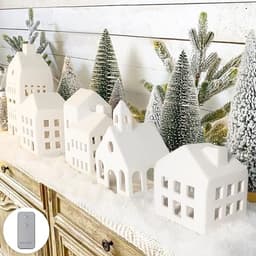
Christmas village set, 5 lighted ceramic houses and 9 trees, remote
5 houses (4 to 8.6 in) plus 9 trees, remote
8.3
/ 10
Our pick. Published dimensions for every piece, enough of them to make a scene, and one remote for the lot.
Published specifications
- Houses
- 5
- House height range
- 4 to 8.6 in
- Trees
- 9
- Tree height range
- 3.5 to 10 in
- Control
- Remote
- Material
- Ceramic
Our scoring
- Published dimensions
- 10 / 10
- Scene completeness
- 10 / 10
- Control
- 9 / 10
- Storage friendliness
- 4 / 10
Good
- The only set here publishing height ranges for both houses and trees, which is what lets you plan a shelf before buying
- Fourteen pieces is enough to build a scene with depth rather than a row of houses
- A remote means the whole village switches with one press rather than five
Watch out
- Fourteen ceramic pieces is a real storage problem — this is the set that needs a divided box
- Mixed heights only look deliberate if the shelf is deep enough to stagger them
#ad · Price as of October 25, 2026 · How we are funded
Specs from the Amazon listing (ASIN B0CG33ZG8V), verified 2026-09-10.
#2 — A smaller shelf, with the same control
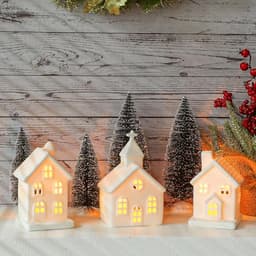
Peninpha Christmas village set, 3 lighted porcelain houses and 4 trees, remote
7 pieces — 3 houses, 4 trees — porcelain, remote
8.0
/ 10
The right size for most mantels. Fewer, better pieces beats a crowded shelf, it publishes every height, and it keeps the remote.
Published specifications
- Pieces
- 7
- Houses
- 3, LED lit — a church and two houses, each a different shape
- Trees
- 4 — two at 5.9 in, two at 7.87 in
- House height
- 5.1 in (2.8 x 2.8 in footprint)
- Material
- Porcelain, white with a fine glitter finish
- Control
- 2-button remote, plus a switch on each base
- Power
- Coin cell batteries, included
- Also included
- 3 LED candles
Our scoring
- Published dimensions
- 10 / 10
- Scene completeness
- 7 / 10
- Control
- 8 / 10
- Storage friendliness
- 7 / 10
Good
- Seven pieces fits a normal mantel without crowding, where fourteen needs a long shelf
- Publishes every height — 5.1 in houses, 5.9 in and 7.87 in trees — so the shelf can be planned before it arrives
- Remote control at the smaller set size, with a switch on each base as a fallback
- All three buildings are different shapes rather than one mould repeated
Watch out
- Three houses is a hamlet rather than a village
- The remote is on/off only — no brightness or timer
#ad · Price as of October 25, 2026 · How we are funded
Specs from the Amazon listing (ASIN B0FHPJG8DF), verified via the Creators API 2026-10-06. Replaces the ZTL B0DHZS1W9X, which Amazon now shows as currently unavailable; this is the same 7-piece format — 3 lighted porcelain houses and 4 trees with a remote — and it publishes the piece heights the ZTL never did. Its finish is published as fine glitter rather than hand-painted.
#3 — A scene with people in it
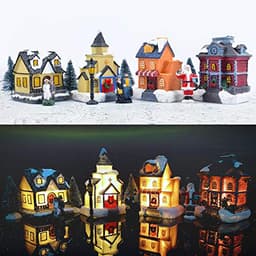
ZornRC lighted Christmas village houses with figurines
Lighted houses plus figurines
4.8
/ 10
The one to buy if you want a populated village rather than empty buildings. Just accept that the listing tells you very little.
Published specifications
- Contents
- Lighted houses with figurines
- Lighting
- LED
- Use
- Indoor room decor, collectible buildings
- Piece count
- Not stated in the listing
Our scoring
- Published dimensions
- 2 / 10
- Scene completeness
- 8 / 10
- Control
- 4 / 10
- Storage friendliness
- 5 / 10
Good
- Figurines are what turn a row of buildings into a scene, and most sets here omit them entirely
- Published as a collectible range, so it can be added to over years
Watch out
- No published piece count or dimensions — the least specified set here
- Small figurines are the first thing lost in storage
#ad · Price as of October 25, 2026 · How we are funded
Specs from the Amazon listing (ASIN B08DD4TV4Y), verified 2026-09-10.
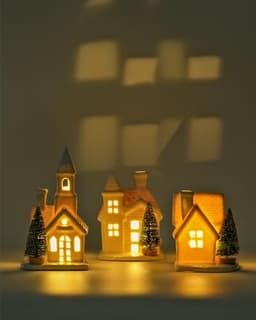
#4 — A side table or a narrow ledge
DN DECONATION porcelain village houses, 3 pieces with frosted trees
3 porcelain houses with frosted trees, LED
5.5
/ 10
The restrained one. A white porcelain trio on a side table is a different, quieter proposition from a fourteen-piece village.
Published specifications
- Houses
- 3
- Material
- White porcelain
- Trees
- Frosted, included
- Lighting
- LED
- Control
- Not stated in the listing
Our scoring
- Published dimensions
- 4 / 10
- Scene completeness
- 5 / 10
- Control
- 4 / 10
- Storage friendliness
- 9 / 10
Good
- Three pieces is the set that fits a windowsill or a hall table without taking it over
- All-white porcelain reads as one object rather than a collection of mismatched buildings
Watch out
- No published control method, so it may be switched individually
- No published dimensions
#ad · Price as of October 25, 2026 · How we are funded
Specs from the Amazon listing (ASIN B0C76YCWLQ), verified 2026-09-10.
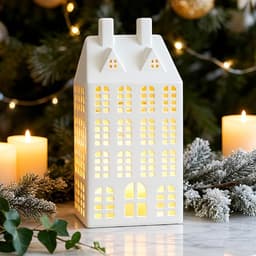
#5 — A piece that stays out past Christmas
DN DECONATION single white ceramic village house, warm LED
One house, 4.92 x 10.16 in, warm LED, 2 AAA
6.3
/ 10
The village piece that earns its shelf beyond December. Buy it as a lit ornament rather than as the start of a collection.
Published specifications
- Pieces
- 1
- Material
- White ceramic
- Size
- 4.92 x 10.16 in (boxed 11.93 x 5.63 x 6.93 in)
- Lighting
- Built-in warm yellow LED
- Power
- 2 AAA batteries, not included
- Style
- Minimalist, published for living room, bedroom and office as well as Christmas
Our scoring
- Published dimensions
- 9 / 10
- Scene completeness
- 3 / 10
- Control
- 4 / 10
- Storage friendliness
- 9 / 10
Good
- A minimalist plain white house, published for living room, bedroom and office decor as well as Christmas — which is what lets it stay out in February
- Battery powered, so there is no cord to run to a hall table
- Publishes its size, where most single village pieces do not
Watch out
- One house, so it does not build into a varied scene
- No timer or remote — it is switched by hand
- The two AAA batteries are not included
#ad · Price as of October 25, 2026 · How we are funded
Specs from the Amazon listing (ASIN B0FDB5J6SH), verified via the Creators API 2026-10-06. Replaces B0DLGFR9XB, which Amazon now shows as currently unavailable. The old listing published night-light use; this one does not, so that claim has been withdrawn — the year-round case now rests on the published minimalist styling and the living room, bedroom and office uses the listing names.
How we ranked these
| Set | Houses | Trees | Published heights | Control |
|---|---|---|---|---|
| 5-house ceramic set | 5 | 9 | Houses 4 to 8.6 in, trees 3.5 to 10 in | Remote |
| Peninpha 7-piece porcelain | 3 | 4 | Houses 5.1 in, trees 5.9 and 7.9 in | Remote |
| ZornRC with figurines | Not stated | Figurines included | Not stated | Not stated |
| DN DECONATION 3-piece | 3 | Frosted, included | Not stated | Not stated |
| DN DECONATION single house | 1 | None | 4.92 x 10.16 in | Built-in LED, 2 AAA |
Three of the five now publish sizes, and two publish a full height range. On a product displayed on a specific shelf, that is the figure that decides whether it fits and whether it reads as a scene.
Source: Manufacturer listings on Amazon.com, verified 2026-09-10.
The five-house ceramic set takes the top spot on documentation and completeness: fourteen pieces, published height ranges for both the houses and the trees, and one remote for the lot.
How much shelf a village actually needs
The arithmetic
- 5 houses at an average of about 6 in wide = 30 in
- 9 trees at about 2 in each = 18 in
- Total footprint if everything is in one line = 48 in
- A standard 60 in mantel leaves 12 in of gap across the whole run
A 14-piece village in a single line fills a 60 in mantel almost exactly. Depth is what turns that row into a scene.
The arithmetic assumes a single row, which is the mistake. A village reads as a village when pieces overlap front to back — small trees in front, tall houses behind, a gap that suggests a street. That needs shelf depth, not just length, and a mantel typically has 6 to 8 inches of it.
If the shelf is shallow, buy fewer pieces. The seven-piece Peninpha set is the right size for a normal mantel, it publishes every piece height, and it keeps the remote.
Scale is what separates a village from a shelf of ornaments
Published height ranges matter for a reason that is not obvious: a village only looks like a place if the buildings are not all the same size. A set where every house is 6 inches reads as a product line. A set spanning 4 to 8.6 inches reads as a town with big and small buildings in it.
The same applies to the trees. A 3.5-inch tree in front of an 8-inch house creates the depth cue that makes the whole thing work; nine identical trees do not.
Buildings alone are not a scene
The set that includes figurines is doing something the others are not. Empty buildings read as architecture; add people, and the eye reads a story. The ZornRC set is the only one here that publishes figurines as included, which is why it places above better-documented sets.
The trade is honest and worth stating: it is also the least specified listing here. No piece count, no dimensions. You are buying the concept rather than a spec sheet.
The piece that survives January
Most village sets are packed away on the same day as the tree. One category does not: a plain white ceramic house in a minimalist shape, with no red, green or glitter on it, is a lit ornament that stays on a hall table in February without looking like leftover Christmas.
The DN DECONATION single house is that piece — its listing names living room, bedroom and office decor alongside Christmas — and the same brand’s three-piece set is the same idea at slightly larger scale. Both suit a narrow ledge where a fourteen-piece village would never fit.
Fourteen ceramic pieces is a storage decision
This is the part nobody plans for. A village is glazed ceramic with fragile chimneys and separate trees, and it goes into the same tote as everything else unless you decide otherwise.
Treat it like ornaments rather than like decor: divided compartments, one piece per cell, nothing stacked on top. The method transfers directly from how to pack ornaments, and the boxes themselves are on the best ornament storage boxes. If a set is going to live on a mantel, the rest of that surface is on mantel decorating.
Questions
›How many pieces should a Christmas village have?
Match it to the shelf. Fourteen pieces in a single row fills a 60-inch mantel almost exactly, which leaves no room to stagger them. On a normal mantel a seven-piece set looks better; a fourteen-piece set wants a sideboard.
›Why does my Christmas village look flat?
Everything is probably in one line and at one scale. A village reads as a place when small trees sit in front of tall houses, which needs shelf depth — and when the buildings are different heights rather than a uniform set.
›Do Christmas village sets come with a remote?
Some publish one and many do not say. It matters more than it sounds: a village with individually switched houses on a shelf you reach across is a village that ends up half lit.
›How do I store a ceramic Christmas village?
Like ornaments, not like decor. Divided compartments, one piece per cell, nothing stacked on top. Chimneys and separate trees are the parts that break, and they break in the box rather than on the shelf.
Sources
- 5-house ceramic village listing (ASIN B0CG33ZG8V) — 5 houses 4 to 8.6 in, 9 trees 3.5 to 10 in, remote
- Peninpha 7-piece village listing (ASIN B0FHPJG8DF) — 3 lighted porcelain houses at 5.1 in (a church and two houses), 4 trees at 5.9 and 7.87 in, 2-button remote plus base switches, coin cells included, 3 LED candles, fine glitter finish
- ZornRC village listing (ASIN B08DD4TV4Y) — LED lighted houses with figurines
- DN DECONATION 3-piece listing (ASIN B0C76YCWLQ) — 3 white porcelain houses with frosted trees
- DN DECONATION single village house listing (ASIN B0FDB5J6SH) — 1 white ceramic house, 4.92 x 10.16 in, warm yellow LED, 2 AAA (not included), minimalist; published for living room, bedroom and office as well as Christmas
- Shelf arithmetic — Published piece counts against an assumed average width — the assumption is printed above
We have not tested these products. Every figure above comes from a published manufacturer specification or from arithmetic shown on this page, and anything a maker does not publish is printed as unavailable rather than estimated. How that works, and what we will not claim, is set out on how we research.