How long an artificial tree lasts, and what actually ends it
Not the foliage. Four failure modes, three of which are decided by how the tree is stored rather than how much it cost.
By Sawyer V. · Published
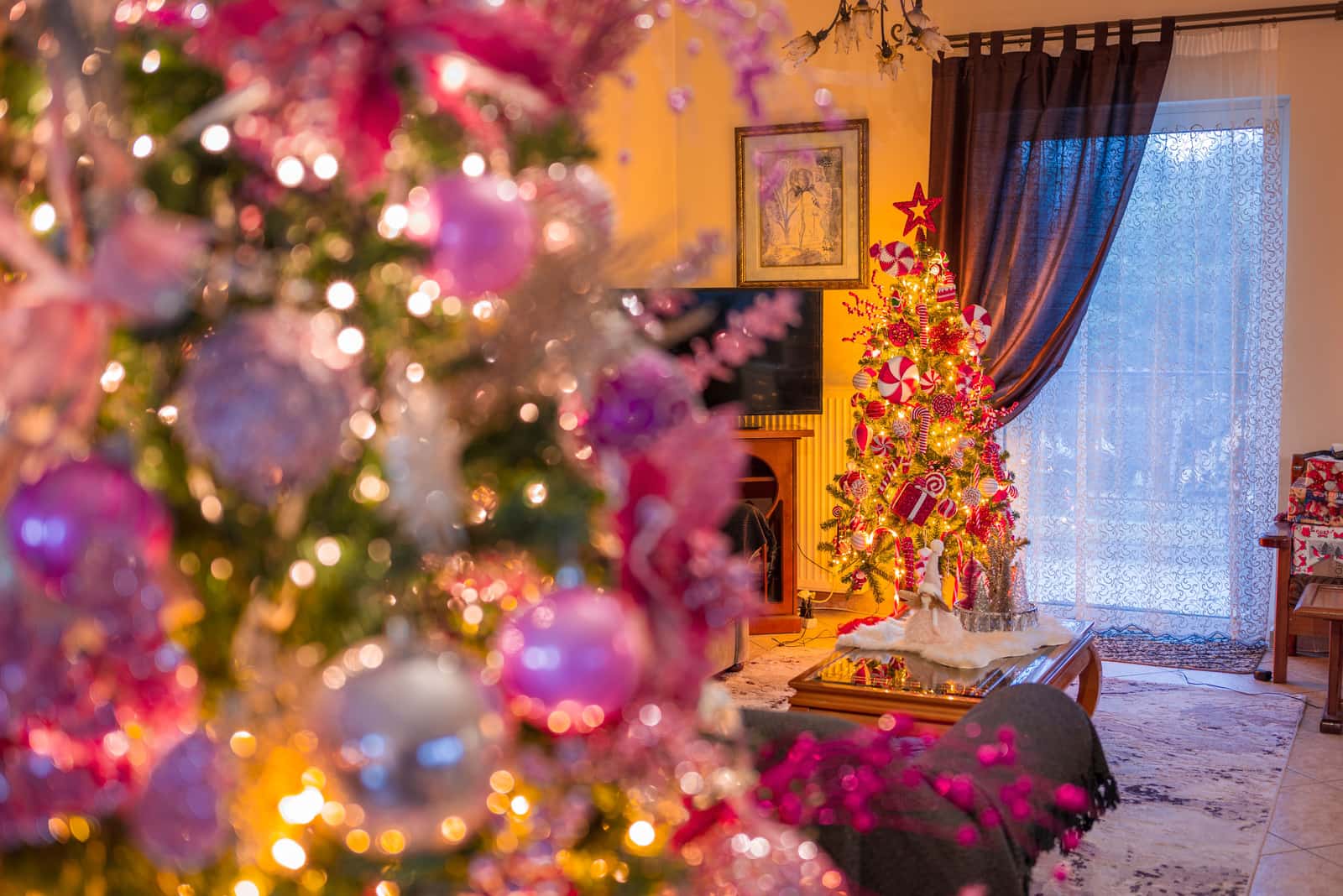
No manufacturer publishes a lifespan for an artificial tree, and we are not going to invent one. What can be described precisely is how these trees are built and therefore what fails — and the honest finding is that three of the four failure modes are decided after the purchase rather than by it.
If you want a tree to reach year ten, the specification matters less than you would hope and the storage matters far more.
Wreath & Watt earns a commission on qualifying purchases made through the Amazon links on this page. It costs you nothing and it does not change the order of the picks — here is exactly how we are funded.
The four things that end a tree
| What fails | Looks like | Decided by | Recoverable? |
|---|---|---|---|
| Branch hinges | Branches that will not hold an upward angle | How it is folded and stored | Partly |
| Tip shedding | Thinning foliage, especially low down | Handling and compression | No |
| A built-in light section | A dark third of the tree | Whether it is pre-lit at all | Rarely |
| Trunk sections and the stand | A lean, or sections that will not seat | Assembly force | Usually yes |
The third row is the only one that is a purchase decision. The other three are consequences of how the tree is handled between Januarys.
Source: Our analysis of how these trees are constructed. No manufacturer publishes a lifespan, a hinge cycle count or a shedding figure.
Hinges: the failure you cause in storage
An artificial branch is a wire spine on a hinge at the trunk. Folded upward, the way the hinge is designed to go, it stores indefinitely. Folded downward against the hinge to make the bundle narrower, it takes a set — and a branch that will not hold an upward angle is a tree that reads as tired regardless of its tip count.
This is why the storage method matters more than the price. Fold up toward the trunk, section by section, and use compression only to hold an already-tidy bundle rather than to force an oversized tree into an undersized bag. The full method is on how to store an artificial tree.
The arithmetic
- Elf Stor bag: 67 x 28 x 24 in = 26.1 cu ft
- Primode 7.5 ft bag: 50 x 16 x 22 in = 10.2 cu ft
- A 7.5 ft tree forced into the smaller bag is compressed, not packed
- Compression at the hinge is what ends the branch
Buy the bag on published dimensions, not on a 'fits up to' claim. The bag that is one size too small is the thing that ages the tree.
The Elf Stor bag is the one worth naming because it publishes its actual dimensions, so you can confirm the tree fits before it arrives rather than discovering it at the zipper.
Tip shedding, and why density buys time
Tips shed. Every artificial tree loses some, mostly from handling and mostly from the lower sections that take the most contact. Nobody publishes a rate, so we will not print one — but the consequence is arithmetic, and it is the strongest argument for buying density.
A tree that starts at 1,878 published tips and one that starts at 1,600 lose tips at broadly similar rates, but the first has 278 more to spare before it looks thin. Density is not only a year-one appearance decision; it is how many years of shedding the tree can absorb before anyone notices.
The failure that is a purchase decision
If longevity is the objective, that argues for unlit. The 1,346-tip unlit spruce lets you light it yourself and re-light it in five years with a set that costs a fraction of the tree. If you want pre-lit anyway — and the hour it saves every December is a real benefit — the Puleo Aspen Fir publishes 700 lights over 1,319 tips, the best light-to-tip ratio we can verify, at 53 lights per 100 tips. The full argument is on pre-lit vs unlit.
The four habits that add years
- Fold branches up, never down. The single highest-value habit on the page.
- Buy the bag on published dimensions. A bag one size too small is a compression device.
- Store the stand at the bottom, not on the foliage. It is the heaviest, hardest component in the bag.
- Keep it out of an unconditioned space if you have the choice. Not because the foliage minds cold, but because a full year of swing is harder on glued and painted components — the allocation is on attic, garage or basement.
When to replace, and what to buy next
Replace when the hinges no longer hold an angle after shaping, when the lower sections have thinned enough that the trunk shows through from the seating position, or when a pre-lit section has failed and you have decided not to live with it. Do not replace because the tree needs shaping — that is a Saturday, not a fault, and the method is on tree assembly and shaping.
When it is time, buy on published tip count and buy unlit if you intend to keep it a decade. The rankings are on the best artificial Christmas trees and the small-room versions on slim and pencil Christmas trees. The cost-per-season framework, which is a formula rather than a number we will invent, is on real vs artificial.
Our picks for this
| # | Product | Best for | Score | Price |
|---|---|---|---|---|
| 1 |  National Tree Company Tiffany Fir slim, 7.5 ft, pre-lit1,878 tips, 600 clear lights, slim profile National Tree Company Tiffany Fir slim, 7.5 ft, pre-lit1,878 tips, 600 clear lights, slim profile | The highest published tip count on this list | 8.5/ 10 | $324.99Amazon #ad · Price as of October 22, 2026 · Disclosure |
| 2 |  Best Choice Products unlit spruce, 7.5 ft, 1,346 tips1,346 tips, unlit Best Choice Products unlit spruce, 7.5 ft, 1,346 tips1,346 tips, unlit | Anyone who wants to choose their own lights | 6.8/ 10 | |
| 3 |  Puleo International Aspen Fir, 7.5 ft, pre-lit, 700 lights1,319 tips, 700 clear lights Puleo International Aspen Fir, 7.5 ft, pre-lit, 700 lights1,319 tips, 700 clear lights | The best light-to-tip ratio here | 8.5/ 10 | $259.00Amazon #ad · Price as of October 22, 2026 · Disclosure |
| 4 |  Elf Stor rolling tree storage bag, up to 12 ft, 67 x 28 x 24 in67 in x 28 in x 24 in — the only published box dimensions here Elf Stor rolling tree storage bag, up to 12 ft, 67 x 28 x 24 in67 in x 28 in x 24 in — the only published box dimensions here | Anyone who wants the actual dimensions before buying | 9.0/ 10 | |
| 5 |  National Tree Company Dunhill Fir slim, 7.5 ft, pre-lit1,600 tips, 600 clear lights, slim National Tree Company Dunhill Fir slim, 7.5 ft, pre-lit1,600 tips, 600 clear lights, slim | A slim tree with a longer-running shape | 8.0/ 10 | $151.00Amazon #ad · Price as of October 22, 2026 · Disclosure |
Scores are our own weighting of published manufacturer specifications, explained in full on how we research. They are not test results. We have not tested these products.
The picks, in detail
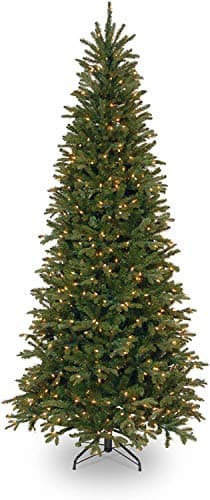
#1 — The highest published tip count on this list
National Tree Company Tiffany Fir slim, 7.5 ft, pre-lit
1,878 tips, 600 clear lights, slim profile
8.5
/ 10
Our top artificial tree on published numbers: the densest tip count here, in a profile that fits real rooms.
Published specifications
- Height
- 7.5 ft
- Branch tips
- 1,878
- Lights
- 600 clear
- Profile
- Slim
- Stand
- Included
- Tips per foot
- 250 (1,878 over 7.5 ft — our arithmetic)
Our scoring
- Published tip count
- 10 / 10
- Density per foot
- 9 / 10
- Light provision
- 6 / 10
- Spec completeness
- 9 / 10
Good
- 1,878 tips on a slim tree is unusually dense; tip count is the single best published proxy for how full a tree looks
- Slim profile fits a corner or a narrow hall without dropping to a pencil tree's sparseness
Watch out
- 600 lights across 7.5 ft is on the low side; plan on adding a string if you want a bright tree
- Pre-lit means the lights and the tree retire together
#ad · Price as of October 22, 2026 · How we are funded
Tip count, light count and height from the National Tree Company Amazon listing (ASIN B005CXFZLY), retrieved 2026-09-04.
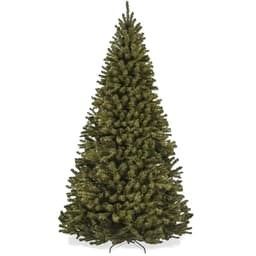
#2 — Anyone who wants to choose their own lights
Best Choice Products unlit spruce, 7.5 ft, 1,346 tips
1,346 tips, unlit
6.8
/ 10
The long-game choice. An unlit tree outlives every pre-lit one on this list, because the failure that kills them cannot happen.
Published specifications
- Height
- 7.5 ft
- Branch tips
- 1,346
- Lights
- None — unlit
- Base
- Metal
Our scoring
- Published tip count
- 9 / 10
- Density per foot
- 7 / 10
- Light provision
- 3 / 10
- Spec completeness
- 8 / 10
Good
- Unlit means a dead light section never retires the whole tree
- You pick the color temperature instead of inheriting it
Watch out
- You are buying and hanging 700-plus lights yourself, which is an hour you did not plan for
Tip count from the Amazon listing (ASIN B01L9X99GC), retrieved 2026-09-04.
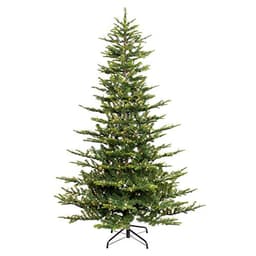
#3 — The best light-to-tip ratio here
Puleo International Aspen Fir, 7.5 ft, pre-lit, 700 lights
1,319 tips, 700 clear lights
8.5
/ 10
Buy this one if you want it bright out of the box. Buy the Tiffany Fir if you want it full and will add your own lights.
Published specifications
- Height
- 7.5 ft
- Branch tips
- 1,319
- Lights
- 700 clear
- Stand
- Sturdy metal, included
- Lights per 100 tips
- 53 (700 / 1,319 — our arithmetic)
Our scoring
- Published tip count
- 9 / 10
- Density per foot
- 7 / 10
- Light provision
- 9 / 10
- Spec completeness
- 9 / 10
Good
- 700 lights is the most on this list, and the lights-per-tip ratio is the highest
- Full profile rather than slim, so it reads as a traditional tree
Watch out
- 1,319 tips is noticeably less dense than the Tiffany Fir at the same height
#ad · Price as of October 22, 2026 · How we are funded
Tip and light counts from the Puleo Amazon listing (ASIN B01N3QFZHR), retrieved 2026-09-04.
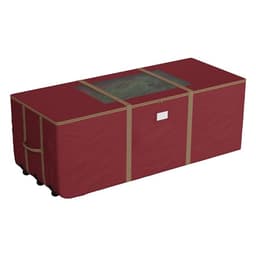
#4 — Anyone who wants the actual dimensions before buying
Elf Stor rolling tree storage bag, up to 12 ft, 67 x 28 x 24 in
67 in x 28 in x 24 in — the only published box dimensions here
9.0
/ 10
Our top tree bag purely because it publishes its dimensions. Every other bag asks you to trust 'fits up to 9 ft'.
Published specifications
- Fits
- Disassembled artificial trees up to 12 ft
- Dimensions
- 67 in x 28 in x 24 in
- Fabric
- 600D Oxford canvas, water resistant, PVC lined
- Mobility
- Three rollerblade-style wheels
- Closure
- Zipper, nylon handles, interior adjustable strap
Our scoring
- Published dimensions
- 10 / 10
- Fabric grade
- 9 / 10
- Mobility
- 9 / 10
- Closure
- 8 / 10
Good
- Published external dimensions, so you can check it against your shelf before it arrives
- 67 inches long takes the longest section of even a 12-foot tree without forcing it
- 24 inches tall is low enough to slide onto a standard garage shelf, which the bag it replaces was not
Watch out
- 67 inches long needs a deep shelf or a clear floor run
- Folds flat when empty, but the wheels stop it stacking under anything
Dimensions and fabric from the Amazon listing (ASIN B078HH3CDL), verified via the Creators API 2026-09-24. Replaces the discontinued Camerons rolling bag (B00O4EWFWY).
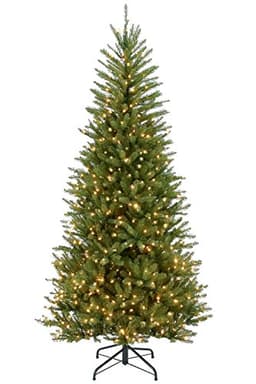
#5 — A slim tree with a longer-running shape
National Tree Company Dunhill Fir slim, 7.5 ft, pre-lit
1,600 tips, 600 clear lights, slim
8.0
/ 10
A solid slim tree that the Tiffany Fir beats on the one number that matters. Choose it on shape, not on specs.
Published specifications
- Height
- 7.5 ft
- Branch tips
- 1,600
- Lights
- 600 clear
- Profile
- Slim
- Stand
- Included
Our scoring
- Published tip count
- 9 / 10
- Density per foot
- 8 / 10
- Light provision
- 6 / 10
- Spec completeness
- 9 / 10
Good
- 1,600 tips is still dense for a slim tree
- A long-running model line, so replacement sections and matching wreaths are easier to find
Watch out
- Fewer tips than the Tiffany Fir at the same price band and the same light count
#ad · Price as of October 22, 2026 · How we are funded
Tip and light counts from the Amazon listing (ASIN B00MS7V40S), retrieved 2026-09-04.
Questions
›How many years does an artificial Christmas tree last?
No manufacturer publishes a figure and we will not invent one. What ends a tree is hinge failure from folding branches the wrong way, tip shedding from handling and compression, or a dead built-in light section — and the first two are storage decisions rather than purchase ones.
›Why does my artificial tree look thin now?
Two causes, usually together: tips shed from the lower sections over years of handling, and branches that have been folded downward against the hinge no longer hold an upward angle. Shaping recovers the second partly and the first not at all.
›Can you fix the lights on a pre-lit tree?
Sometimes, but the string is wired through the branches, which makes any repair awkward. The common outcomes are living with the dark section, adding a separate set of lights over it, or replacing the tree — which is the main argument for buying unlit if you plan to keep it a decade.
›Does a more expensive tree last longer?
A denser tree has more tips to lose before it looks thin, which buys years. Beyond that, the difference between a tree at year ten and one at year four is mostly how it was folded and what it was stored in.
Sources
- National Tree Tiffany Fir slim listing (ASIN B005CXFZLY) — 7.5 ft, 1,878 tips
- National Tree Dunhill Fir slim listing (ASIN B00MS7V40S) — 7.5 ft, 1,600 tips
- Best Choice Products unlit spruce listing (ASIN B01L9X99GC) — 7.5 ft, 1,346 tips, unlit
- Puleo Aspen Fir pre-lit listing (ASIN B01N3QFZHR) — 1,319 tips, 700 lights
- Elf Stor rolling tree bag listing (ASIN B078HH3CDL) — 67 x 28 x 24 in published dimensions
- Lifespan figures — Not published by any manufacturer in this category; none is claimed here
We have not tested these products. Every figure above comes from a published manufacturer specification or from arithmetic shown on this page, and anything a maker does not publish is printed as unavailable rather than estimated. How that works, and what we will not claim, is set out on how we research.