How to assemble and fluff an artificial tree so it stops looking artificial
The difference between a tree that looks expensive and one that looks like wire is about ninety minutes of shaping, done in a specific order.
By Sawyer V. · Published
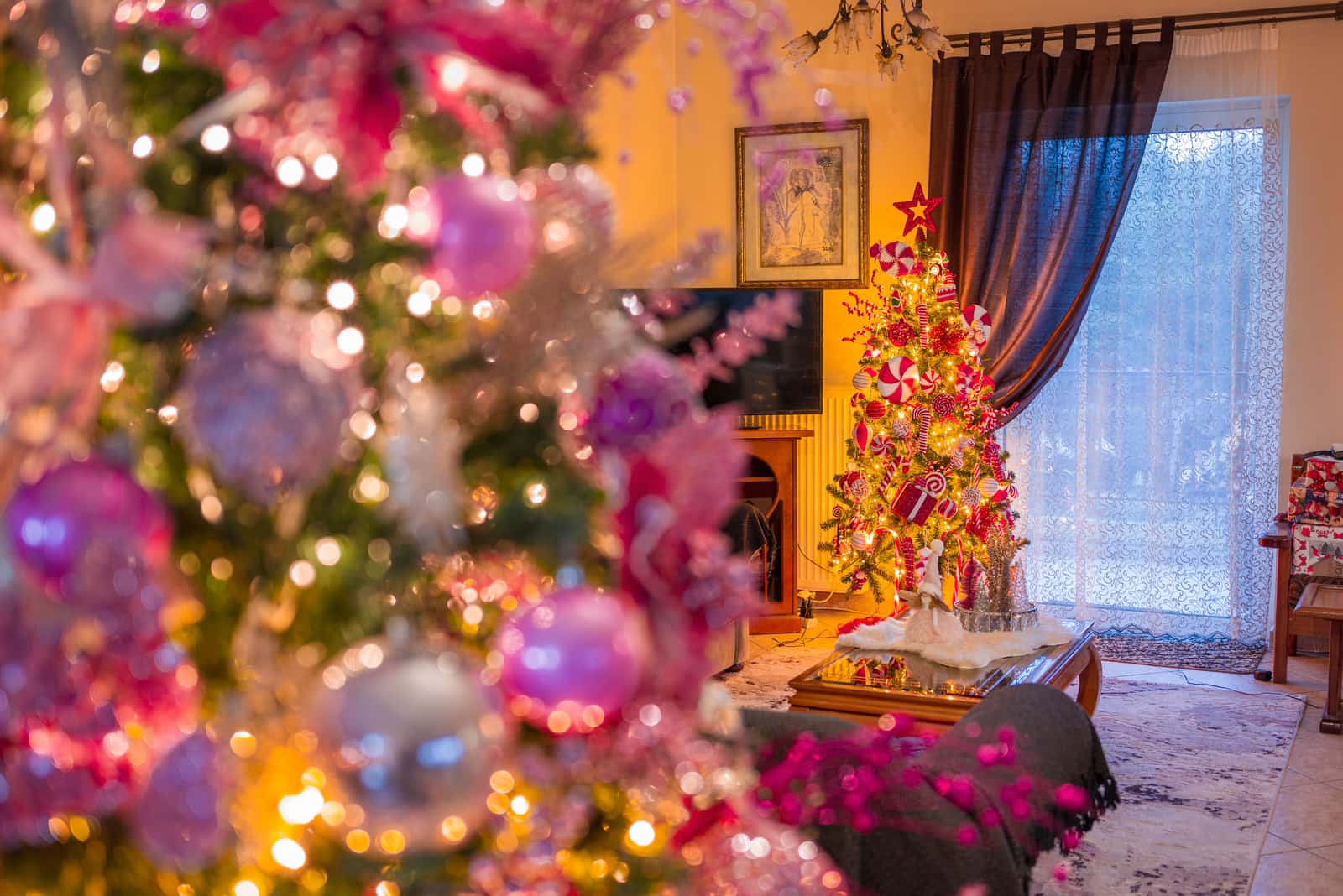
An artificial tree ships compressed into a box, and it arrives looking exactly like something that was compressed into a box. Every branch is folded flat against the pole in one plane, which is the single reason a new tree looks flat and sparse when it comes out.
Fixing that is not a trick, it is labor, and the amount of it scales directly with the tip count you paid for. Here is the order that makes it go fastest.
Wreath & Watt earns a commission on qualifying purchases made through the Amazon links on this page. It costs you nothing and it does not change the order of the picks — here is exactly how we are funded.
How long it takes
Shaping time scales with branch tips, not with height, which is why a dense tree takes longer than a tall one. As a working figure, allow roughly one minute per hundred tips for a first, careful pass.
| Tree | Tips | First-year shaping | Later years |
|---|---|---|---|
| National Tiffany Fir, 7.5 ft | 1,878 | About 3 hours | About 1.5 hours |
| National Dunhill Fir, 7.5 ft | 1,600 | About 2.5 hours | About 1.25 hours |
| Best Choice unlit spruce, 7.5 ft | 1,346 | About 2.25 hours | About 1 hour |
| Puleo Aspen Fir, 7.5 ft | 1,319 | About 2.25 hours | About 1 hour |
Times are our own working estimate at roughly one minute per hundred tips, not measurements. Later years are faster because branches keep some of the shape you gave them, provided the tree is stored fluffed.
Source: Tip counts from the manufacturer listings. The per-tip timing is our own stated estimate.
That is a real cost and it is worth knowing before you buy. A denser tree looks better and takes longer, every year. If three hours in December is not something you have, buy the lower tip count deliberately rather than buying the dense tree and under-shaping it — an under-fluffed 1,878-tip tree looks worse than a properly fluffed 1,346-tip one.
Assembly, in order
- Stand first, on the floor it will live on. Level it before anything goes in. A tree that leans is almost always a stand problem, and it is far easier to fix now than with 1,800 tips fanned out.
- Bottom section, seated fully. On a pre-lit tree the sections make their electrical connection as they seat, so a section that is not fully down is the usual cause of a dark tier — check the lights work before adding the next section.
- Let the branches drop before shaping. Swing each hinged branch down to roughly horizontal and leave the whole section for twenty minutes. PVC relaxes, and branches shaped cold and folded fight you.
- Shape that section completely before adding the next. This is the step people get wrong. Fluffing from the top of a fully built tree means reaching through finished branches to get at the ones underneath.
- Then the next section up, and repeat.
The three-plane method
Take one branch at a time, from the trunk outward. Each branch has a central stem with branchlets coming off it, and each branchlet has tips. The goal is that no two adjacent pieces of foliage sit in the same plane.
- Plane one, up and down. Bend alternating branchlets upward and downward off the central stem, roughly 45 degrees each way. This alone removes most of the flatness.
- Plane two, left and right. Fan the branchlets apart horizontally so they are evenly spaced along the branch rather than clustered.
- Plane three, forward. Pull the outermost tips slightly toward you, away from the trunk. This is what gives the tree depth from the front and it is the step most often skipped.
Work in overlapping passes rather than trying to perfect one branch. A tree looks full because of the aggregate, not because any one branch is right.
Filling gaps and hiding the pole
After the first pass, stand back six feet and look for holes. Two rules fix almost all of them:
- Aim tips into the gap, not around it. The branches either side of a hole are the material you have; bend them toward it.
- Point the innermost branchlets at the pole, not outward. Foliage near the trunk is what stops daylight showing through the middle, and on a sparse tree it is the difference between depth and a visible pole.
If the pole still shows on a tree above roughly 175 tips per foot, the tree is under-shaped rather than under-specified. Below that, the tree is simply sparse — see tree size and tip count for what the published figures actually promise.
Then the lights, if it is unlit
Shape first, always. Wrapping lights onto an unshaped tree means re-doing both when you shape it afterwards. Once the tree is full, work in vertical sections rather than horizontal rings: it uses the strand more evenly, it puts light inside the tree rather than only on its surface, and a failed string later replaces one vertical panel instead of the whole tree.
Quantities are in how many Christmas lights do I need and the calculator will size it for your tree height and density.
Store it fluffed
This is the part that makes next year quicker, and it costs nothing. Branches keep whatever shape they were left in for eleven months, so a tree collapsed carefully — branches folded up against the pole rather than crushed flat — comes out needing a touch-up instead of a full pass.
Which means the bag matters. A bag that requires compressing the tree to close undoes the shaping you just paid three hours for. Size it against the tree’s longest section rather than trusting a “fits up to 9 ft” claim — the table is in Christmas tree storage bags, and compression straps are worth more here than an extra wheel.
Our picks for this
| # | Product | Best for | Score | Price |
|---|---|---|---|---|
| 1 |  National Tree Company Tiffany Fir slim, 7.5 ft, pre-lit1,878 tips, 600 clear lights, slim profile National Tree Company Tiffany Fir slim, 7.5 ft, pre-lit1,878 tips, 600 clear lights, slim profile | The highest published tip count on this list | 8.5/ 10 | $324.99Amazon #ad · Price as of October 19, 2026 · Disclosure |
| 2 |  Best Choice Products unlit spruce, 7.5 ft, 1,346 tips1,346 tips, unlit Best Choice Products unlit spruce, 7.5 ft, 1,346 tips1,346 tips, unlit | Anyone who wants to choose their own lights | 6.8/ 10 | |
| 3 |  Puleo International Aspen Fir, 7.5 ft, pre-lit, 700 lights1,319 tips, 700 clear lights Puleo International Aspen Fir, 7.5 ft, pre-lit, 700 lights1,319 tips, 700 clear lights | The best light-to-tip ratio here | 8.5/ 10 | $259.00Amazon #ad · Price as of October 19, 2026 · Disclosure |
| 4 |  Elf Stor rolling tree storage bag, up to 12 ft, 67 x 28 x 24 in67 in x 28 in x 24 in — the only published box dimensions here Elf Stor rolling tree storage bag, up to 12 ft, 67 x 28 x 24 in67 in x 28 in x 24 in — the only published box dimensions here | Anyone who wants the actual dimensions before buying | 9.0/ 10 |
Scores are our own weighting of published manufacturer specifications, explained in full on how we research. They are not test results. We have not tested these products.
The picks, in detail
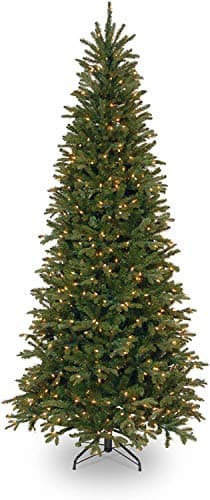
#1 — The highest published tip count on this list
National Tree Company Tiffany Fir slim, 7.5 ft, pre-lit
1,878 tips, 600 clear lights, slim profile
8.5
/ 10
Our top artificial tree on published numbers: the densest tip count here, in a profile that fits real rooms.
Published specifications
- Height
- 7.5 ft
- Branch tips
- 1,878
- Lights
- 600 clear
- Profile
- Slim
- Stand
- Included
- Tips per foot
- 250 (1,878 over 7.5 ft — our arithmetic)
Our scoring
- Published tip count
- 10 / 10
- Density per foot
- 9 / 10
- Light provision
- 6 / 10
- Spec completeness
- 9 / 10
Good
- 1,878 tips on a slim tree is unusually dense; tip count is the single best published proxy for how full a tree looks
- Slim profile fits a corner or a narrow hall without dropping to a pencil tree's sparseness
Watch out
- 600 lights across 7.5 ft is on the low side; plan on adding a string if you want a bright tree
- Pre-lit means the lights and the tree retire together
#ad · Price as of October 19, 2026 · How we are funded
Tip count, light count and height from the National Tree Company Amazon listing (ASIN B005CXFZLY), retrieved 2026-09-04.
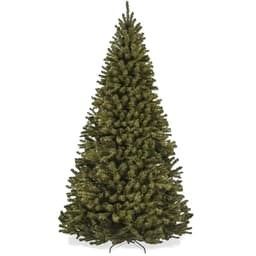
#2 — Anyone who wants to choose their own lights
Best Choice Products unlit spruce, 7.5 ft, 1,346 tips
1,346 tips, unlit
6.8
/ 10
The long-game choice. An unlit tree outlives every pre-lit one on this list, because the failure that kills them cannot happen.
Published specifications
- Height
- 7.5 ft
- Branch tips
- 1,346
- Lights
- None — unlit
- Base
- Metal
Our scoring
- Published tip count
- 9 / 10
- Density per foot
- 7 / 10
- Light provision
- 3 / 10
- Spec completeness
- 8 / 10
Good
- Unlit means a dead light section never retires the whole tree
- You pick the color temperature instead of inheriting it
Watch out
- You are buying and hanging 700-plus lights yourself, which is an hour you did not plan for
Tip count from the Amazon listing (ASIN B01L9X99GC), retrieved 2026-09-04.
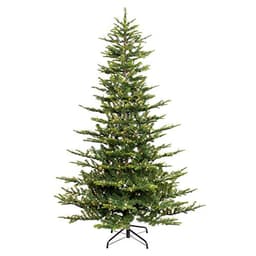
#3 — The best light-to-tip ratio here
Puleo International Aspen Fir, 7.5 ft, pre-lit, 700 lights
1,319 tips, 700 clear lights
8.5
/ 10
Buy this one if you want it bright out of the box. Buy the Tiffany Fir if you want it full and will add your own lights.
Published specifications
- Height
- 7.5 ft
- Branch tips
- 1,319
- Lights
- 700 clear
- Stand
- Sturdy metal, included
- Lights per 100 tips
- 53 (700 / 1,319 — our arithmetic)
Our scoring
- Published tip count
- 9 / 10
- Density per foot
- 7 / 10
- Light provision
- 9 / 10
- Spec completeness
- 9 / 10
Good
- 700 lights is the most on this list, and the lights-per-tip ratio is the highest
- Full profile rather than slim, so it reads as a traditional tree
Watch out
- 1,319 tips is noticeably less dense than the Tiffany Fir at the same height
#ad · Price as of October 19, 2026 · How we are funded
Tip and light counts from the Puleo Amazon listing (ASIN B01N3QFZHR), retrieved 2026-09-04.
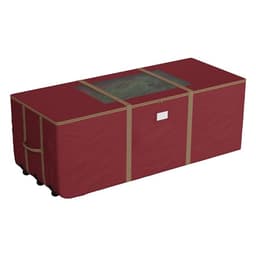
#4 — Anyone who wants the actual dimensions before buying
Elf Stor rolling tree storage bag, up to 12 ft, 67 x 28 x 24 in
67 in x 28 in x 24 in — the only published box dimensions here
9.0
/ 10
Our top tree bag purely because it publishes its dimensions. Every other bag asks you to trust 'fits up to 9 ft'.
Published specifications
- Fits
- Disassembled artificial trees up to 12 ft
- Dimensions
- 67 in x 28 in x 24 in
- Fabric
- 600D Oxford canvas, water resistant, PVC lined
- Mobility
- Three rollerblade-style wheels
- Closure
- Zipper, nylon handles, interior adjustable strap
Our scoring
- Published dimensions
- 10 / 10
- Fabric grade
- 9 / 10
- Mobility
- 9 / 10
- Closure
- 8 / 10
Good
- Published external dimensions, so you can check it against your shelf before it arrives
- 67 inches long takes the longest section of even a 12-foot tree without forcing it
- 24 inches tall is low enough to slide onto a standard garage shelf, which the bag it replaces was not
Watch out
- 67 inches long needs a deep shelf or a clear floor run
- Folds flat when empty, but the wheels stop it stacking under anything
Dimensions and fabric from the Amazon listing (ASIN B078HH3CDL), verified via the Creators API 2026-09-24. Replaces the discontinued Camerons rolling bag (B00O4EWFWY).
Questions
›How long does it take to fluff an artificial Christmas tree?
Allow roughly a minute per hundred branch tips for a first careful pass, so about three hours on a 1,878-tip tree and a little over two on a 1,346-tip one. Later years are roughly half that if the tree is stored fluffed.
›Why does my new artificial tree look flat?
Because it was compressed into a box and every branchlet is in one plane. Fluffing in three planes — up and down, left and right, then forward — is what removes it. A tree above about 175 tips per foot that still shows its pole is under-shaped rather than sparse.
›Should I fluff the tree before or after adding lights?
Before, always. Wrapping lights onto an unshaped tree means redoing both. Once it is full, wrap in vertical sections rather than horizontal rings so a failed string later costs you one panel instead of the whole tree.
Sources
- National Tree Company Tiffany Fir listing (ASIN B005CXFZLY) — 1,878 tips at 7.5 ft
- National Tree Company Dunhill Fir listing (ASIN B00MS7V40S) — 1,600 tips at 7.5 ft
- Best Choice Products unlit spruce listing (ASIN B01L9X99GC) — 1,346 tips at 7.5 ft
- Puleo Aspen Fir listing (ASIN B01N3QFZHR) — 1,319 tips at 7.5 ft
- Shaping-time estimate — our own working figure of roughly one minute per hundred tips, stated as an estimate rather than a measurement
We have not tested these products. Every figure above comes from a published manufacturer specification or from arithmetic shown on this page, and anything a maker does not publish is printed as unavailable rather than estimated. How that works, and what we will not claim, is set out on how we research.