How much garland a staircase, a mantel and a doorway actually take
Measured length is not garland length. Here is the swag allowance, the doorway perimeter formula, and the tip density behind a nine-foot claim.
By Sawyer V. · Published
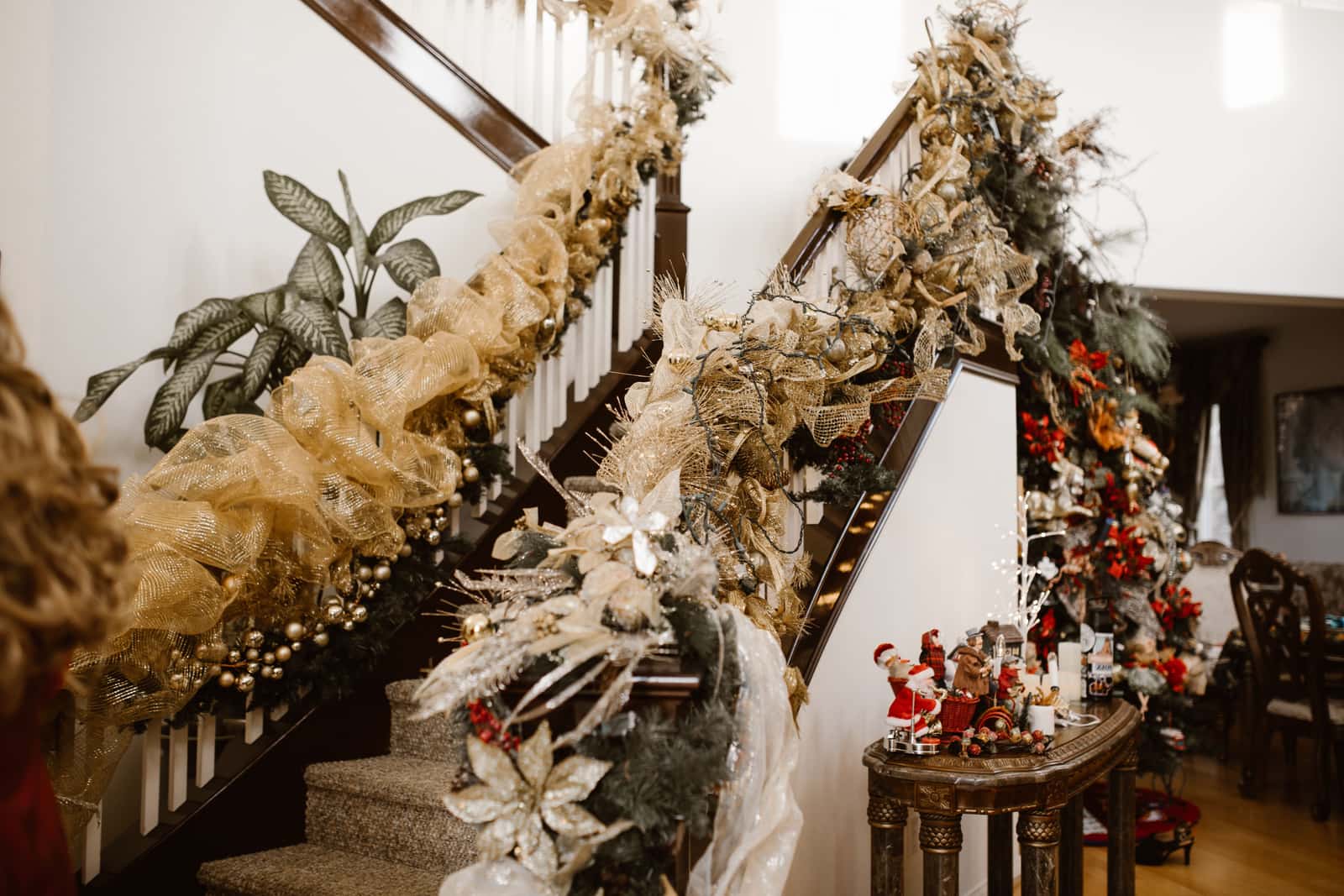
Garland is sold in nine-foot lengths and used in a way that consumes considerably more than nine feet per nine feet of banister. Every draped swag is longer than the straight line it spans, and a doorway is three sides rather than one. Between those two facts is the reason so many staircases end at the second-to-last post.
The arithmetic is short. Below is the method for each of the three places garland actually goes, plus the published tip density that separates a full garland from a wire with foliage on it.
Wreath & Watt earns a commission on qualifying purchases made through the Amazon links on this page. It costs you nothing and it does not change the order of the picks — here is exactly how we are funded.
The swag allowance
A garland run flat along a mantel edge uses roughly its measured length. A garland swagged between fixing points uses more, because each swag is an arc rather than a chord. How much more depends entirely on how deep you want the swags to hang, which is a look decision rather than a measurement.
| Style | Multiplier | 10 ft of rail needs | 20 ft of rail needs |
|---|---|---|---|
| Flat along the rail | 1.0x | 10 ft | 20 ft |
| Shallow swag | 1.2x | 12 ft | 24 ft |
| Standard swag | 1.33x | 13.3 ft | 26.6 ft |
| Deep, heavy swag | 2.0x | 20 ft | 40 ft |
These multipliers are our own convention for translating a look into a length. They are not a manufacturer standard, and a deeper swag than you planned is the usual reason a run comes up short.
Source: Our editorial convention. The measured rail length is yours to supply; the multiplier converts it into garland length.
The arithmetic
- Staircase rail, measured along the slope: 16 ft
- Standard swag at 1.33x: 16 x 1.33 = 21.3 ft of garland
- 21.3 ft / 9 ft per garland = 2.37
- Round up: 3 garlands
A 16 ft banister with normal swags takes three 9 ft garlands, not two. Round up — you cannot buy two-thirds of a garland.
Measure the rail along its slope, not the horizontal distance it covers. A staircase rail is a hypotenuse, and taking the floor-plan measurement is the second most common way to end up short.
A doorway is three sides
Framing a door means going up one side, across the top and down the other. The perimeter is twice the height plus the width, and for a standard opening that comes out well above what most people estimate.
The arithmetic
- Standard door opening: 80 in high, 36 in wide
- Perimeter = (2 x 80) + 36 = 196 in
- 196 / 12 = 16.3 ft
- 16.3 ft / 9 ft per garland = 1.8
- Round up: 2 garlands, flat. With a swag over the top, still 2.
A single standard doorway takes two 9 ft garlands. One is never enough, and that is before any swag.
A mantel is the easy case: measure the shelf, add a foot at each end if you want the garland to fall past the corners, and that is your number. Most mantels are covered by a single nine-foot length, which is why they are the one place a single garland genuinely finishes the job.
What a nine-foot garland actually contains
Length is the headline; tip count is the substance. Only one of the four garlands we can rank publishes a tip count, and the difference that number makes is visible from the other side of the room.
| Garland | Tips | Tips per foot | Power |
|---|---|---|---|
| Pre-lit garland, 100 lights | Not published | Cannot be computed | Battery |
| Pre-lit garland, plug-in | Not published | — | Plug-in |
| Battery garland, 50 LED | Not published | — | Battery, timer |
| Cedar pre-lit garland | Not published | — | Pre-lit |
One published tip count across four garlands is the state of this category. Where the figure is absent we print that rather than estimating from a photograph.
Source: Manufacturer listings on Amazon.com, retrieved 2026-09-04.
Not one garland in this group publishes a tip count any more, including the 100-light pre-lit garland that used to. Density is now a judgment from the photograph, which is exactly the problem this table was built to avoid. Our full ranking, including how the light counts compare, is on the garland page.
Power, and the outlet that is not there
A staircase run usually has an outlet at one end and nothing at the other, which is the constraint that decides which garland to buy. A plug-in garland is the brighter, more reliable choice where a cord can reach. A battery garland with a timer is what goes over a doorway or a window where no cord can — and the timer is what makes batteries workable at all, since it stops the set running through the night for nobody. That comparison is on battery vs plug-in decorations.
If you want a softer texture than stiff pine, the cedar-style garland is the one that reads as foliage rather than as a decoration; it publishes very little beyond its length, which is why it sits where it does in our ranking.
Our picks for this
| # | Product | Best for | Score | Price |
|---|---|---|---|---|
| 1 |  DOIOWN pre-lit garland, 9 ft, 100 LED, battery9 ft, 100 LED, trimmed and battery powered DOIOWN pre-lit garland, 9 ft, 100 LED, battery9 ft, 100 LED, trimmed and battery powered | A mantel or a single stair run | 5.3/ 10 | |
| 2 |  Amaoasis pre-lit garland, 9 ft, 70 lights, plug-in9 ft, 70 lights, plug-in Amaoasis pre-lit garland, 9 ft, 70 lights, plug-in9 ft, 70 lights, plug-in | Runs near an outlet you would rather not keep re-batterying | 5.5/ 10 | $47.99Amazon #ad · Price as of October 20, 2026 · Disclosure |
| 3 |  Pre-lit garland, 9 ft, 50 LED, battery with timer9 ft, 50 LED, battery, timer Pre-lit garland, 9 ft, 50 LED, battery with timer9 ft, 50 LED, battery, timer | Doorways and windows with no outlet | 4.5/ 10 | $42.99Amazon #ad · Price as of October 20, 2026 · Disclosure |
| 4 |  Cedar pre-lit garland, 9 ft9 ft cedar-style foliage Cedar pre-lit garland, 9 ft9 ft cedar-style foliage | A softer cedar texture rather than stiff pine | 3.8/ 10 | $49.98Amazon #ad · Price as of October 20, 2026 · Disclosure |
Scores are our own weighting of published manufacturer specifications, explained in full on how we research. They are not test results. We have not tested these products.
The picks, in detail

#1 — A mantel or a single stair run
DOIOWN pre-lit garland, 9 ft, 100 LED, battery
9 ft, 100 LED, trimmed and battery powered
5.3
/ 10
The trimmed-and-lit pick. It arrives finished, which is most of the appeal; the tip count it no longer publishes is what you give up.
Published specifications
- Length
- 9 ft
- Lights
- 100 LED
- Power
- Battery
- Trim
- Berries, bows, pine cones and flowers
- Use
- Indoor and outdoor, per the listing
- Branch tips
- Not published by the manufacturer
Our scoring
- Published tip count
- 1 / 10
- Density per foot
- 5 / 10
- Light provision
- 9 / 10
- Spec completeness
- 6 / 10
Good
- 100 lights over 9 feet is roughly one every inch of lit length, which is the density that reads as lit rather than dotted
- Trimmed on arrival with berries, bows and cones, so a bare banister needs nothing added
- Battery means no cord down the stairs and no outlet at the mantel
Watch out
- No published tip count, so it cannot be compared on density with the garlands that publish one
- Battery means a cell change partway through December
- Nine feet does one banister run — a full staircase usually needs two or three
Specs from the Amazon listing (ASIN B0DCJZZZWR), verified via the Creators API 2026-10-04. Replaces the discontinued 9 ft / 100 light garland (B09YR6TYH3), whose published 252 branch tips no live garland here carries.

#2 — Runs near an outlet you would rather not keep re-batterying
Amaoasis pre-lit garland, 9 ft, 70 lights, plug-in
9 ft, 70 lights, plug-in
5.5
/ 10
The plug-in alternative. Choose it when a cord can be hidden; choose battery when it cannot.
Published specifications
- Length
- 9 ft
- Lights
- 70, plug-in
- Timer
- Not published by the manufacturer
- Branch tips
- Not published by the manufacturer
Our scoring
- Published tip count
- 2 / 10
- Density per foot
- 6 / 10
- Light provision
- 9 / 10
- Spec completeness
- 5 / 10
Good
- Plug-in means no mid-December battery hunt
- Publishes frosted berries and pinecones as trim, which the battery sets here do not
Watch out
- No tip count published
- A cord has to reach, and mantels rarely have an outlet
#ad · Price as of October 20, 2026 · How we are funded
Features from the Amazon listing (ASIN B0D8791ZGB), retrieved 2026-09-04.

#3 — Doorways and windows with no outlet
Pre-lit garland, 9 ft, 50 LED, battery with timer
9 ft, 50 LED, battery, timer
4.5
/ 10
The cordless option. Accept the lower light density as the price of no cord.
Published specifications
- Length
- 9 ft
- Lights
- 50 LED, battery operated
- Timer
- Yes
- Branch tips
- Not published by the manufacturer
Our scoring
- Published tip count
- 2 / 10
- Density per foot
- 5 / 10
- Light provision
- 6 / 10
- Spec completeness
- 5 / 10
Good
- Battery plus timer is the combination that makes a doorway garland practical
Watch out
- 50 lights over 9 feet is half the density of our top pick
#ad · Price as of October 20, 2026 · How we are funded
Features from the Amazon listing (ASIN B0D87964QG), retrieved 2026-09-04.

#4 — A softer cedar texture rather than stiff pine
Cedar pre-lit garland, 9 ft
9 ft cedar-style foliage
3.8
/ 10
A texture choice, not a spec choice. Nothing about it is published in numbers, so buy it on the photograph.
Published specifications
- Length
- 9 ft
- Foliage
- Faux cedar / pine mix
- Branch tips
- Not published by the manufacturer
- Light count
- Not published by the manufacturer in the listing title
Our scoring
- Published tip count
- 1 / 10
- Density per foot
- 6 / 10
- Light provision
- 5 / 10
- Spec completeness
- 3 / 10
Good
- Cedar foliage drapes more naturally over a mantel edge than stiff pine tips
Watch out
- Neither tip count nor light count is published, so nothing here is comparable
#ad · Price as of October 20, 2026 · How we are funded
Description from the Amazon listing (ASIN B0DHXLXZMN), retrieved 2026-09-04.
Questions
›How many garlands do I need for my staircase?
Measure the rail along its slope, multiply by your swag style — 1.33 times for a standard swag — and divide by nine. A 16-foot rail with standard swags needs 21.3 feet of garland, which is three 9-foot lengths.
›How much garland does a doorway take?
Twice the height plus the width. A standard 80 by 36 inch opening is 196 inches, or 16.3 feet, which is two 9-foot garlands before any swag over the top.
›Why did my garland run out halfway?
Almost always one of two reasons: the rail was measured horizontally rather than along its slope, or the swags were hung deeper than the length allowed for. A deep swag can use twice the measured length.
›Can I mix garlands bought in different years?
You can, but the greens rarely match across production batches and the difference is visible on a single continuous run. If a project needs three, order three together.
Sources
- Pre-lit garland listing (ASIN B0DCJZZZWR) — 9 ft, 100 LED, battery; no tip count published
- Pre-lit plug-in garland with timer listing (ASIN B0D8791ZGB) — 9 ft, 100 lights, timer
- Battery pre-lit garland listing (ASIN B0D87964QG) — 9 ft, 50 LED, battery, timer
- Cedar pre-lit garland listing (ASIN B0DHXLXZMN) — 9 ft cedar-style foliage
- Length arithmetic — Doorway perimeter = 2 x height + width. Swag multipliers are our stated editorial convention.
We have not tested these products. Every figure above comes from a published manufacturer specification or from arithmetic shown on this page, and anything a maker does not publish is printed as unavailable rather than estimated. How that works, and what we will not claim, is set out on how we research.