Making a bow that still looks like a bow in January
Loop count, wired edge and the right length cut before you start. The method is short; the ribbon arithmetic is the part people get wrong.
By Sawyer V. · Published
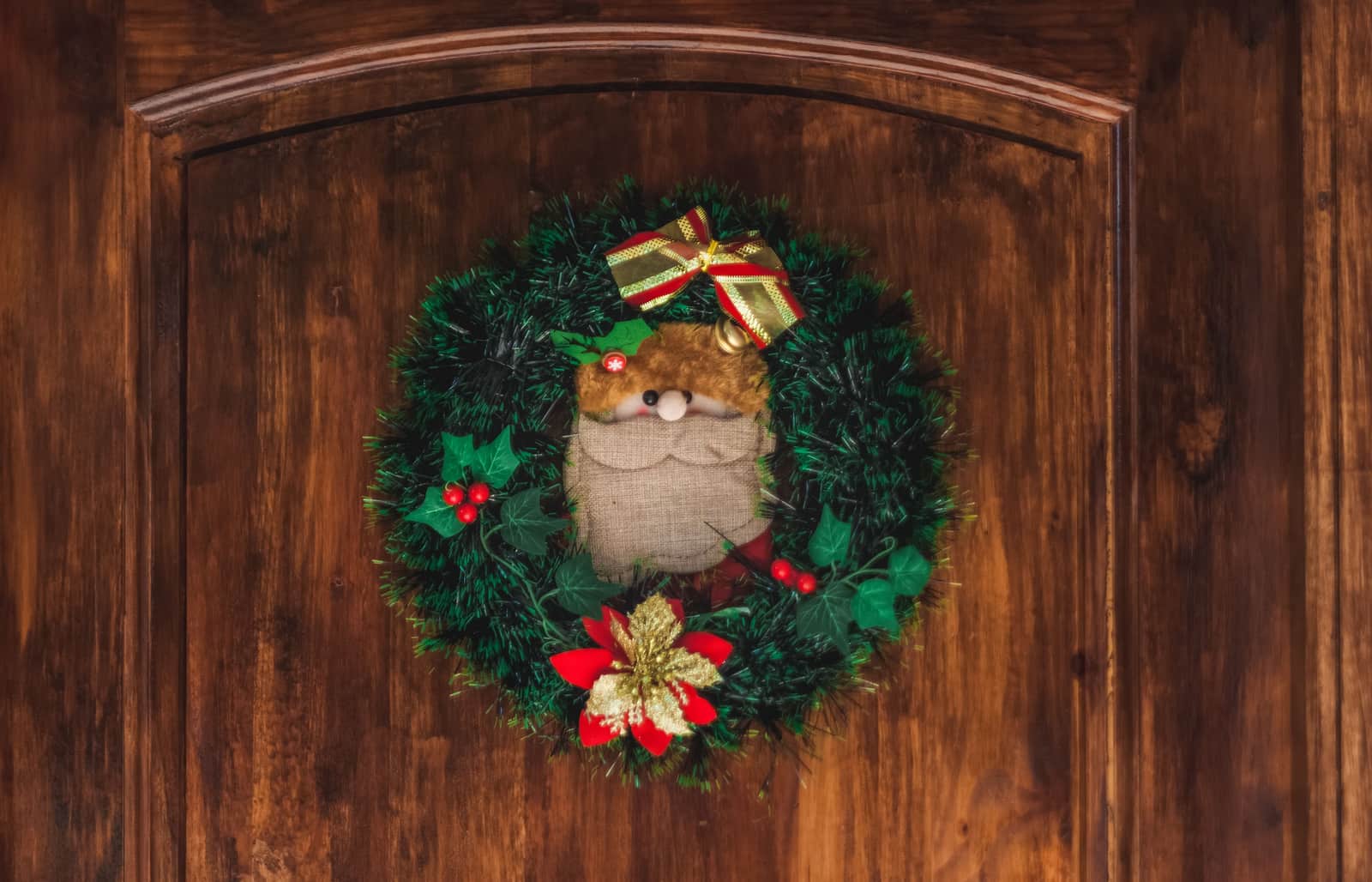
A shop-bought bow costs more than the ribbon it is made of and rarely matches anything else you own. Making one takes about five minutes once you have done it twice, and the only part that needs planning is how much ribbon to cut.
Here is the length arithmetic first, because cutting short is the one mistake that cannot be recovered, and then the loop method.
Wreath & Watt earns a commission on qualifying purchases made through the Amazon links on this page. It costs you nothing and it does not change the order of the picks — here is exactly how we are funded.
How much ribbon each bow takes
| Bow | Loops | Tails | Ribbon needed |
|---|---|---|---|
| Small, for a 12 to 16 in wreath | 4 | 8 to 10 in | About 2 yd |
| Standard, for a 24 in wreath | 6 | 12 to 16 in | About 3.5 yd |
| Large, for a 30 in wreath or a mantel | 8 | 18 to 24 in | About 5 yd |
| Statement, for a door surround | 10 | 24 in plus | About 7 yd |
These are our own working allowances, not a standard. Cut generously — a bow can be trimmed after tying and cannot be extended.
Source: Our editorial guidance on bow proportions. Ribbon dimensions are the manufacturers' published figures.
The arithmetic
- A standard 6-loop bow on 2.5 in ribbon
- Each loop about 5 in across, so about 10 in of ribbon per loop
- 6 loops x 10 in = 60 in
- Plus two tails at 14 in = 28 in, plus 8 in to tie = 96 in
- 96 in / 36 = 2.7 yd, so cut 3.5 yd to be safe
A standard wreath bow takes about three and a half yards. A five-yard roll makes one large bow, which is what the six-roll packs are sized for.
That is why the six-roll pack of five-yard rolls is the bow-maker’s product rather than a run product: one roll is one large bow, and six patterns is six wreaths that do not match each other by accident. The full comparison is on Christmas ribbon and bows.
The loop method, step by step
- Leave a tail, then pinch. Measure your tail length, then pinch the ribbon between finger and thumb. Every loop returns to this pinch.
- Make the first loop and twist at the pinch. The twist keeps the patterned face outward on every loop. Skip it and half the loops show the back.
- Alternate sides. One loop left, one right, the same size each time. Do not build the whole bow on one side and fan it out afterwards.
- Work in pairs. Four, six or eight loops — an even count sits symmetrically. Six is the standard.
- Finish with the second tail, then tie the pinch. Use florist wire or a twist tie through the centre, pulled tight. A ribbon tie at the pinch will loosen.
- Fan and shape. Pull each loop out and up and rotate it so the face is outward. This is where a wired edge earns its money.
- Cut the tails last, on an angle or a V. Cutting before the bow is shaped is how they end up uneven.
Attaching it to the wreath
Use the same wire that tied the pinch. Pass both ends through the wreath frame, twist them together at the back, and trim. Do not use adhesive and do not rely on tucking the bow into the foliage — it will be outdoors and it will move.
Position matters as much as construction. A bow at the bottom of a wreath is traditional and reads as a full circle; a bow at the top reads taller and suits a narrow door. On a dense wreath like the 160-tip Crestwood Spruce the bow has enough foliage to sit into; on a sparse one it floats, and a smaller bow looks better.
Bows that live outside
A bow on an exterior door is exposed all season, and two things go wrong: loops flatten in rain and tails fade in sun. Neither is fixable, so treat an outdoor bow as a one-or-two season item made from a pattern you can buy again.
That argues for the 25-yard single roll if the bow is part of a whole-house scheme: enough length to remake the outdoor bow annually and still run the indoor surfaces from the same pattern. Burlap, like the red and burlap roll, holds up visually but frays at cut ends, so fold and wire the tails rather than leaving them raw.
Reviving a flat bow
A stored bow comes out crushed and recovers better than people expect, because the wire is still in it. Open each loop by hand, pull it out and up, and re-set the twist at the pinch. Five minutes brings back most of it.
What prevents the problem is storing bows so nothing sits on them, which is the same principle as everything else in this collection: the fragile things get the top of the stack. The general method is on a storage system that survives January.
Our picks for this
| # | Product | Best for | Score | Price |
|---|---|---|---|---|
| 1 |  Rinoly wired ribbon, 2.5 in, 6 rolls of 5 yards2.5 in, 6 rolls of 5 yards each Rinoly wired ribbon, 2.5 in, 6 rolls of 5 yards2.5 in, 6 rolls of 5 yards each | Bows rather than continuous runs | 8.3/ 10 | $15.98Amazon #ad · Price as of October 23, 2026 · Disclosure |
| 2 |  GWHOLE wired ribbon, 2.5 in x 25 yards, red and black plaid2.5 in, 25 yards on one roll GWHOLE wired ribbon, 2.5 in x 25 yards, red and black plaid2.5 in, 25 yards on one roll | Long continuous runs in one pattern | 8.0/ 10 | $9.99Amazon #ad · Price as of October 23, 2026 · Disclosure |
| 3 |  Wired ribbon, 2.5 in x 11 yards, red and burlap2.5 in, 11 yards, burlap Wired ribbon, 2.5 in x 11 yards, red and burlap2.5 in, 11 yards, burlap | A natural or farmhouse palette | 7.0/ 10 | $9.99Amazon #ad · Price as of October 23, 2026 · Disclosure |
| 4 |  National Tree Company Crestwood Spruce wreath, 24 in, pre-lit160 tips, 50 warm white LEDs, built-in timer National Tree Company Crestwood Spruce wreath, 24 in, pre-lit160 tips, 50 warm white LEDs, built-in timer | The densest published tip count at 24 in | 8.5/ 10 | $42.95Amazon #ad · Price as of October 23, 2026 · Disclosure |
Scores are our own weighting of published manufacturer specifications, explained in full on how we research. They are not test results. We have not tested these products.
The picks, in detail
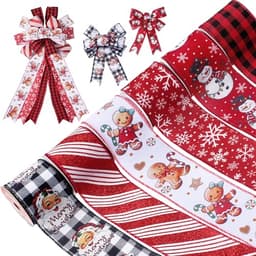
#1 — Bows rather than continuous runs
Rinoly wired ribbon, 2.5 in, 6 rolls of 5 yards
2.5 in, 6 rolls of 5 yards each
8.3
/ 10
The bow-maker's pack. Five yards is a bow, not a run, and this is the only listing honest enough to say so.
Published specifications
- Width
- 2.5 in
- Rolls
- 6
- Length per roll
- 5 yards
- Patterns
- Snowflake, Santa, glitter stripe, buffalo plaid
Our scoring
- Published specs
- 10 / 10
- Length per roll
- 5 / 10
- Pattern range
- 9 / 10
- Wired edge
- 9 / 10
Good
- Publishes per-roll length as well as the total, which is the number that decides whether a run joins
- Five yards is about right for one large bow plus tails
Watch out
- Too short for a staircase run in one piece
- Glitter finishes shed
#ad · Price as of October 23, 2026 · How we are funded
Specs from the Amazon listing (ASIN B0D73H4SXZ), retrieved 2026-09-07.
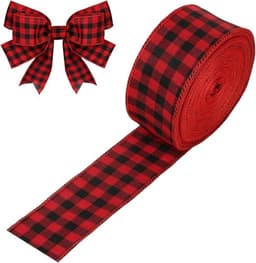
#2 — Long continuous runs in one pattern
GWHOLE wired ribbon, 2.5 in x 25 yards, red and black plaid
2.5 in, 25 yards on one roll
8.0
/ 10
Our pick for anyone doing a staircase. Continuous length is the spec that matters and this publishes the most.
Published specifications
- Width
- 2.5 in
- Length
- 25 yards, single roll
- Edge
- Wired
- Pattern
- Red and black buffalo plaid
Our scoring
- Published specs
- 10 / 10
- Length per roll
- 10 / 10
- Pattern range
- 3 / 10
- Wired edge
- 9 / 10
Good
- The longest continuous length here, so a staircase runs without a join
- One pattern across the whole house is what makes a scheme read as deliberate
Watch out
- One pattern only
- A large roll is awkward to store part-used
#ad · Price as of October 23, 2026 · How we are funded
Specs from the Amazon listing (ASIN B099WT3DYH), retrieved 2026-09-07.
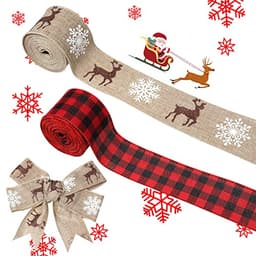
#3 — A natural or farmhouse palette
Wired ribbon, 2.5 in x 11 yards, red and burlap
2.5 in, 11 yards, burlap
7.0
/ 10
The texture option. If the scheme is natural rather than traditional, this is the ribbon for it.
Published specifications
- Width
- 2.5 in
- Length
- 11 yards
- Edge
- Wired
- Material
- Red and burlap
Our scoring
- Published specs
- 10 / 10
- Length per roll
- 7 / 10
- Pattern range
- 3 / 10
- Wired edge
- 8 / 10
Good
- Burlap suits a neutral scheme where plaid reads as too much
- Eleven yards covers a wreath set plus bows
Watch out
- Burlap frays at cut ends more than woven polyester
- One pattern
#ad · Price as of October 23, 2026 · How we are funded
Specs from the Amazon listing (ASIN B0BJYVJTMF), retrieved 2026-09-07.

#4 — The densest published tip count at 24 in
National Tree Company Crestwood Spruce wreath, 24 in, pre-lit
160 tips, 50 warm white LEDs, built-in timer
8.5
/ 10
Our top 24-inch wreath. Dense, warm-white, timed — and then measure it across the berries before you buy the box.
Published specifications
- Diameter
- 24 in
- Branch tips
- 160
- Lights
- 50 warm white LED
- Timer
- Built in
- Trim
- Glitter, pinecones, red berries
- Depth with trim
- Not published by the manufacturer
Our scoring
- Published tip count
- 9 / 10
- Light quality
- 9 / 10
- Convenience
- 9 / 10
- Spec completeness
- 7 / 10
Good
- 160 tips on a 24-inch frame is dense enough that the wire ring does not show
- A built-in timer on a battery wreath is the difference between using it and forgetting it
- Warm white LED reads correctly against a painted door; cool white does not
Watch out
- Trim adds depth that no listing publishes, and that depth is what decides your storage box size
#ad · Price as of October 23, 2026 · How we are funded
Tip count, lighting and timer from the Amazon listing (ASIN B00LKRMNWK), retrieved 2026-09-04.
Questions
›How much ribbon do I need for a wreath bow?
About 3.5 yards for a standard six-loop bow on a 24-inch wreath, and around 5 yards for a large eight-loop one. Cut generously — a bow can be trimmed after tying and cannot be extended.
›Why does my bow go flat?
Either the ribbon is not wired, or the loops were not twisted at the pinch so half are showing the back and collapsing. A wired loop holds the shape you set.
›How many loops should a bow have?
An even number so it sits symmetrically. Four for a small wreath, six for a standard 24-inch one, eight for a large wreath or a mantel.
›Should the bow go at the top or bottom of a wreath?
Bottom reads as a traditional full circle; top reads taller and suits a narrow door. What matters more is that the wreath is dense enough for the bow to sit into rather than float on.
Sources
- Rinoly wired ribbon listing (ASIN B0D73H4SXZ) — 2.5 in, 6 rolls of 5 yards, wired
- GWHOLE wired ribbon listing (ASIN B099WT3DYH) — 2.5 in x 25 yards, single roll
- Red and burlap ribbon listing (ASIN B0BJYVJTMF) — 2.5 in x 11 yards, wired
- National Tree Crestwood Spruce listing (ASIN B00LKRMNWK) — 24 in, 160 tips
- Bow arithmetic — Loops x loop length, plus tails and tie allowance. Our own working figures.
We have not tested these products. Every figure above comes from a published manufacturer specification or from arithmetic shown on this page, and anything a maker does not publish is printed as unavailable rather than estimated. How that works, and what we will not claim, is set out on how we research.