Buying lighting you never take down
A set that stays up is a fixture, not a decoration. Three specifications matter more, one matters less, and the running cost becomes a real number.
By Sawyer V. · Published
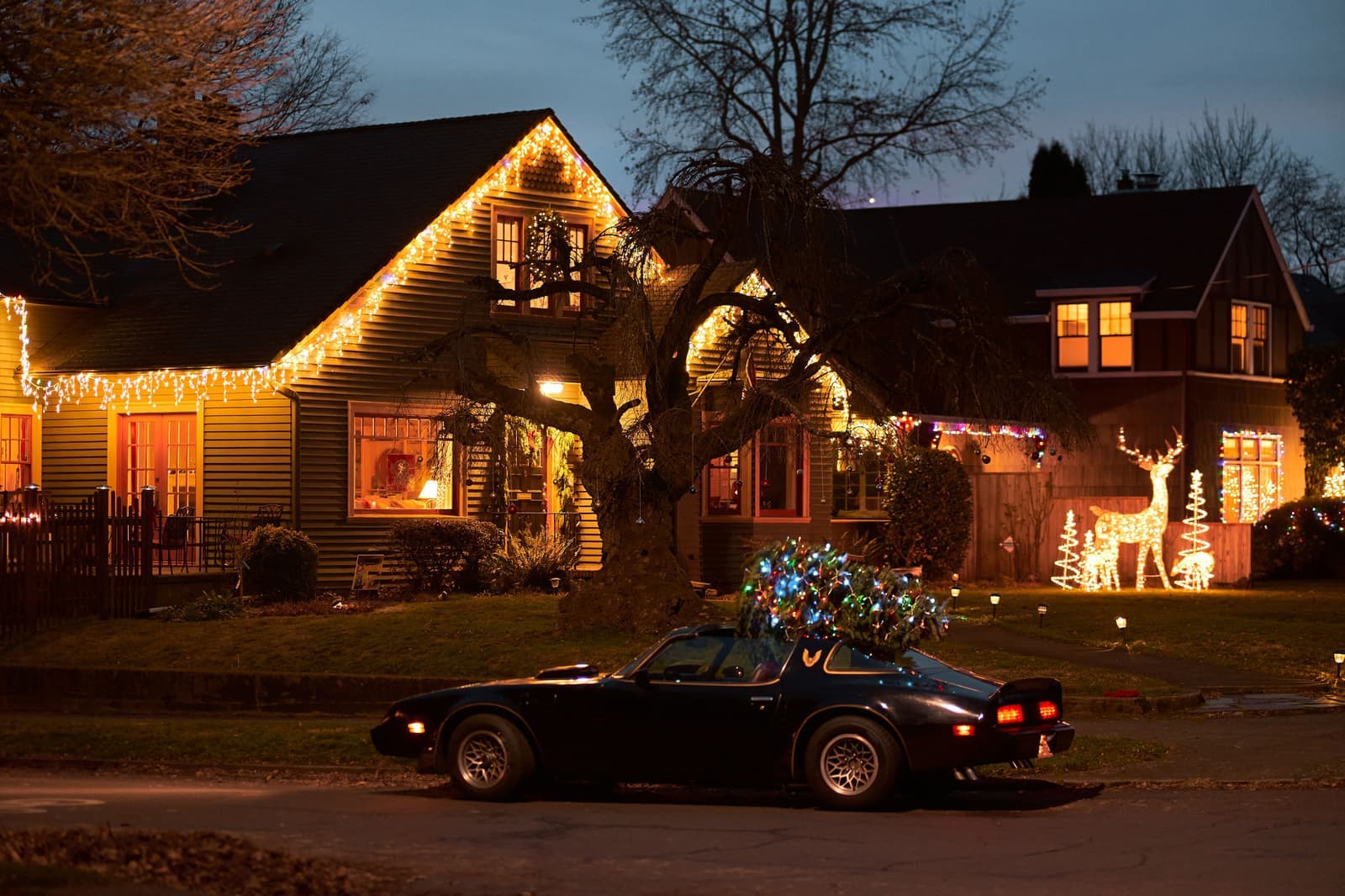
Most outdoor lighting is bought as a decoration: up for six weeks, down in January, stored in a box. A growing amount of it is bought as a fixture instead — installed once and left, doing Christmas in December, a patio in July and a porch light the rest of the time.
That changes which specifications matter. Two become far more important, one stops mattering at all, and a cost that was previously trivial becomes worth calculating.
Wreath & Watt earns a commission on qualifying purchases made through the Amazon links on this page. It costs you nothing and it does not change the order of the picks — here is exactly how we are funded.
Quick picks
| # | Product | Best for | Score | Price |
|---|---|---|---|---|
| 1 |  Govee Permanent Outdoor Lights 2, 50 ft RGBIC50 ft, IP67 Govee Permanent Outdoor Lights 2, 50 ft RGBIC50 ft, IP67 | A porch, a deck edge, or trying the idea before committing | 7.5/ 10 | |
| 2 |  Govee Permanent Outdoor Lights 2, 100 ft RGBIC100 ft, IP67, 100 scene modes Govee Permanent Outdoor Lights 2, 100 ft RGBIC100 ft, IP67, 100 scene modes | A single-story front elevation | 7.5/ 10 | |
| 3 |  Twinkly Festoon, 40 AWW bulbs, 65.6 ft40 tunable-white bulbs over 65.6 ft Twinkly Festoon, 40 AWW bulbs, 65.6 ft40 tunable-white bulbs over 65.6 ft | Patios and pergolas that stay lit past Christmas | 7.8/ 10 | $67.87Amazon #ad · Price as of October 22, 2026 · Disclosure |
| 4 |  Twinkly Strings, 100 RGB LEDs, 8 m, green wire100 mappable RGB LEDs over 8 m Twinkly Strings, 100 RGB LEDs, 8 m, green wire100 mappable RGB LEDs over 8 m | A single indoor tree or a first taste of mapping | 7.0/ 10 | $74.99Amazon #ad · Price as of October 22, 2026 · Disclosure |
| 5 |  BN-LINK outdoor light timer, dusk-to-dawn, dual grounded outlets15 A / 1/2 HP, ETL listed, two grounded outlets BN-LINK outdoor light timer, dusk-to-dawn, dual grounded outlets15 A / 1/2 HP, ETL listed, two grounded outlets | Set it in October, forget it until January | 8.0/ 10 |
Scores are our own weighting of published manufacturer specifications, explained in full on how we research. They are not test results. We have not tested these products.
The picks in full
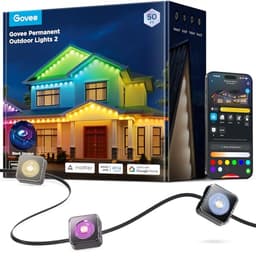
#1 — A porch, a deck edge, or trying the idea before committing
Govee Permanent Outdoor Lights 2, 50 ft RGBIC
50 ft, IP67
7.5
/ 10
The trial size. Fine for a porch; not a roofline solution.
Published specifications
- Length
- 50 ft
- Ingress rating
- IP67
- Modes
- 100 scene modes
- Control
- App, Alexa, Google Assistant
Our scoring
- Published specs
- 7 / 10
- Weather tolerance
- 9 / 10
- Control
- 8 / 10
- Density
- 6 / 10
Good
- Cheapest way to find out whether you actually want permanent lighting
- 50 ft is enough for a porch roof or a deck perimeter
Watch out
- Too short for a roofline — measure first, or you will be buying twice
Specs from the Govee Amazon listing (ASIN B0D14VKJV1), verified via the Creators API 2026-10-07. Replaces B0D14W3213, a variant listing of the same Permanent Outdoor Lights 2 50 ft kit that Amazon now shows as currently unavailable; length, IP67 rating, 100 scene modes and assistant support are unchanged.
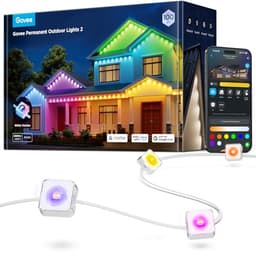
#2 — A single-story front elevation
Govee Permanent Outdoor Lights 2, 100 ft RGBIC
100 ft, IP67, 100 scene modes
7.5
/ 10
The entry point. Buy it if 100 feet covers your front elevation and you can live without Matter.
Published specifications
- Length
- 100 ft
- Ingress rating
- IP67
- Modes
- 100 scene modes, 16 million colors
- Control
- App, Alexa, Google Assistant
- LED count
- Not published by the manufacturer for this SKU in the listing title
Our scoring
- Published specs
- 7 / 10
- Weather tolerance
- 9 / 10
- Control
- 8 / 10
- Density
- 6 / 10
Good
- The cheapest honest entry into permanent lighting with a published IP67 rating
- 100 ft covers most single-story front elevations with slack to spare
Watch out
- The listing title does not state the LED count, so pitch cannot be computed before purchase
- No Matter support on this line
Specs from the Govee Amazon listing (ASIN B0D14WP9TB), retrieved 2026-09-04.
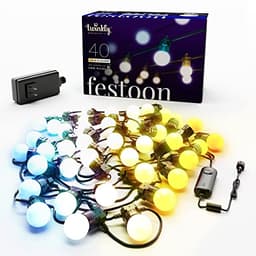
#3 — Patios and pergolas that stay lit past Christmas
Twinkly Festoon, 40 AWW bulbs, 65.6 ft
40 tunable-white bulbs over 65.6 ft
7.8
/ 10
The one set here that has a job in July. Buy it as patio lighting that also does December.
Published specifications
- Bulbs
- 40 AWW (warm to cool white)
- Length
- 65.6 ft
- Spacing
- 19.7 in (65.6 ft over 40 bulbs — our arithmetic)
- Cable
- Black
- Use
- Indoor and outdoor
Our scoring
- Published specs
- 8 / 10
- Weather tolerance
- 7 / 10
- Control
- 9 / 10
- Serviceability
- 7 / 10
Good
- Reads as patio lighting in January rather than as leftover Christmas lights
- Tunable white covers both the party setting and the quiet setting
- 65.6 ft is two spans of a normal pergola, where the 33 ft version did one
Watch out
- 40 bulbs over 66 feet is still a sparse canopy; the spacing is festoon, not fairy
#ad · Price as of October 22, 2026 · How we are funded
Specs from the Twinkly Amazon listing (ASIN B09SHM72JK), verified via the Creators API 2026-10-04. Replaces the discontinued 20-bulb / 32.8 ft Festoon (B09SHKS6Z2); the count and length both double.
#4 — A single indoor tree or a first taste of mapping
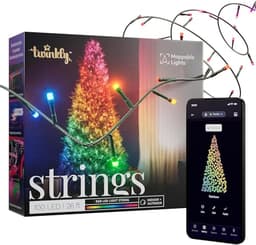
Twinkly Strings, 100 RGB LEDs, 8 m, green wire
100 mappable RGB LEDs over 8 m
7.0
/ 10
The sampler. Fine on a 6-foot tree, immediately too short for anything larger.
Published specifications
- LEDs
- 100 RGB, mappable
- Length
- 8 m (about 26 ft)
- Ingress rating
- IP44
- Voice
- Alexa, Google Assistant
Our scoring
- Published specs
- 8 / 10
- Weather tolerance
- 6 / 10
- Control
- 9 / 10
- Serviceability
- 5 / 10
Good
- The cheapest way to see whether mapping is a gimmick to you or not
Watch out
- 100 LEDs is one small tree, not a room and certainly not a facade
#ad · Price as of October 22, 2026 · How we are funded
Specs from the Twinkly Amazon listing (ASIN B086XJ6TB8), retrieved 2026-09-04.
#5 — Set it in October, forget it until January
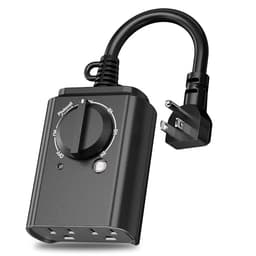
BN-LINK outdoor light timer, dusk-to-dawn, dual grounded outlets
15 A / 1/2 HP, ETL listed, two grounded outlets
8.0
/ 10
The no-fuss choice. If you never want to think about the timer again, buy this one instead of the remote model.
Published specifications
- Rating
- 15 A, 1/2 HP, ETL listed
- Outlets
- Two grounded, weatherproof
- Control
- Dusk-to-dawn photocell
Our scoring
- Published rating
- 9 / 10
- Safety listing
- 9 / 10
- Weather tolerance
- 8 / 10
- Control
- 6 / 10
Good
- Two outlets means the roofline and the yard can share one timer without a splitter
- Photocell only — nothing to reprogram when the clocks change
Watch out
- No remote, so changes mean going outside
Rating and features from the Amazon listing (ASIN B01MAWA81Q), retrieved 2026-09-04.
What changes when it never comes down
| Specification | Seasonal set | Year-round fixture | Why it moves |
|---|---|---|---|
| Ingress rating | Useful | Decisive | It is outside for 52 weeks, not 6 |
| Operating temperature range | Rarely stated | Decisive | It sees the whole year, not one season |
| Control and scheduling | Nice to have | Essential | Nobody adjusts a fixture by hand |
| Packability | Matters | Irrelevant | It is never packed |
| Running cost | Small | Worth calculating | 52 weeks of hours instead of 6 |
The packability row is the one to notice. A great deal of what makes a good seasonal set — coils neatly, stores small, reels well — stops being a benefit entirely.
Source: Our editorial framework. Product-specific figures are the manufacturers' published specifications.
Ingress rating and temperature range
These are the two published specifications that genuinely predict whether a fixture survives, and they are the two most often absent from a listing.
The Govee permanent track line publishes IP67 across both the 50-foot and 100-foot versions — dust-tight and able to survive temporary immersion, which is the specification you want on something fastened under a drip edge permanently. The Pro line goes further and publishes an operating range of −4 F to 140 F, which is a claim about the whole year rather than one season.
Against that, the Twinkly Festoon publishes indoor and outdoor use over 32.8 feet with 20 tunable bulbs, and the 100-LED Twinkly string publishes IP44 — honest, and a meaningfully lower bar. IP44 is rain, not standing water, so a run that pools rather than sheds is the wrong placement for it.
Control stops being a feature and becomes the point
A seasonal set is switched on in November and off in January, so scheduling is a convenience. A fixture that runs all year is switched on and off around seven hundred times, and nobody does that by hand.
App-scheduled track handles this internally — the 100-foot Permanent 2 publishes 100 scene modes and app, Alexa and Google control, which folds the timer job into the light itself. For a plain festoon run, an external dusk-to-dawn timer at a published 15 A / 1/2 HP with an ETL listing does the same job for the whole circuit, and the photocell means it follows the season rather than needing to be reset as the evenings move. The ranking is on outdoor light timers.
The running cost becomes worth calculating
Six weeks of an LED display is a rounding error. Fifty-two weeks is not necessarily, and it is one line of arithmetic to check rather than assume.
The arithmetic
- Cost = (watts x hours / 1,000) x rate per kWh
- A 60 W run, 5 hours a night, 365 nights
- 60 x 5 x 365 = 109,500 Wh = 109.5 kWh a year
- At $0.20 per kWh: 109.5 x 0.20 = $21.90 a year
- The same run for a 40-night season: 12 kWh, about $2.40
Year-round use is roughly nine times the energy of a seasonal display for the same hardware. Still modest — but worth knowing rather than assuming.
Substitute your own rate; it is the input that varies most and it is printed on your bill. The full treatment, including what scheduling does to the number, is on what Christmas lights cost to run.
What actually ends a year-round fixture
Not the LEDs. A published 50,000-hour rating divided by year-round use at five hours a night is over twenty-seven years, so the rated life is not the binding constraint. What ends these is the controller, or the app that drives it, or water finding a way into a junction that was never meant to be underwater.
No manufacturer publishes an app-support window, so we print none — but it is a real end-of-life mechanism that a plain string of lights simply does not have, and it is worth weighing against the convenience. The full argument is on how long Christmas lights last.
Which to buy, by what you actually want
- A roofline you never want to climb to again — permanent track, and the cost-per-foot comparison including the dealer-installed option we earn nothing from is on permanent Christmas lights.
- A patio or pergola you use most of the year — festoon, hung properly, and the method is on how to hang patio string lights.
- A short run to try the idea — the 50-foot track is the low-commitment version of the same specification.
- Colour you will actually change — a mappable string, with the IP44 caveat about placement respected.
Whatever you choose, it is a fixture rather than a decoration, so buy it for the fifty-two weeks rather than the six. The seasonal patio ranking is on patio string lights.
Questions
›Can outdoor string lights be left up all year?
Yes, if the published ingress rating suits the placement. IP67 is dust-tight and survives temporary immersion, which suits track fastened under a drip edge; IP44 covers rain but not standing water and belongs where water runs off.
›What does IP67 mean on outdoor lighting?
The first digit is dust ingress and the second is water. A 6 means fully dust-tight and a 7 means the unit survives temporary immersion in water. It is a published, testable standard rather than a marketing phrase.
›How much does it cost to run outdoor lights all year?
Multiply watts by hours, divide by 1,000, and multiply by your rate. A 60 W run at five hours a night for a year is 109.5 kWh — about nine times the energy of the same hardware over a 40-night season. Substitute your own rate from your bill.
›What ends a permanent lighting system?
Rarely the LEDs. A 50,000-hour rating at five hours a night is over twenty-seven years. What ends these is the controller, the app support behind it, or water reaching a junction — and no manufacturer publishes a support window.
Sources
- Govee Permanent Outdoor Lights 2, 50 ft listing (ASIN B0D14VKJV1) — 50 ft, IP67, 100 scene modes
- Govee Permanent Outdoor Lights 2, 100 ft listing (ASIN B0D14WP9TB) — 100 ft, IP67, app and voice control
- Twinkly Festoon listing (ASIN B09SHM72JK) — 40 AWW bulbs, 65.6 ft, indoor and outdoor
- Twinkly Strings 100 RGB listing (ASIN B086XJ6TB8) — 100 mappable LEDs, 8 m, IP44
- BN-LINK dusk-to-dawn timer listing (ASIN B01MAWA81Q) — 15 A / 1/2 HP, ETL listed
- Energy arithmetic — kWh = watts x hours / 1,000. The rate is the reader's own input and no national average is quoted.
We have not tested these products. Every figure above comes from a published manufacturer specification or from arithmetic shown on this page, and anything a maker does not publish is printed as unavailable rather than estimated. How that works, and what we will not claim, is set out on how we research.