Christmas light projectors, ranked on the rating that decides survival
IP65 or better, or nothing stated. Rotation angle, timer settings and whether the effect can be dimmed. Five picks, and one you should skip outdoors.
By Sawyer V. · Published
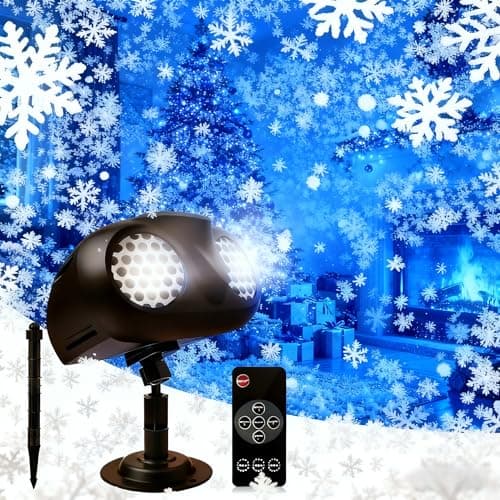
A projector is the only Christmas lighting product that decorates a surface without anything being attached to it. No clips, no ladder, no fastening — a stake in the lawn and a wall to aim at. That makes it the obvious answer for a rented house, a high gable, or a first display.
It also makes the weather rating the whole specification, because the unit itself sits outdoors, at ground level, in a flowerbed, through December. We have not tested any of these. Every figure below is a specification the listing publishes or arithmetic printed on this page.
Wreath & Watt earns a commission on qualifying purchases made through the Amazon links on this page. It costs you nothing and it does not change the order of the picks — here is exactly how we are funded.
Quick picks
| # | Product | Best for | Score | Price |
|---|---|---|---|---|
| 1 |  Dual-head dynamic snowflake projector, IP65, RF remote and timerDual head, IP65, 360-degree rotation Dual-head dynamic snowflake projector, IP65, RF remote and timerDual head, IP65, 360-degree rotation | Covering two surfaces from one stake | 9.5/ 10 | $25.99Amazon #ad · Price as of October 23, 2026 · Disclosure |
| 2 |  Triple-head snowflake projector with timer, waterproofThree heads, timer, waterproof Triple-head snowflake projector with timer, waterproofThree heads, timer, waterproof | The most heads on one stake | 4.3/ 10 | $39.99Amazon #ad · Price as of October 23, 2026 · Disclosure |
| 3 |  Borelor snowfall LED projector, IP65, RF remote and timerMini body, IP65, RF remote with speed control Borelor snowfall LED projector, IP65, RF remote and timerMini body, IP65, RF remote with speed control | A small frontage, or a first projector | 7.8/ 10 | $25.99Amazon #ad · Price as of October 23, 2026 · Disclosure |
| 4 |  ZHENGXOO dual-head snowflake projector, IP65, 180-degree rotationDual head, IP65, 180-degree rotation ZHENGXOO dual-head snowflake projector, IP65, 180-degree rotationDual head, IP65, 180-degree rotation | Two heads on a narrower frontage | 7.3/ 10 | $47.99Amazon #ad · Price as of October 23, 2026 · Disclosure |
| 5 |  Christmas snowfall projector, snow-spots effect, with remoteRotating snow-spots effect, remote controlSkip this Christmas snowfall projector, snow-spots effect, with remoteRotating snow-spots effect, remote controlSkip this | A plain white effect over an existing colored display | 4.8/ 10 | $25.99Amazon #ad · Price as of October 23, 2026 · Disclosure |
Scores are our own weighting of published manufacturer specifications, explained in full on how we research. They are not test results. We have not tested these products.
The picks in full
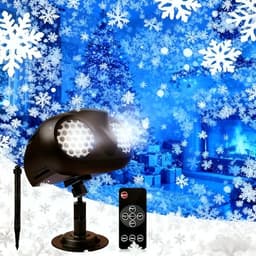
#1 — Covering two surfaces from one stake
Dual-head dynamic snowflake projector, IP65, RF remote and timer
Dual head, IP65, 360-degree rotation
9.5
/ 10
The projector to buy if you only buy one. It publishes every figure that matters and covers a second surface without a second purchase.
Published specifications
- Heads
- 2
- Ingress rating
- IP65
- Rotation
- 360 degrees
- Control
- RF remote and timer
- Timer settings
- 2, 4 or 6 hours
- Operating range
- -20 C to 50 C
- Light angle
- 165 degrees
- Coverage
- 15 to 54 square meters
Our scoring
- Published specs
- 10 / 10
- Weather tolerance
- 9 / 10
- Control
- 9 / 10
- Coverage
- 10 / 10
Good
- The most completely specified unit here: rating, rotation, timer settings, temperature range and a coverage figure
- Two heads cover two surfaces from one stake and one plug
- IP65 plus a published operating range is the combination that predicts surviving a season outdoors
Watch out
- Two heads is two aiming decisions rather than one
- IP65 is dust-tight and jet-resistant, not an immersion rating — it still should not sit in a puddle
#ad · Price as of October 23, 2026 · How we are funded
Specs from the Amazon listing (ASIN B0B672ST1V), verified 2026-09-08.
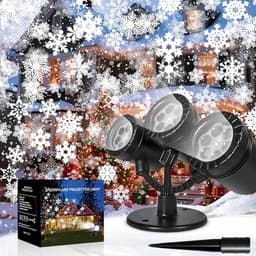
#2 — The most heads on one stake
Triple-head snowflake projector with timer, waterproof
Three heads, timer, waterproof
4.3
/ 10
Buy it for coverage and nothing else. Three heads from one stake is a real advantage on a wide front; everything you would want to know about weather sealing and control is missing from the listing.
Published specifications
- Heads
- 3
- Timer
- Yes; duration not stated
- Weather
- Waterproof, per the listing; no IP figure
- Light source
- LED
- Placement stated
- Outdoor, yard, holiday party
- Ingress rating
- Not stated in the listing
- Rotation
- Not stated in the listing
- Brightness levels
- Not stated in the listing
- Remote
- Not stated in the listing
Our scoring
- Published specs
- 2 / 10
- Weather tolerance
- 2 / 10
- Control
- 3 / 10
- Coverage
- 10 / 10
Good
- Three heads is one more than anything else on this page, and head count is the figure that decides how many surfaces one stake can cover
- A timer is published, which on a projector left out all December is the control that matters most
- The widest coverage per stake here, which is the argument for putting one unit on a wide frontage rather than two units at the ends
Watch out
- Publishes no ingress rating at all, where three of the five units on this page publish IP65 — waterproof without a figure is a word
- No rotation angle published, so how far the heads sweep is unknown
- No remote and no brightness control published, so this is an on-or-off unit at the socket
- No timer duration published either, so the one control it does name is unquantified
#ad · Price as of October 23, 2026 · How we are funded
Specs from the Amazon listing (ASIN B0FDQC8CGK), verified via the Creators API 2026-10-21. Replaces the Anoak B0H942FQS2, which went Currently unavailable — the second death in this slot after B0DD6Y1JC1. The slot's premise was the DIMMER, and no live candidate honestly fits it: the only listing still publishing a dimmer at a 270-degree sweep (B0D9VXSKDP) showed one unit left in stock, which would have put this page straight back in the dead-link queue. The slot has therefore been re-cut from control to COVERAGE, which is the one thing this replacement genuinely leads on. The IP68 rating, the 270-degree rotation, the four brightness levels, the three projection modes, the four speed settings, the 32.8 ft remote and the 2/4/6/8 h timer all belonged to the dead listing and have been withdrawn rather than carried over.
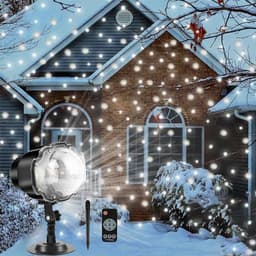
#3 — A small frontage, or a first projector
Borelor snowfall LED projector, IP65, RF remote and timer
Mini body, IP65, RF remote with speed control
7.8
/ 10
The sensible small-frontage pick. It publishes what the remote does, which matters more day to day than an extra ten degrees of rotation.
Published specifications
- Ingress rating
- IP65
- Form
- Mini
- Control
- RF remote and timer
- Timer settings
- 2, 4 or 6 hours
- Remote functions
- On/off, flash speed, motor speed, timer
- Rotation
- Not stated in the listing
Our scoring
- Published specs
- 8 / 10
- Weather tolerance
- 9 / 10
- Control
- 9 / 10
- Coverage
- 5 / 10
Good
- A published remote function list, so you know what can actually be adjusted before buying
- Motor-speed control separate from flash speed is genuinely useful and rarely stated
- A mini body is easier to hide in planting than a full-size unit
Watch out
- No published rotation angle, so coverage cannot be compared directly
- A smaller unit throws a smaller image, which is the trade for the size
#ad · Price as of October 23, 2026 · How we are funded
Specs from the Amazon listing (ASIN B07H8CFG21), verified 2026-09-08.
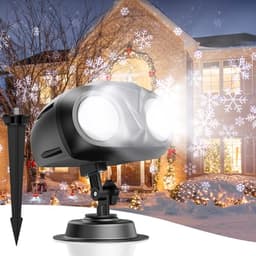
#4 — Two heads on a narrower frontage
ZHENGXOO dual-head snowflake projector, IP65, 180-degree rotation
Dual head, IP65, 180-degree rotation
7.3
/ 10
A dual-head unit at a narrower sweep. Fine where the two target surfaces are close together, and the wrong choice where they are not.
Published specifications
- Heads
- 2
- Ingress rating
- IP65
- Rotation
- 180 degrees
- Projection patterns
- 3 snowflake forms
- Mounting
- Wall, ground, or lawn stake — 3 methods, screws included
- Placement
- Indoor, patio, wall, window
- Warranty
- 12 months
- Timer settings
- Not stated in the listing
Our scoring
- Published specs
- 8 / 10
- Weather tolerance
- 9 / 10
- Control
- 5 / 10
- Coverage
- 7 / 10
Good
- A second dual-head option, so two surfaces can be covered from one stake
- IP65 published, which is the rating to insist on for a ground-level unit
- Three mounting methods published — wall, ground or lawn stake, screws in the box
Watch out
- 180 degrees is the narrowest published rotation here, so placement is less forgiving
- No published timer settings, which means it may need to sit on an external timer
#ad · Price as of October 23, 2026 · How we are funded
Specs from the Amazon listing (ASIN B0DFH7TB7F), verified via the Creators API 2026-10-06. Replaces the SATXTREM B0D7MB49QM, which Amazon now shows as currently unavailable; this listing publishes the same dual head, IP65 rating and 180-degree rotation, plus three mounting methods and three projection patterns.
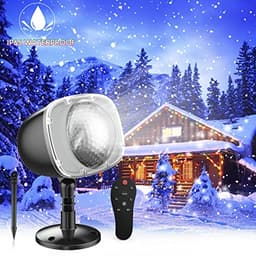
#5 — skip this
Christmas snowfall projector, snow-spots effect, with remote
Rotating snow-spots effect, remote control
4.8
/ 10
Skip this here. Not for an exposed position. It is the only unit here with no published ingress rating and no published timer, on a product that sits at ground level for six weeks — put it in a window or under cover instead.
The restrained effect and the thinnest specification. Buy it for the look, and put it somewhere sheltered.
Published specifications
- Effect
- Rotating snow spots
- Control
- Remote
- Placement
- Indoor and outdoor
- Ingress rating
- Not stated in the listing
- Timer settings
- Not stated in the listing
Our scoring
- Published specs
- 3 / 10
- Weather tolerance
- 4 / 10
- Control
- 6 / 10
- Coverage
- 6 / 10
Good
- A plain white snow-spot effect layers over an existing warm-white display without fighting it
- Published for indoor as well as outdoor use, so it can move to a window
Watch out
- No published ingress rating, on a product intended to sit outdoors for six weeks
- No published timer, so it needs an external one to run on a schedule
#ad · Price as of October 23, 2026 · How we are funded
Specs from the Amazon listing (ASIN B07HP54YNF), verified 2026-09-08.
How we ranked these
Four criteria, applied to every unit, and they are the same four the scoring columns show:
- Published specs. How much the seller tells you before you buy. In a category where an ingress rating is optional, publishing one is a real signal.
- Weather tolerance. A published IP rating, and better still a published operating temperature range. “Waterproof” in a title counts for nothing.
- Control. Timer settings, speed settings, and whether the effect can be dimmed. A projector at ground level is the least convenient thing in a display to reach.
- Coverage. Head count and rotation angle, which together decide how much of a frontage one unit can serve.
| Projector | Ingress rating | Heads | Rotation | Timer |
|---|---|---|---|---|
| Dual-head snowflake | IP65 | 2 | 360 deg | 2 / 4 / 6 h |
| Triple head | Not stated | 3 | Not stated | Yes; duration not stated |
| Borelor mini | IP65 | Not stated | Not stated | 2 / 4 / 6 h |
| ZHENGXOO dual-head | IP65 | 2 | 180 deg | Not stated |
| Snow-spots projector | Not stated | Not stated | Rotating | Not stated |
Three of the five publish an ingress rating, all at IP65. Of the two that do not, one still publishes a timer and the other publishes neither a rating nor a timer — which is why that one is our skip for an exposed position rather than a mid-table entry.
Source: Manufacturer listings on Amazon.com, verified 2026-09-08.
The dual-head unit takes the top spot on a straightforward argument: it publishes more than anything else here — IP65, a 360-degree sweep, timer settings, an operating range of −20 C to 50 C, a 165-degree light angle and a coverage figure — and two heads cover two surfaces from one stake and one plug. On a house with a garage door and a gable, that is a second projector you do not have to buy.
What IP65 actually means, and why it is the whole spec
The first digit is dust ingress and the second is water. A 6 means fully dust-tight; a 5 means protected against water jets from any direction. That is the correct rating for a powered device sitting in a flowerbed being rained on for six weeks.
It is not an immersion rating. IP65 does not mean the unit can stand in a puddle, and the low spot in a lawn is where water collects when the ground freezes and thaws. Site it on higher ground, or on a paver, and the rating does the rest.
Placement, and the trade you cannot buy your way out of
Coverage depends on throw distance, and none of these publishes a throw ratio — so we will not print one. What can be stated is the relationship, and it is the thing that decides where the stake goes.
The arithmetic
- Moving a projector back increases the projected area
- The same light is spread over that larger area, so it is dimmer
- Moving it closer concentrates the effect and shrinks the coverage
- Neither direction is fixed by buying a brighter unit
Placement is a brightness-versus-coverage trade. Expect to move the stake two or three times on the first evening.
The one published coverage figure here is on the top pick: 15 to 54 square meters, at a 165-degree light angle. That range is wide because it is the same unit at different distances — which is exactly the trade above, stated by the manufacturer.
There is a second way to put falling snow on a house, and it does not involve a throw distance at all: cascading tubes hung from the gutter, where the movement is inside the tube rather than projected onto the wall. It covers far less area per plug and it does not care how dark the street is or what the siding is made of. The tube format is ranked on meteor shower lights.
Rotation angle is a placement constraint, not a feature
It is easy to read 360 against 180 degrees as more-is-better. What it actually decides is how forgiving the stake position is.
A 360-degree unit can be dropped anywhere and aimed afterwards. The ZHENGXOO dual-head at 180 degrees has to be positioned so that both its target surfaces fall inside a half-circle — fine where a wall and a garage door are adjacent, and a problem where they are on opposite sides of a drive. The triple-head unit publishes no rotation figure at all, so plan its placement on the three fixed heads rather than on a sweep.
Work out where the stake can physically go before choosing the sweep, not afterwards. If the only power is at one corner of the house, that decides it.
Control is what makes the difference in week three
Every unit here has a remote, because a projector at ground level is the least convenient thing in a display to reach. The differences are in what the remote actually does.
Brightness control is the one thing none of them currently offers. A dimmable snowflake projector is a real product — this page ranked one until October 2026 — but no listing in this field publishes a dimmer today. On a small frontage a fast, full-brightness snowfall is overwhelming, and without a dimmer the fix is placement rather than settings: move the stake further back, aim at a darker surface, or pick a unit whose motor speed can be slowed.
The Borelor mini publishes its remote function list outright — on/off, flash speed, motor speed, timer — which is rare and genuinely useful, because motor speed and flash speed being separate controls is the difference between adjusting the snowfall and adjusting the sparkle.
Which surfaces actually take a projection
The projector is only half the decision; the wall is the other half, and no amount of specification fixes a bad surface.
| Surface | How it takes an image | Verdict |
|---|---|---|
| Pale render or painted board | Flat and reflective | The best target there is |
| A light garage door | Large, flat, close to a lawn | The classic target, and usually the biggest surface |
| Pale brick | Texture breaks the image slightly | Works, with some loss of definition |
| Trees and hedges | Broken surface suits moving points of light | Surprisingly good for snowfall |
| Dark cladding or stone | Absorbs most of the light | Aim somewhere else instead |
Aim at the palest flat surface you have. Buying a brighter unit does not compensate for a dark or heavily textured wall.
Source: Our editorial assessment of surface suitability. No product figures are claimed in this table.
These are not the same as Halloween projectors
Worth stating plainly, because the two categories look identical in a listing photograph and are completely different products.
A Halloween projector is a video projector: it plays pre-loaded effect files onto a screen or a window, and the content library is most of what you are buying. A snowfall projector is an optical unit — a fixed pattern, a motor, and a lens. There is no content, no file to choose, and nothing to update. It does one thing indefinitely.
That makes them cheaper, simpler and far more weather-tolerant, and it also means they cannot do a face at a window. If you want projected characters rather than projected weather, the video units are on Halloween projectors and the setup geometry is on window projection setup.
What projection replaces, and what it does not
It replaces the effort of lighting a large blank surface, and nothing else. A projector does not outline a roofline, does not light a path, and produces nothing at all in daylight. A display built only from projection is a dark house with a moving wall.
Used as one layer among several it is excellent, and it is the cheapest way to add motion to a display. Strings do the architecture — the ranked sets are on the best outdoor Christmas lights — and projection fills the walls between them. Where the frontage is tall rather than wide, the reach question changes the answer again, and that is on lighting a two-story house.
Power, and keeping the connection out of the wet
A projector is a low draw compared with anything else in a display, so the circuit is rarely the constraint — the arithmetic is on how many amps Christmas lights use. What matters is the connection.
The unit sits at ground level, which is exactly where water collects, so the cord joint wants a drip loop and should not lie in grass. Use an outdoor-rated cord for the whole run rather than an indoor cord for the last few feet — the gauge comparison is on extension cords by gauge, and the rest of the outdoor practices are on outdoor Christmas light safety.
Choosing, in one pass
- Two surfaces to cover, one power point. The dual-head 360-degree unit.
- Three surfaces, or a wide front from one power point. The triple-head unit, which is the only one here with more than two heads.
- One wall, and you want the remote to actually do something. The Borelor mini, which publishes its function list.
- Two adjacent surfaces on a narrow frontage. The 180-degree dual-head.
- A window, or somewhere sheltered. The snow-spots unit — and not outdoors in an exposed position, because it publishes no rating.
Questions
›What IP rating should an outdoor Christmas projector have?
IP65 is the one to insist on: fully dust-tight and protected against water jets, which is what a unit sitting in a flowerbed through December is exposed to. It is not an immersion rating, so keep it out of the low spot in the lawn. Several listings in this category publish no rating at all.
›Why is my Christmas projector image so dim?
Usually ambient light, and usually your own porch or security light falling on the same surface. Otherwise it is placement: moving the unit back spreads the same light over a larger area, which is dimmer by definition. A darker or more textured wall also absorbs much of it.
›Is a snowfall projector the same as a Halloween projector?
No. A Halloween projector is a video unit that plays pre-loaded effect files, and the content library is most of what you are buying. A snowfall projector is optical — a fixed pattern, a motor and a lens — with no content to choose and nothing to update. It is simpler, more weather-tolerant, and cannot project characters.
›Do I need a projector with a timer built in?
Not if the rest of your display is already on an outdoor timer — the projector just joins it. A built-in timer is worth having when the projector is on a different circuit from everything else, or when you want it running a shorter window than the roofline.
›Can one projector cover the whole front of a house?
One head covers one surface. A dual-head unit covers two from a single stake and plug, which on a house with a garage door and a gable saves buying a second projector. Rotation angle then decides how far apart those two surfaces can be.
Sources
- Dual-head snowflake projector listing (ASIN B0B672ST1V) — IP65, dual head, 360-degree rotation, RF remote, 2/4/6 h timer, -20 C to 50 C, 165-degree light angle, 15-54 sq m coverage
- Triple-head snowflake projector listing (ASIN B0FDQC8CGK) — Three heads, timer with no stated duration, waterproof with no IP figure, LED; no ingress rating, rotation angle, remote or brightness control published
- Borelor snowfall projector listing (ASIN B07H8CFG21) — IP65, mini, RF remote with on/off, flash speed, motor speed and timer, 2/4/6 h
- ZHENGXOO dual-head projector listing (ASIN B0DFH7TB7F) — IP65, dual head, 180-degree rotation, 3 snowflake projection forms, 3 mounting methods with screws, 12-month warranty, indoor and patio placement
- Snow-spots snowfall projector listing (ASIN B07HP54YNF) — rotating snow-spots effect, remote, indoor and outdoor; no ingress rating or timer published
- Throw ratios and lumen figures — Not published by any listing in this category; no coverage or brightness figure is estimated here
- Availability — All five listings verified live on Amazon.com on 2026-09-08. The Creators API is unavailable on this build, so ASINs were confirmed by search rather than resolved through the catalog API.
We have not tested these products. Every figure above comes from a published manufacturer specification or from arithmetic shown on this page, and anything a maker does not publish is printed as unavailable rather than estimated. How that works, and what we will not claim, is set out on how we research.