Anchoring an inflatable so it is still standing in the morning
Stakes are the part everyone under-does. The siting decision, the tether pattern, and what to do where there is no ground.
By Sawyer V. · Published
An inflatable that ends up flat across a neighbour’s lawn did not fail because it was cheap. It failed because it was staked at four points on soft ground, in a position that funnelled wind, with the tethers left slack.
All three are decisions rather than accidents. What follows is the siting rule, the anchoring pattern, and the honest answer for a frontage with no ground to stake into.
Wreath & Watt earns a commission on qualifying purchases made through the Amazon links on this page. It costs you nothing and it does not change the order of the picks — here is exactly how we are funded.
Site it before you anchor it
The biggest factor is where the piece stands, decided before any stake goes in. A large inflatable is a sail: the flatter and more exposed the position, the more load the anchors carry.
| Position | Wind exposure | Anchoring | Notes |
|---|---|---|---|
| Against a house wall, out of the wind | Low | Standard stakes plus two tethers | The default, and the easiest |
| Beside a hedge or fence | Low to moderate | Standard stakes, tethers to the fence | The fence takes some of the load |
| Open lawn, centre of the frontage | High | Every stake and tether, tensioned | The position everybody wants |
| Between two buildings or a driveway gap | Highest | Reconsider the position | Gaps accelerate wind rather than block it |
The last row catches people out. A gap between two solid objects is not shelter — it is the windiest part of the frontage.
Source: Our own siting guidance. No manufacturer in this category publishes a wind rating.
The pattern that actually holds
Manufacturers supply stakes and tethers, and most people use about half of them. The pattern below is our working method; it costs ten minutes once.
- Use every stake in the bag. The supplied count is the minimum, and the base ring is designed around all of them.
- Drive stakes at an angle, leaning away from the figure. A vertical stake pulls straight out; an angled one has to lift a wedge of soil first.
- Tension the tethers, do not just attach them. A slack tether does nothing until the figure has already moved, and by then it is a shock load.
- Tether in opposing pairs. Three tethers on the windward side and none on the other simply pulls the figure over the other way.
- Re-check after the first windy night. Soaked soil holds a stake very differently from dry soil.
The arithmetic
- Supplied anchoring on a typical 8 ft figure: stakes plus guy tethers
- Using half of them halves the anchor points, not the load
- Load per remaining anchor therefore doubles
- The failure is always at the point carrying the most
Using half the stakes does not halve the risk. It doubles the load on each one that is in the ground.
When there is no ground to stake into
Concrete, decking, a paved drive and a balcony share the same problem, and sandbags alone are usually not the answer people hope for. The honest options, in order:
Tether to something structural. A railing, a post, a porch frame. The only approach that genuinely resists an upward pull.
Move to a position with soil. A planter, a border, the lawn edge. Two feet of relocation often solves the whole problem.
Choose a different format. A roof-published piece like the GUDELAK climbing Santa is a different proposition again, and one where the fixing question is about your roof rather than about the product.
Power, and keeping the cord out of the way
A blower runs continuously, so the cord to it is live for the whole display period and usually crosses ground people walk on. Run one rated cord out and distribute there rather than chaining cords across a lawn: a 50 ft 14 AWG outdoor cord publishes 15 A / 1875 W with an ETL listing, and a six-outlet ETL-listed stake lifts the distribution point out of the wet grass.
Put the whole thing on a schedule while you are there. The load arithmetic for a yard full of blowers is on powering a yard display, and it applies identically in December.
The January half of the job
How an inflatable comes down decides whether it goes up again. Two habits matter.
Dry it before it is folded. A figure packed damp spends eleven months damp, which is how a good piece develops a smell and a stain nobody can remove. Deflate, leave it out on a dry afternoon, then fold.
Fold it into its own bag. No inflatable on this page ships with one any more — the listing that did has been withdrawn from sale — so buy the bag rather than compressing the figure into a tote under something heavy. The general method is on storing seasonal yard pieces.
Our picks for this
| # | Product | Best for | Score | Price |
|---|---|---|---|---|
| 1 |  8 ft inflatable Santa with gift bag, built-in LEDs8 ft, built-in LEDs, stated waterproof 8 ft inflatable Santa with gift bag, built-in LEDs8 ft, built-in LEDs, stated waterproof | A plain 8 ft Santa at the lowest price here | 5.0/ 10 | $44.99Amazon #ad · Price as of October 23, 2026 · Disclosure |
| 2 |  FunFanso 8 ft inflatable Santa, IP44 weatherproof8 ft, IP44, built-in LED FunFanso 8 ft inflatable Santa, IP44 weatherproof8 ft, IP44, built-in LED | Anyone who wants a published weather rating | 7.8/ 10 | |
| 3 |  GUDELAK 8 ft climbing inflatable Santa, roof placement8 ft, published for roof placement GUDELAK 8 ft climbing inflatable Santa, roof placement8 ft, published for roof placement | A frontage with no lawn | 5.5/ 10 | $44.99Amazon #ad · Price as of October 23, 2026 · Disclosure |
| 4 |  TiFFCOFiO outdoor power stake timer, 6 outlets, ETL listed6 grounded outlets, ETL listed TiFFCOFiO outdoor power stake timer, 6 outlets, ETL listed6 grounded outlets, ETL listed | The same job, with a safety listing stated up front | 8.0/ 10 | $25.99Amazon #ad · Price as of October 23, 2026 · Disclosure |
| 5 |  14/3 heavy-duty outdoor extension cord, 50 ft, 3 outlets14 AWG, 15 A / 1875 W, 50 ft 14/3 heavy-duty outdoor extension cord, 50 ft, 3 outlets14 AWG, 15 A / 1875 W, 50 ft | Reaching the far corner of the yard | 8.5/ 10 | $51.99Amazon #ad · Price as of October 23, 2026 · Disclosure |
Scores are our own weighting of published manufacturer specifications, explained in full on how we research. They are not test results. We have not tested these products.
The picks, in detail

#1 — A plain 8 ft Santa at the lowest price here
8 ft inflatable Santa with gift bag, built-in LEDs
8 ft, built-in LEDs, stated waterproof
5.0
/ 10
The budget 8 ft Santa. It publishes its height and a waterproof claim and very little else, so buy it on price and plan the anchoring and the storage yourself.
Published specifications
- Height
- 8 ft
- Inflated size
- Not stated in the listing
- Lighting
- Built-in LEDs; count not stated in the listing
- Material
- Not stated in the listing
- Included
- Not stated in the listing
- Adapter
- Not stated in the listing
- Ingress rating
- Not stated in the listing
Our scoring
- Published specs
- 3 / 10
- Street presence
- 8 / 10
- Weather tolerance
- 4 / 10
- Setup effort
- 5 / 10
Good
- Eight feet of Santa at the lowest price on this page, which is the figure that decides whether it reads from the street
- A stated waterproof construction, which is more than two of the five inflatables here commit to
Watch out
- Publishes almost nothing beyond the height: no inflated footprint, no material, no accessory list, no adapter detail
- No published ingress rating, where two of this field publish IP44 — and 'waterproof' without a rating is a word, not a number
- No storage bag, and nothing in this field publishes one any more, so budget for a bag separately
- Built-in LEDs with no published count
#ad · Price as of October 23, 2026 · How we are funded
Specs from the Amazon listing (ASIN B0H7WKJ7NT), verified via the Creators API 2026-10-16. Third listing in this slot: B0FGJT652D went unavailable, then B0CH4QWVM4 (the GOOSH Santa with a storage bag). NO live 8 ft standing yard Santa in this field publishes a storage bag — the nearest thing is a CLIMBING roof figure (B0H6PRP2WW, which publishes a blower, ropes, stakes and a sandbag), and that is a different variant class from the standing Santas this page ranks, so it was rejected on that basis. The storage bag, the sandbag, the stakes, the ropes, the CE/UL adapter with its 10 ft cord, the waterproof polyester and the 96.46 x 64.96 x 35.46 in inflated footprint are all NOT on this listing and have been withdrawn, along with the slot's storage-bag premise.

#2 — Anyone who wants a published weather rating
FunFanso 8 ft inflatable Santa, IP44 weatherproof
8 ft, IP44, built-in LED
7.8
/ 10
Our pick, on the one line that separates these: it publishes an ingress rating and most do not.
Published specifications
- Height
- 8 ft
- Ingress rating
- IP44
- Lighting
- Built-in LED
- Blower wattage
- Not stated in the listing
Our scoring
- Published specs
- 7 / 10
- Street presence
- 9 / 10
- Weather tolerance
- 7 / 10
- Setup effort
- 8 / 10
Good
- Publishes an IP44 rating, which most of this category does not
- Same 8 ft height as the unrated sets, so the rating costs nothing in presence
Watch out
- IP44 is rain, not standing water
- No published blower wattage, so the circuit cannot be planned from the listing
Specs from the Amazon listing (ASIN B0CCV35G4W), retrieved 2026-09-07.
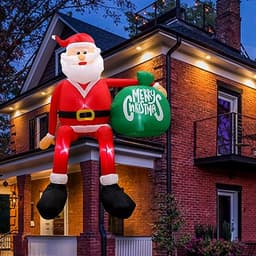
#3 — A frontage with no lawn
GUDELAK 8 ft climbing inflatable Santa, roof placement
8 ft, published for roof placement
5.5
/ 10
Buy it for the position, not the specification. Anchoring it is a question about your roof.
Published specifications
- Height
- 8 ft
- Lighting
- LED
- Placement
- Yard, roof, garden, lawn
- Ingress rating
- Not stated in the listing
Our scoring
- Published specs
- 4 / 10
- Street presence
- 8 / 10
- Weather tolerance
- 5 / 10
- Setup effort
- 5 / 10
Good
- The only figure here published for roof placement
- A climbing pose reads correctly against a wall where a standing figure does not
Watch out
- Roof placement is the hardest position to anchor and the listing does not describe fixings
- No published ingress rating for a piece meant to sit on a roof
#ad · Price as of October 23, 2026 · How we are funded
Specs from the Amazon listing (ASIN B0C85QRXRY), retrieved 2026-09-07.
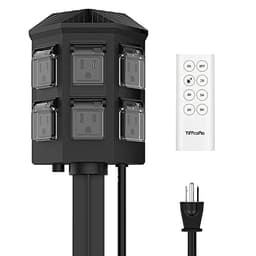
#4 — The same job, with a safety listing stated up front
TiFFCOFiO outdoor power stake timer, 6 outlets, ETL listed
6 grounded outlets, ETL listed
8.0
/ 10
Between two near-identical stake timers, take the one that publishes its safety listing.
Published specifications
- Outlets
- 6 grounded
- Lead
- 6 ft waterproof extension cord
- Control
- Dusk-to-dawn, countdown, 100 ft remote
- Listing
- ETL listed
Our scoring
- Published rating
- 6 / 10
- Safety listing
- 9 / 10
- Weather tolerance
- 8 / 10
- Control
- 9 / 10
Good
- ETL listing is stated in the listing title, which the competing stake timer does not do
Watch out
- Amp rating still is not in the title
#ad · Price as of October 23, 2026 · How we are funded
Features from the Amazon listing (ASIN B0B4RQMMBR), retrieved 2026-09-04.
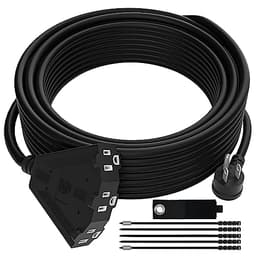
#5 — Reaching the far corner of the yard
14/3 heavy-duty outdoor extension cord, 50 ft, 3 outlets
14 AWG, 15 A / 1875 W, 50 ft
8.5
/ 10
Same gauge as our top cord, twice the reach. Buy it only if you need the distance.
Published specifications
- Gauge
- 14 AWG, 3 conductor
- Rating
- 15 A, 125 V, 1875 W, ETL listed
- Length
- 50 ft
- Plug
- 90-degree angled, 3 prong
Our scoring
- Published rating
- 10 / 10
- Capacity headroom
- 9 / 10
- Outdoor jacket
- 8 / 10
- Usability
- 7 / 10
Good
- The watt rating is printed, so it drops straight into the load arithmetic
- An angled plug sits flat against an exterior outlet cover instead of levering it open
Watch out
- 50 feet of 14 gauge is genuinely heavy to coil in January
#ad · Price as of October 23, 2026 · How we are funded
Rating from the Amazon listing (ASIN B0BG46K4QQ), retrieved 2026-09-04.
Questions
›How do you keep a Christmas inflatable from blowing over?
Site it out of the prevailing wind, use every supplied stake driven at an angle leaning away from the figure, and tension the tethers in opposing pairs rather than attaching them slack. Re-check after the first wet, windy night.
›How do I anchor an inflatable on concrete or a deck?
Tether it to something structural — a railing, a post, a porch frame. Weight alone resists sideways movement but not the upward pull that lifts these. If there is nothing structural, move it to soil.
›Should I deflate my inflatable at night?
Putting it on a timer means it deflates when the display is off, which is both less unattended motor time and less exposure. In genuinely bad weather, take it down rather than trusting more tethers.
›Why does my inflatable smell after storage?
It was folded damp. Deflate, dry it fully on a dry afternoon, then fold into a bag rather than compressing it into a tote. Eleven months is a long time for trapped moisture.
Sources
- 8 ft inflatable Santa with gift bag listing (ASIN B0H7WKJ7NT) — 8 ft, stated waterproof; no storage bag or anchoring accessories published
- FunFanso 8 ft Santa listing (ASIN B0CCV35G4W) — IP44 weatherproof
- GUDELAK climbing Santa listing (ASIN B0C85QRXRY) — published for roof placement
- TiFFCOFiO outdoor power stake listing (ASIN B0B4RQMMBR) — 6 grounded outlets, ETL listed
- 14/3 outdoor extension cord listing (ASIN B0BG46K4QQ) — 15 A / 1875 W, ETL listed
- Wind ratings — Not published by any manufacturer in this category; none is claimed here
We have not tested these products. Every figure above comes from a published manufacturer specification or from arithmetic shown on this page, and anything a maker does not publish is printed as unavailable rather than estimated. How that works, and what we will not claim, is set out on how we research.