Getting power to a Halloween yard display
Blowers run all evening, lights do not, and one outdoor outlet has to carry both. The circuit budget, the cord gauge and the stake that ends the daisy chain.
By Sawyer V. · Published

A Halloween yard is a harder electrical problem than a Christmas roofline, for a reason that is not obvious: an inflatable’s blower runs continuously for the entire time the piece is up, where a string of lights draws only while it is lit. Four inflatables is four motors running every evening for a month, all fed from one outdoor outlet at the front of the house.
This page is the arithmetic for that, the cord that carries it, and the honest account of what these products do and do not publish.
Wreath & Watt earns a commission on qualifying purchases made through the Amazon links on this page. It costs you nothing and it does not change the order of the picks — here is exactly how we are funded.
The budget you are working inside
The convention is the same one that governs any display: 80 percent of the breaker rating for a load running three hours or more. Everything else already on that circuit — and an exterior outlet is frequently shared with a garage or a bathroom — comes out of the same number.
The arithmetic
- 15 A x 120 V = 1,800 W circuit capacity
- 1,800 W x 0.8 = 1,440 W continuous budget
- 20 A x 120 V x 0.8 = 1,920 W on a 20 A circuit
- Subtract whatever else is already on that circuit
1,440 W is the working budget on a standard 15 A circuit, shared with everything else on it.
The cord is the part people get wrong
Gauge is a capacity rating, and a lower number is a heavier wire. This is the decision that determines whether the far end of a long run has enough to work with.
| Cord | Gauge | Published rating | Job |
|---|---|---|---|
| 14/3 outdoor, 50 ft | 14 AWG | 15 A / 1875 W, ETL listed | The main artery from the house |
| Iron Forge 16/3, 50 ft | 16 AWG | 13 A, SJTW jacket | A single light run you would rather not see |
Green jacket on the 16-gauge cord is a real feature for a lawn crossing. It is not a substitute for the capacity of the heavier cord on the main run.
Source: Manufacturer listings on Amazon.com, retrieved 2026-09-04.
Run one heavy cord out to where the display is, then distribute locally. Do not daisy-chain three light cords across a lawn: every joint is a connection sitting in wet grass, and the whole display is downstream of the weakest one. The full gauge argument, including why 16 AWG is fine for one string and wrong for a display, is on our cord comparison.
Where the daisy chain should end
A stake outlet is the piece that turns one cord into a distribution point at the display rather than a chain of couplers across the grass. Both of the ones we rank publish six grounded outlets with photocell control.
The difference between them is what they publish about safety. The TiFFCOFiO stake states an ETL listing and a waterproof six-foot lead; the SURAIELEC stake publishes the same six outlets and a waterproof dusk-to-dawn timer, and is less forthcoming about everything else — no safety listing, no lead length and no remote. For a unit that will sit in wet grass carrying most of a display, the stated listing is worth more than the extra outlet. That preference runs through our whole timer ranking.
Scheduling, and why it matters more here
A blower running dusk to dawn for a month is a motor running roughly 14 hours a night for nobody, and it is the single largest avoidable draw in a Halloween display. A dusk-to-dawn timer with a 15 A / 1/2 HP ETL-listed rating across two grounded weatherproof outlets is the simplest fix; the 1/2 HP rating matters here specifically because it is a motor rating, and a blower is a motor rather than a resistive load.
The arithmetic
- Blower running dusk to dawn: about 14 hours a night
- Blower running 6 pm to 11 pm: 5 hours a night
- 14 - 5 = 9 hours a night not run
- Over 31 nights: 279 hours of motor run time avoided
A timer removes about 279 hours of blower run time across October. The set-up is identical either way.
Weather, and where the connections sit
Every connection in a yard display is outdoors for a month in autumn weather. Keep couplers off the ground, use a drip loop so water runs away from the joint rather than into it, and use outdoor-rated cord for every part of the run rather than one indoor cord for the last few feet.
None of that is a substitute for the protection your circuit already has or does not have. We are not electricians and this page is arithmetic and product specification, not an inspection of your wiring. Follow local code, and if the display is large enough that you are counting watts against a budget, that is the point at which asking a professional is the cheap option. The full circuit treatment is on how many amps Christmas lights use, and the same load calculator works for a Halloween display — run your numbers through it.
Our picks for this
| # | Product | Best for | Score | Price |
|---|---|---|---|---|
| 1 |  TiFFCOFiO outdoor power stake timer, 6 outlets, ETL listed6 grounded outlets, ETL listed TiFFCOFiO outdoor power stake timer, 6 outlets, ETL listed6 grounded outlets, ETL listed | The same job, with a safety listing stated up front | 8.0/ 10 | |
| 2 |  SURAIELEC outdoor power stake timer, 6 outlets, dusk to dawn6 grounded outlets on a stake, dusk-to-dawn timer SURAIELEC outdoor power stake timer, 6 outlets, dusk to dawn6 grounded outlets on a stake, dusk-to-dawn timer | A yard display with several things to plug in | 7.3/ 10 | $23.99Amazon #ad · Price as of October 21, 2026 · Disclosure |
| 3 |  14/3 heavy-duty outdoor extension cord, 50 ft, 3 outlets14 AWG, 15 A / 1875 W, 50 ft 14/3 heavy-duty outdoor extension cord, 50 ft, 3 outlets14 AWG, 15 A / 1875 W, 50 ft | Reaching the far corner of the yard | 8.5/ 10 | $51.99Amazon #ad · Price as of October 21, 2026 · Disclosure |
| 4 |  BN-LINK outdoor light timer, dusk-to-dawn, dual grounded outlets15 A / 1/2 HP, ETL listed, two grounded outlets BN-LINK outdoor light timer, dusk-to-dawn, dual grounded outlets15 A / 1/2 HP, ETL listed, two grounded outlets | Set it in October, forget it until January | 8.0/ 10 | |
| 5 |  Iron Forge Cable 16/3 outdoor extension cord, 50 ft, green16 AWG, 13 A, 50 ft Iron Forge Cable 16/3 outdoor extension cord, 50 ft, green16 AWG, 13 A, 50 ft | Light runs you would rather not see | 8.5/ 10 | $32.99Amazon #ad · Price as of October 21, 2026 · Disclosure |
Scores are our own weighting of published manufacturer specifications, explained in full on how we research. They are not test results. We have not tested these products.
The picks, in detail
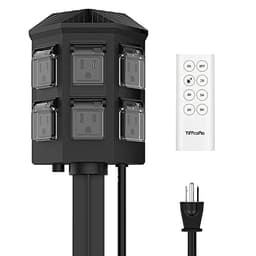
#1 — The same job, with a safety listing stated up front
TiFFCOFiO outdoor power stake timer, 6 outlets, ETL listed
6 grounded outlets, ETL listed
8.0
/ 10
Between two near-identical stake timers, take the one that publishes its safety listing.
Published specifications
- Outlets
- 6 grounded
- Lead
- 6 ft waterproof extension cord
- Control
- Dusk-to-dawn, countdown, 100 ft remote
- Listing
- ETL listed
Our scoring
- Published rating
- 6 / 10
- Safety listing
- 9 / 10
- Weather tolerance
- 8 / 10
- Control
- 9 / 10
Good
- ETL listing is stated in the listing title, which the competing stake timer does not do
Watch out
- Amp rating still is not in the title
Features from the Amazon listing (ASIN B0B4RQMMBR), retrieved 2026-09-04.
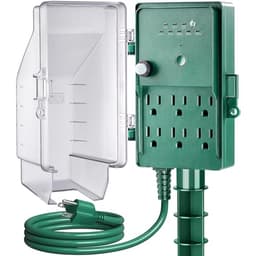
#2 — A yard display with several things to plug in
SURAIELEC outdoor power stake timer, 6 outlets, dusk to dawn
6 grounded outlets on a stake, dusk-to-dawn timer
7.3
/ 10
The right shape for an inflatable-and-stakes yard. Find its amp rating on the box before you plan the load, and expect dusk-to-dawn rather than a set schedule.
Published specifications
- Outlets
- 6 grounded
- Control
- Photocell dusk-to-dawn timer
- Weather
- Waterproof, per the listing
- Lead length
- Not published by the manufacturer in the listing title
- Remote
- Not published by the manufacturer in the listing title
- Amp rating
- Not published by the manufacturer in the listing title
Our scoring
- Published rating
- 5 / 10
- Safety listing
- 7 / 10
- Weather tolerance
- 8 / 10
- Control
- 9 / 10
Good
- Six outlets at ground level is what a yard display actually needs
- Stake mounting keeps the connections out of standing water
Watch out
- The amp rating is not in the listing title, so you must read the spec panel before loading it
- Dusk-to-dawn only in this listing: no remote and no countdown timer are published, so the on and off times are the sun's rather than yours
- No published lead length, so check it reaches your outlet before planning where the stake goes
#ad · Price as of October 21, 2026 · How we are funded
Features from the Amazon listing (ASIN B0CCHKWDKZ), verified via the Creators API 2026-10-07. Replaces B0CZMRL1RL, SURAIELEC's 6-outlet stake with a 100 ft remote, which Amazon now shows as currently unavailable. Six grounded outlets, the stake mounting and the waterproof claim carry over; the remote, the countdown timer and the 6 ft lead are not published on this listing and the spec lines above say so.
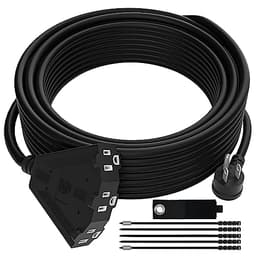
#3 — Reaching the far corner of the yard
14/3 heavy-duty outdoor extension cord, 50 ft, 3 outlets
14 AWG, 15 A / 1875 W, 50 ft
8.5
/ 10
Same gauge as our top cord, twice the reach. Buy it only if you need the distance.
Published specifications
- Gauge
- 14 AWG, 3 conductor
- Rating
- 15 A, 125 V, 1875 W, ETL listed
- Length
- 50 ft
- Plug
- 90-degree angled, 3 prong
Our scoring
- Published rating
- 10 / 10
- Capacity headroom
- 9 / 10
- Outdoor jacket
- 8 / 10
- Usability
- 7 / 10
Good
- The watt rating is printed, so it drops straight into the load arithmetic
- An angled plug sits flat against an exterior outlet cover instead of levering it open
Watch out
- 50 feet of 14 gauge is genuinely heavy to coil in January
#ad · Price as of October 21, 2026 · How we are funded
Rating from the Amazon listing (ASIN B0BG46K4QQ), retrieved 2026-09-04.
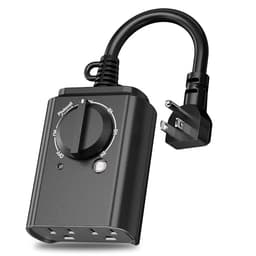
#4 — Set it in October, forget it until January
BN-LINK outdoor light timer, dusk-to-dawn, dual grounded outlets
15 A / 1/2 HP, ETL listed, two grounded outlets
8.0
/ 10
The no-fuss choice. If you never want to think about the timer again, buy this one instead of the remote model.
Published specifications
- Rating
- 15 A, 1/2 HP, ETL listed
- Outlets
- Two grounded, weatherproof
- Control
- Dusk-to-dawn photocell
Our scoring
- Published rating
- 9 / 10
- Safety listing
- 9 / 10
- Weather tolerance
- 8 / 10
- Control
- 6 / 10
Good
- Two outlets means the roofline and the yard can share one timer without a splitter
- Photocell only — nothing to reprogram when the clocks change
Watch out
- No remote, so changes mean going outside
Rating and features from the Amazon listing (ASIN B01MAWA81Q), retrieved 2026-09-04.
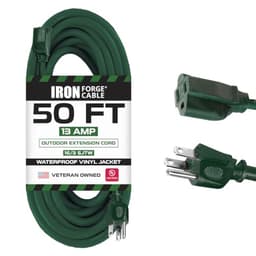
#5 — Light runs you would rather not see
Iron Forge Cable 16/3 outdoor extension cord, 50 ft, green
16 AWG, 13 A, 50 ft
8.5
/ 10
The right cord for LED strings and the wrong cord for incandescent ones. The gauge is the whole decision.
Published specifications
- Gauge
- 16 AWG, 3 conductor
- Jacket
- SJTW, outdoor rated
- Rating
- 13 A
- Length
- 50 ft
- Color
- Green
Our scoring
- Published rating
- 10 / 10
- Capacity headroom
- 6 / 10
- Outdoor jacket
- 9 / 10
- Usability
- 9 / 10
Good
- Green disappears across a lawn in a way orange never will
- 13 A published, so you know exactly where the ceiling is
Watch out
- 16 gauge is a smaller conductor: fine for LED strings, wrong for a run of incandescent sets
#ad · Price as of October 21, 2026 · How we are funded
Gauge and rating from the Amazon listing (ASIN B01JN1JRXW), retrieved 2026-09-04.
Questions
›How many Halloween inflatables can I run on one outlet?
It depends on their published wattages, which most manufacturers do not state. Read the tag on each unit, add the figures, and compare against the 1,440 W continuous budget of a 15 A circuit — less whatever else is on it. If you are close to that number, split the display across two circuits.
›What extension cord do I need for a yard display?
One heavy outdoor-rated cord to the display, then distribute at the display itself. A 14 AWG cord publishes a 15 A / 1875 W rating, which is the headroom you want on the main run; 16 AWG at 13 A is a single-string cord, not an artery.
›Do inflatable blowers use a lot of power?
The relevant difference is not size but duration: a blower runs continuously the whole time the piece is up, where lights draw only while lit. We do not print wattages for these units because none of them publishes one.
›Should I use a timer on a Halloween display?
Yes, and the case is stronger than for Christmas lights because you are switching motors rather than LEDs. Cutting a display from dusk-to-dawn to a five-hour evening window removes about 279 hours of blower run time across October.
Sources
- TiFFCOFiO outdoor power stake listing (ASIN B0B4RQMMBR) — 6 grounded outlets, ETL listed, waterproof lead
- SURAIELEC outdoor power stake listing (ASIN B0CCHKWDKZ) — 6 grounded outlets, waterproof, photocell dusk-to-dawn; no remote published
- 14/3 outdoor extension cord listing (ASIN B0BG46K4QQ) — 15 A / 1875 W, ETL listed, 50 ft
- Iron Forge 16/3 outdoor cord listing (ASIN B01JN1JRXW) — 13 A, SJTW jacket, 50 ft, green
- BN-LINK dusk-to-dawn timer listing (ASIN B01MAWA81Q) — 15 A / 1/2 HP, ETL listed
- Load convention — Watts = volts x amps at 120 V. The 80 percent ceiling is the standard continuous-load convention for a load running three hours or more. Where a manufacturer does not publish a wattage we print that rather than substituting a figure from a similar product.
We have not tested these products. Every figure above comes from a published manufacturer specification or from arithmetic shown on this page, and anything a maker does not publish is printed as unavailable rather than estimated. How that works, and what we will not claim, is set out on how we research.