The best rope lights, ranked on density, rating and linking limit
Every set here is 50 feet. What separates them is LEDs per foot, whether the weather claim is an actual IP number, and how far you can chain it.
By Sawyer V. · Published
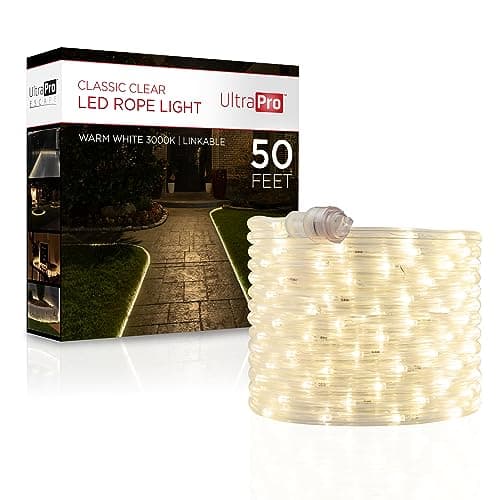
Rope light is the format for an edge you want to trace rather than a surface you want to fill. A sealed flexible tube follows a deck rail, a stair nosing, a fascia line or a column in a single continuous line, which is something no string of individual bulbs does neatly.
The category has standardized on 50 ft, so length is not a differentiator. Four things are: LEDs per foot, whether there is a real IP rating behind the word waterproof, whether the color temperature is published, and how many runs you can link. Five sets below.
Wreath & Watt earns a commission on qualifying purchases made through the Amazon links on this page. It costs you nothing and it does not change the order of the picks — here is exactly how we are funded.
Quick picks
| # | Product | Best for | Score | Price |
|---|---|---|---|---|
| 1 |  UltraPro rope light, 50 ft, warm white 3000K3000K warm white, published UltraPro rope light, 50 ft, warm white 3000K3000K warm white, published | The only published color temperature | 4.5/ 10 | |
| 2 |  ollrieu rope light, 50 ft, 360 LED, warm white 3000K3 strands end to end — 150 ft from one outlet ollrieu rope light, 50 ft, 360 LED, warm white 3000K3 strands end to end — 150 ft from one outlet | The set that publishes its linking limit | 8.5/ 10 | $39.99Amazon #ad · Price as of October 25, 2026 · Disclosure |
| 3 |  GUOTONG strip rope light, 50 ft, warm, outdoorFlat strip profile rather than round tube GUOTONG strip rope light, 50 ft, warm, outdoorFlat strip profile rather than round tube | Running flush along a straight edge | 4.8/ 10 | $36.99Amazon #ad · Price as of October 25, 2026 · Disclosure |
| 4 |  CHORLED rope light, 50 ft, 8 modes, waterproof tube8-mode controller on a 50 ft tube CHORLED rope light, 50 ft, 8 modes, waterproof tube8-mode controller on a 50 ft tube | Mode control on a display run | 5.5/ 10 | $39.99Amazon #ad · Price as of October 25, 2026 · Disclosure |
| 5 |  Vivideal rope light, 50 ft, 360 LED, cool whiteCool white, 360 LED over 50 ftSkip this Vivideal rope light, 50 ft, 360 LED, cool whiteCool white, 360 LED over 50 ftSkip this | Skip on a Christmas run | 4.0/ 10 |
Scores are our own weighting of published manufacturer specifications, explained in full on how we research. They are not test results. We have not tested these products.
The picks in full
#1 — The only published color temperature
UltraPro rope light, 50 ft, warm white 3000K
3000K warm white, published
4.5
/ 10
The pick on color. Nothing else here tells you what shade of white you are buying; what it no longer tells you is how it is rated.
Published specifications
- Length
- 50 ft
- Color temperature
- 3000K
- Color
- Warm white
- Tube
- Clear
- Use
- Outdoor, per the listing
- LEDs
- Not stated in the listing
- Weatherproofing
- Not stated in the listing
- Linking
- Not stated in the listing
Our scoring
- Weather rating
- 2 / 10
- LED density
- 1 / 10
- Published color temperature
- 10 / 10
- Spec completeness
- 5 / 10
Good
- 3000K is the only published color temperature on this page, and on a rope light the exact warmth is what clashes or matches
- A clear tube rather than a frosted one, which is what makes a rope read as a line of light instead of a glowing hose
Watch out
- No published LED count, so density cannot be compared
- No published IP code and no published linking limit, where the rope it replaces published IP65
Specs from the Amazon listing (ASIN B08NF95VRY), verified via the Creators API 2026-10-05. Replaces the discontinued FOEERS 450 LED rope (B0D14CCKYD), whose published IP65 rating and 450 LED count no live 50 ft rope light here carries.
#2 — The set that publishes its linking limit
ollrieu rope light, 50 ft, 360 LED, warm white 3000K
3 strands end to end — 150 ft from one outlet
8.5
/ 10
The planning pick. A published color temperature and a published linking limit are worth more than raw LED count on a run this long.
Published specifications
- Length
- 50 ft
- LEDs
- 360
- LEDs per foot
- 7.2 (360 over 50 ft — our arithmetic)
- Color temperature
- Warm white 3000K
- Voltage
- 110V
- Linking
- Male and female joints, up to 3 strands (150 ft)
- Form
- Round tube
Our scoring
- Published linking limit
- 10 / 10
- Color temperature spec
- 10 / 10
- LED density
- 5 / 10
- Spec completeness
- 9 / 10
Good
- A published linking limit of three strands is the number you need before planning a 150 ft run
- A stated 3000K is a real color temperature rather than the word warm
Watch out
- 7.2 LEDs per foot is the lowest density here — visible gaps at close range
- Three strands is a hard ceiling; a longer perimeter needs a second outlet
#ad · Price as of October 25, 2026 · How we are funded
Specs from the Amazon listing (ASIN B07KR5PQLB), verified 2026-09-10.
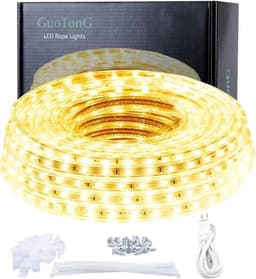
#3 — Running flush along a straight edge
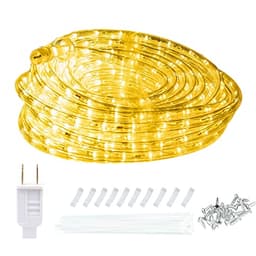
GUOTONG strip rope light, 50 ft, warm, outdoor
Flat strip profile rather than round tube
4.8
/ 10
The shape pick. If the run is a straight architectural edge rather than a wrapped column, a strip beats a tube every time — and this is the warm one.
Published specifications
- Length
- 50 ft
- Voltage
- 110V
- Form
- Strip, not round tube
- Color
- Warm
- Use
- Outdoor and indoor
- Weatherproofing
- Waterproof (no IP code stated)
- Color temperature
- Not stated in the listing
- LEDs
- Not stated in the listing
- Linking
- Not stated in the listing
Our scoring
- Profile for straight runs
- 10 / 10
- Color temperature spec
- 4 / 10
- LED density spec
- 1 / 10
- Spec completeness
- 4 / 10
Good
- A strip profile sits flush against a fascia or a deck rail instead of rolling off it, which is the one job a round tube cannot do
- Warm rather than cool, so it belongs in a Christmas palette — the cool white strip at the bottom of this page does not
- Rated for outdoor and indoor use in the listing
Watch out
- No published LED count, so density is unknowable before it arrives
- No published linking limit, where the ollrieu tube publishes three strands
- Warm is published as a word rather than a number — no Kelvin figure, where two sets here publish 3000K
#ad · Price as of October 25, 2026 · How we are funded
Specs from the Amazon listing (ASIN B0911ZF68L), verified via the Creators API 2026-10-07. Replaces B07GTGT1XC, the SURNIE 50 ft warm white flat strip, which Amazon no longer returns. SURNIE's live 50 ft warm white listing is explicitly a round tube and its live flat strip is 6000K daylight, so neither preserves this slot. This is a cross-brand replacement that keeps the variant class the slot exists for — a 50 ft warm strip for straight runs. The published 3000K figure and the cuttable claim are NOT on this listing and have been removed rather than carried across.
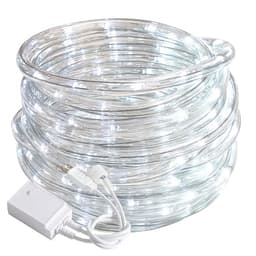
#4 — Mode control on a display run
CHORLED rope light, 50 ft, 8 modes, waterproof tube
8-mode controller on a 50 ft tube
5.5
/ 10
Buy it for the controller if you want movement on the run. Do not buy it expecting to know what you are getting on brightness.
Published specifications
- Length
- 50 ft
- Modes
- 8, with controller
- Form
- Round tube
- Linking
- Connectable (limit not stated)
- Weatherproofing
- Waterproof (no IP code stated)
- LEDs
- Not stated in the listing
- Color temperature
- Not stated in the listing
Our scoring
- Mode control
- 9 / 10
- Profile for wrapping
- 8 / 10
- Published brightness
- 1 / 10
- Spec completeness
- 4 / 10
Good
- A controller is the only way to get a chase or a fade out of a rope light, which is the one effect the format does well
- Round tube is the right profile for wrapping a post or a railing
Watch out
- Neither LED count nor color temperature is published — two of the three specs that matter
- Waterproof with no IP code again, on a product sold for outdoor use
#ad · Price as of October 25, 2026 · How we are funded
Specs from the Amazon listing (ASIN B0F3X2WRV4), verified 2026-09-10.
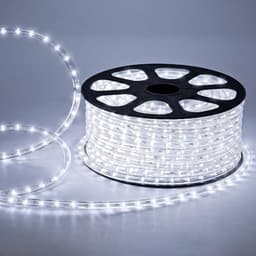
#5 — skip this
Vivideal rope light, 50 ft, 360 LED, cool white
Cool white, 360 LED over 50 ft
4.0
/ 10
Our skip for a Christmas run specifically. It is a competent rope light in the wrong color temperature for the job most people are buying it for.
Published specifications
- Length
- 50 ft
- LEDs
- 360
- LEDs per foot
- 7.2 (360 over 50 ft — our arithmetic)
- Color
- Cool white
- Voltage
- 110V
- Linking
- Connectable (limit not stated)
Our scoring
- Fit for a holiday palette
- 3 / 10
- LED density
- 5 / 10
- Published linking limit
- 2 / 10
- Spec completeness
- 6 / 10
Good
- Cool white is the correct choice for a winter-white or all-blue scheme, and for year-round utility lighting
Watch out
- Cool white against warm-white house lights is the most common mismatch in a holiday display
- The same 7.2 LEDs per foot as the ollrieu, without the published linking limit or the Kelvin figure
Specs from the Amazon listing (ASIN B0H6B23STL), verified 2026-09-10.
How we ranked these
Weather rating first, because rope light is bought for outdoor edges and an unrated tube is a one-season purchase. Then LED density, then whether the linking limit and color temperature are published at all.
| Rope | LEDs | LEDs per foot | Rating | Color temp | Linking limit |
|---|---|---|---|---|---|
| UltraPro | Not stated | Not stated | Not stated | 3000K | Not stated |
| ollrieu | 360 | 7.2 | Waterproof | 3000K | 3 strands (150 ft) |
| GUOTONG strip | Not stated | — | Waterproof | 3000K | Not stated |
| CHORLED | Not stated | — | Waterproof | Not stated | Not stated |
| Vivideal | 360 | 7.2 | Waterproof | Cool white | Not stated |
Every rope here is 50 ft, so LED count is directly comparable. LEDs per foot is our arithmetic. One listing publishes an IP code; the rest print the word waterproof with no number behind it.
Source: Manufacturer listings on Amazon.com, verified September 2026.
Waterproof is a word. IP65 is a number.
This is the gap on the page. Every rope light here says waterproof and not one publishes an IP code any more — the rope that published IP65 is discontinued. IP65 has a defined meaning, dust tight and protected against low-pressure water jets from any direction, and "waterproof" on its own has none.
That is the rating you want on anything mounted where rain hits it directly or where a hose might. An unrated tube may well be fine; you simply have no basis for expecting it to be. The same distinction applies across every outdoor product on this site and is set out on outdoor Christmas light safety.
LEDs per foot, and what a gap looks like
Rope light is viewed close — along a rail, up a stair edge, around a doorway. At that distance the spacing between diodes is visible, and a low count reads as dots rather than as a line.
The arithmetic
- ollrieu: 360 LEDs / 50 ft = 7.2 per foot, one every 1.67 in
- CHORLED and Vivideal: 360 over the same 50 ft
- UltraPro: LED count not published
Three of the five publish 360 diodes over 50 ft, one every 1.67 in. The two that do not publish a count cannot be compared on density at all, which is why the color temperature carries the top pick instead.
Neither of those is dense by string-light standards, and that is inherent to the format: the diffusing tube is doing the work of blending them. Further away than about six feet it stops mattering at all.
Linking limits, and why they are lower than you think
The ollrieu rope is the only one here that publishes a linking limit: three strands, 150 ft, from one outlet. That is not a conservative number invented by the manufacturer — it is the point at which voltage drop along the run starts to dim the far end.
Where no limit is published, do not assume the connector permits chaining at all. Feed a second run from a separate outlet instead, on an outdoor-rated cord. The method for planning that is on extension cords, and the load arithmetic is on how many amps.
Flat strip or round tube
Round tube is the default and it is the right shape for anything you are wrapping — a post, a railing, a column. It rolls into a spiral naturally and it looks the same from every angle.
Flat strip sits flush. Against a fascia board, a stair nosing, or the underside of a handrail, a flat profile stays where you put it and shows a clean line rather than a tube trying to roll off the edge. If the run is a straight architectural edge, the GUOTONG strip is the correct shape for it.
Color temperature, and the mismatch that ruins a run
Two listings here publish 3000K, one publishes cool white, and two publish nothing. That matters more on rope light than on almost any other format, because rope light is usually run adjacent to something else that is already lit.
A 3000K rope beside 2700K string lights looks fine. A cool white rope beside warm white string lights looks broken, which is why the Vivideal is our skip for a Christmas run specifically — it is a perfectly good rope light in the wrong color for the job. The full argument is on warm white vs cool white.
Rope light against the other formats
Against a string of C9 bulbs, rope light loses on presence and wins on continuity — the reason to choose it is that you want an unbroken line rather than points of light. C9 lights are the opposite choice.
Against net lights it is not really a comparison: nets cover a surface, rope traces an edge. And against permanent architectural lighting, rope light is the temporary, hundred-dollar version of the same idea, with the same weakness — it looks best on a clean, straight, well-defined edge.
One rope, three seasons
Rope light is the least holiday-specific product in this hub. A warm white run along a deck rail is a Christmas edge in December and deck lighting in July, which makes the IP rating worth more than it first appears — a rope you leave up is a rope in the weather for twelve months.
If that is the plan, read year-round outdoor lighting before you mount it, and put it on a timer rather than a switch: timers.
Questions
›How many LEDs per foot should a rope light have?
The published field here runs 7.2 to 9.0 per foot over 50 ft. Nine per foot is one diode every 1.33 inches, which reads as a continuous line at arm’s length. Below about seven you can see the individual points close up.
›Can rope lights be used outside in the rain?
The ones with a published IP rating, yes. Only one listing in this group prints an actual code (IP65 — dust tight and protected against water jets); the others print the word waterproof with no number behind it, which is a claim rather than a rating.
›How many rope lights can you connect together?
One listing here publishes a limit of three 50 ft strands, or 150 ft, from a single outlet. Where no limit is published, run a second feed from another outlet rather than assuming the connector will chain.
›Can you cut rope light to length?
Only the ones sold as cuttable, and only at the marked intervals. The cut end is no longer sealed, so an outdoor run needs the end capped — otherwise the waterproof claim no longer applies to that run.
Sources
- UltraPro 50 ft rope light listing (ASIN B08NF95VRY) — 50 ft, warm white 3000K, clear tube, outdoor; no LED count or IP code published
- ollrieu 50 ft rope light listing (ASIN B07KR5PQLB) — 50 ft, 360 LED, 110V, warm white 3000K, up to 3 strands linked
- GUOTONG 50 ft strip rope light listing (ASIN B0911ZF68L) — 50 ft, warm, 110V, strip not tube, outdoor and indoor, waterproof; no Kelvin figure, LED count or linking limit published
- CHORLED 50 ft rope light listing (ASIN B0F3X2WRV4) — 50 ft, 8 modes with controller, connectable flexible tube
- Vivideal 50 ft rope light listing (ASIN B0H6B23STL) — 50 ft, 360 LED, 110V, cool white, connectable
- Density arithmetic — LEDs per foot = published LED count / 50 ft
We have not tested these products. Every figure above comes from a published manufacturer specification or from arithmetic shown on this page, and anything a maker does not publish is printed as unavailable rather than estimated. How that works, and what we will not claim, is set out on how we research.