The best shelving for decoration storage, ranked on depth rather than capacity
Nobody's Christmas totes weigh 1,500 pounds. Depth and shelf surface are what decide whether the bins actually sit on the rack.
By Sawyer V. · Published
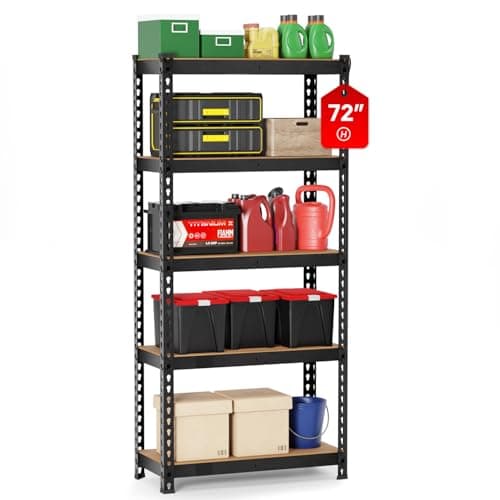
Every storage page on this site ends in the same place: put it in a labeled tote and put the tote somewhere sensible. This is the page about somewhere sensible, and it is the one fixture in the whole decoration inventory that people buy on the wrong number.
That number is capacity. Shelving in this category is sold on 1,500 and 3,000 pound headline figures, and a garage full of holiday decorations does not come close to either. What actually decides it is depth, shelf surface, and whether the thing moves. Five units below.
Wreath & Watt earns a commission on qualifying purchases made through the Amazon links on this page. It costs you nothing and it does not change the order of the picks — here is exactly how we are funded.
Quick picks
| # | Product | Best for | Score | Price |
|---|---|---|---|---|
| 1 |  PayLessHere 5-tier shelving, 36 x 16 x 72 in, MDF boardsSolid MDF boards, 16 in deep, height adjustable PayLessHere 5-tier shelving, 36 x 16 x 72 in, MDF boardsSolid MDF boards, 16 in deep, height adjustable | Solid shelves at the deepest published depth | 6.3/ 10 | $29.99Amazon #ad · Price as of October 25, 2026 · Disclosure |
| 2 |  RackBro 5-tier wire shelving, 48 in wide, 1,875 lb48 in wide, 1,875 lb total, shelf liners included RackBro 5-tier wire shelving, 48 in wide, 1,875 lb48 in wide, 1,875 lb total, shelf liners included | The widest run in one unit | 7.0/ 10 | $129.99Amazon #ad · Price as of October 25, 2026 · Disclosure |
| 3 | 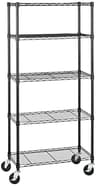 Amazon Basics 5-shelf rack with casters, 300 lb per shelf4 in casters with 300 lb per shelf Amazon Basics 5-shelf rack with casters, 300 lb per shelf4 in casters with 300 lb per shelf | Rolling the whole rack out at Christmas | 8.8/ 10 | |
| 4 |  Amazon Basics 5-shelf wire unit, 36 x 14 x 72 in36 x 14 x 72 in, adjustable Amazon Basics 5-shelf wire unit, 36 x 14 x 72 in36 x 14 x 72 in, adjustable | The standard-size unit | 6.5/ 10 | |
| 5 |  Industrial 5-tier shelving, 3,000 lb, 72 in3,000 lb published, one dimension publishedSkip this Industrial 5-tier shelving, 3,000 lb, 72 in3,000 lb published, one dimension publishedSkip this | Skip | 4.8/ 10 | $79.99Amazon #ad · Price as of October 25, 2026 · Disclosure |
Scores are our own weighting of published manufacturer specifications, explained in full on how we research. They are not test results. We have not tested these products.
The picks in full
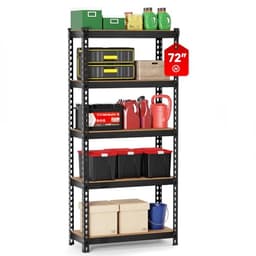
#1 — Solid shelves at the deepest published depth
PayLessHere 5-tier shelving, 36 x 16 x 72 in, MDF boards
Solid MDF boards, 16 in deep, height adjustable
6.3
/ 10
The pick for decoration storage specifically. Depth and a solid shelf are what the totes actually need, and this is the only unit here that publishes both.
Published specifications
- Tiers
- 5
- Width
- 36 in
- Depth
- 16 in
- Height
- 72 in
- Capacity per tier
- Not stated in the listing
- Total capacity
- Not stated in the listing
- Shelf surface
- MDF boards
- Frame
- Metal
- Assembly
- Height adjustable
Our scoring
- Shelf depth
- 10 / 10
- Solid shelf surface
- 10 / 10
- Published capacity
- 1 / 10
- Damp tolerance
- 4 / 10
Good
- Solid MDF boards rather than wire mesh — small items, ornament boxes and bag handles do not fall through
- 16 in is the deepest here, and depth is the dimension that decides whether a tote sits flat or overhangs
- The cheapest unit on this page, and the only solid-surface one
Watch out
- MDF and a damp garage floor are a bad combination over years — this wants a dry space
- Publishes no capacity at all, per shelf or in total — the one figure this page argues does not matter, but it is still a blank
- 36 in wide, so a full decoration inventory takes two units rather than one
#ad · Price as of October 25, 2026 · How we are funded
Specs from the Amazon listing (ASIN B0F87P3QX5), verified via the Creators API 2026-10-17. Replaces the Topeakmart 35.5 x 16 x 71 in unit (B07W82TLW7), which went Currently unavailable. That listing published a powder-coated iron frame and 386 lb per tier; this one publishes neither, so both figures have been withdrawn rather than carried over. What it does publish — 16 in of depth and solid MDF boards — are the two specs this page ranks on.
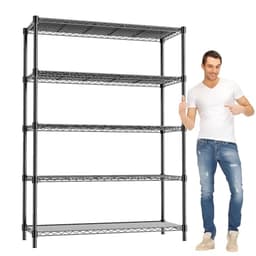
#2 — The widest run in one unit
RackBro 5-tier wire shelving, 48 in wide, 1,875 lb
48 in wide, 1,875 lb total, shelf liners included
7.0
/ 10
The width pick, and the liners make the wire surface usable. The trade is depth: this is the deepest unit here, so measure the wall as well as the totes.
Published specifications
- Tiers
- 5
- Width
- 48 in
- Depth
- 18 in
- Height
- 72 in
- Capacity per shelf
- Not stated in the listing
- Total capacity
- 1,875 lb
- Shelf surface
- Wire, with liners included
- Frame
- Steel
- Certification
- Not stated in the listing
- Assembly
- Adjustable shelf height
Our scoring
- Width per unit
- 10 / 10
- Published capacity
- 6 / 10
- Shelf depth
- 5 / 10
- Spec completeness
- 7 / 10
Good
- 48 in of width in a single unit is the widest here by three inches, and it covers a garage wall run that would take two of the 35 in racks
- Shelf liners are included, which is the fix for the one real failing of wire shelving — small items falling through and bag handles catching
- 1,875 lb total is the second-highest published capacity on this page
Watch out
- Publishes no per-shelf figure, only the headline total, so you cannot tell how to distribute the load
- At 18 in it is now the deepest unit on this page outright, which on a page that ranks on depth is the wrong end of the spread — it needs 18 in of clear wall, not 16
- No certification published, where the unit this slot started with published NSF
#ad · Price as of October 25, 2026 · How we are funded
Specs from the Amazon listing (ASIN B0FPM5BWJQ), verified via the Creators API 2026-10-25. Replaces B0FF8ZZJ85, the 45 in unit, which Amazon now shows as currently unavailable — the second death in this slot after the 58 in B0H6PCRSLV. This is the SAME RackBro line one width up, which is why it was taken over a 45.3 x 15.7 in cross-brand unit that would have held this page's 14 to 16 in depth range: it carries the 1,875 lb total, the shelf liners and the adjustable shelf height that the dead listing published and that cross-brand unit publishes none of, and it adds a steel frame material the dead listing did not state. The cost is depth — 18 in rather than 16 — so the page's published depth range has been widened to 14 to 18 in and its width range to 30 to 48 in rather than left stale.
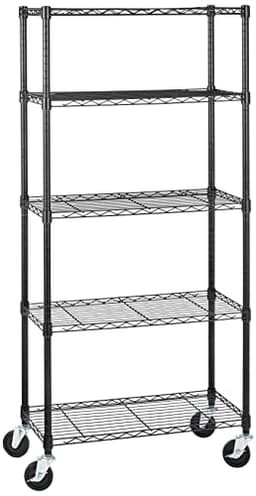
#3 — Rolling the whole rack out at Christmas
Amazon Basics 5-shelf rack with casters, 300 lb per shelf
4 in casters with 300 lb per shelf
8.8
/ 10
The one people should consider and do not. A rolling rack turns the annual decoration haul into one trip.
Published specifications
- Tiers
- 5
- Width
- 30 in
- Depth
- 14 in
- Height
- 64.75 in
- Capacity per shelf
- 300 lb
- Total capacity
- 1,500 lb (300 x 5 — our arithmetic)
- Casters
- 4 in wheels
- Shelf surface
- Steel wire
- Adjustable
- Yes
Our scoring
- Mobility
- 10 / 10
- Published capacity
- 10 / 10
- Storage volume
- 5 / 10
- Spec completeness
- 10 / 10
Good
- Casters change how decoration storage actually works — you roll the rack to the door in November instead of carrying thirty totes
- Publishes both a per-shelf capacity and full dimensions, which the fixed Amazon Basics unit does not
Watch out
- 30 in is the narrowest unit here and 64.75 in the shortest, so it holds the least
- Wheels on a sloped garage floor need locking casters and a wall tether
Specs from the Amazon listing (ASIN B071DZHLXH), verified 2026-09-10.
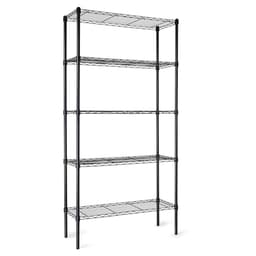
#4 — The standard-size unit
Amazon Basics 5-shelf wire unit, 36 x 14 x 72 in
36 x 14 x 72 in, adjustable
6.5
/ 10
The default. It publishes its dimensions and not its capacity, which is exactly the trade most people accept in this category.
Published specifications
- Tiers
- 5
- Width
- 36 in
- Depth
- 14 in
- Height
- 72 in
- Shelf surface
- Steel wire
- Adjustable
- Yes
- Assembly
- Easy assembly, per the listing
- Capacity per shelf
- Not stated in the listing
Our scoring
- Standard footprint
- 9 / 10
- Published dimensions
- 10 / 10
- Published capacity
- 1 / 10
- Spec completeness
- 6 / 10
Good
- 36 by 14 in is the standard footprint most garages are already laid out around, so two or three line up cleanly
- 72 in of height gives five tiers with real spacing between them rather than five cramped ones
Watch out
- No published capacity at all, which is the one figure you would want before loading a top shelf
- Wire shelves again, with the same small-item problem
Specs from the Amazon listing (ASIN B018YLFJX4), verified 2026-09-10.
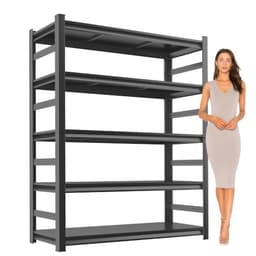
#5 — skip this
Industrial 5-tier shelving, 3,000 lb, 72 in
3,000 lb published, one dimension published
4.8
/ 10
Our skip. It leads on the one number that does not matter for this job and omits the two that do.
Published specifications
- Tiers
- 5
- Total capacity
- 3,000 lb
- Height
- 72 in
- Frame
- Steel
- Adjustable
- Yes
- Width
- Not stated in the listing
- Depth
- Not stated in the listing
Our scoring
- Published capacity
- 10 / 10
- Published dimensions
- 2 / 10
- Relevance to decor storage
- 4 / 10
- Spec completeness
- 3 / 10
Good
- 3,000 lb is twice the capacity of anything else here, and steel industrial shelving is genuinely built for it
Watch out
- Neither width nor depth is published, so you cannot tell whether it fits your wall or your totes
- Capacity is not the binding constraint on decoration storage — a garage of holiday totes does not weigh 1,500 lb, let alone 3,000
#ad · Price as of October 25, 2026 · How we are funded
Specs from the Amazon listing (ASIN B0DJ33ZWHM), verified 2026-09-10.
How we ranked these
Published depth first, then shelf surface, then per-shelf capacity where it is published at all, then footprint. Capacity is ranked last deliberately, and the reason is the arithmetic below.
| Unit | W x D x H | Shelf surface | Per shelf | Total | Casters |
|---|---|---|---|---|---|
| PayLessHere | 36 x 16 x 72 in | MDF board | Not stated | Not stated | No |
| RackBro 48 in wire unit | 48 x 18 x 72 in | Wire, liners | Not stated | 1,875 lb | No |
| Amazon Basics, casters | 30 x 14 x 64.75 in | Wire | 300 lb | 1,500 lb | 4 in |
| Amazon Basics, fixed | 36 x 14 x 72 in | Wire | Not stated | Not stated | No |
| Industrial 3,000 lb | 72 in tall, rest not stated | Steel | Not stated | 3,000 lb | No |
Every unit here is five tiers. Total capacity is our arithmetic where the listing publishes a per-shelf figure and no total.
Source: Manufacturer listings on Amazon.com, verified September 2026.
Why capacity is the wrong number
A 27-gallon tote is 3.6 cubic feet, using this site’s standing conversion. Filled with Christmas decorations — garland, ornaments in boxes, light strings, a wreath — it is a bulky object rather than a heavy one.
The arithmetic
- 1 US gallon = 231 cubic inches; 1 cubic foot = 1,728 cubic inches
- 27 gal tote = 27 x 231 = 6,237 cubic inches = 3.6 cu ft
- A 5-tier rack at 36 x 16 in gives 576 sq in of shelf per tier
- 300 lb per shelf against a few totes of soft goods
You will run out of shelf area long before you approach any of the published weight limits. Depth and width are the binding constraints; pounds are not.
Which is why the 3,000 lb industrial unit is our skip. It leads on the number that does not matter here and publishes neither of the two that do. The volume-planning method is on how much storage space do I need.
Depth is the spec that decides it
The published depths here run from 14 to 18 inches, and that four-inch spread is the difference between a tote sitting flat and a tote overhanging the front edge of every shelf in the rack.
An overhanging tote is not a disaster but it is a permanent annoyance: it catches you as you walk past, it cannot be pushed back flush, and it makes the rack look like a pile. Get a tape measure to the totes you already own before you order — the front-to-back dimension is the one to write down. The RackBro is the deepest here at 18 in and the PayLessHere next at 16 in, with the two Amazon Basics units at 14 in the shallowest.
The rolling rack nobody buys
One unit here has four-inch casters, and it is the most interesting thing on the page. The annual decoration haul is thirty trips between the garage and the house; a rack on wheels is one trip with the rack.
It costs you volume — at 30 by 14 by 64.75 inches the caster unit is the smallest here — and it needs locking wheels plus a wall tether on a sloped garage floor. For most people that is a good trade for one November afternoon a year.
Fitting the rack to the wall, not the wall to the rack
Width per unit runs from 30 to 48 inches here, and it is worth doing this arithmetic before you order rather than after. Two 35.5 in racks side by side need 71 inches of wall; the single 48 in rack needs 48 and gives you five long shelves instead of ten short ones.
Long shelves are better for a decoration inventory, because the objects are long — wreath boxes, tree bags, garland. A 48 in shelf takes a 30 in wreath box and a garland bin side by side along its length; a 30 in shelf takes the wreath box and nothing else. A bagged artificial tree is longer than any shelf here, which is why it goes upright or on the floor rather than on a rack. The tree-specific problem is on how to store an artificial tree and the container sizing on the best Christmas tree storage bags.
Five tiers, 64.75 to 72 inches, and the top shelf
Every unit here is five tiers, and the height differences come out of shelf spacing rather than tier count. At 72 inches you get genuine clearance between shelves; at 64.75 you get five shorter gaps.
The practical point is the top shelf: on a 72 inch rack it is above eye level for most people, which makes it the right place for the things you touch once a year and the wrong place for a 40 pound tote. Put the light and awkward things high and the heavy totes at waist height, which is the layout logic on decoration storage ideas.
Garage, basement, or the wrong one
Shelving does not change the environment it stands in. An MDF-shelved rack in a damp basement will fail at the shelves rather than the frame, and a steel rack against an exterior garage wall will find condensation.
Get the rack off the wall by an inch or two, get the totes off the floor entirely, and read attic, garage or basement before deciding where any of it goes. Damp and pest protection covers what to do about the space you actually have.
A rack is half a system
Shelving only pays off if what goes on it is uniform, sealed and labeled. Mixed cardboard boxes on a five-tier rack is the same chaos at a higher elevation.
Standardize on one tote size first, label the ends rather than the lids so you can read them on a shelf, and only then buy the rack. That order matters — bins vs bags vs totes and labeling and inventory come first, and this page comes second.
Questions
›How deep should garage shelving be for storage totes?
Deeper than your totes are front-to-back, which is a measurement you have to take yourself. The published depths here run 14 to 18 inches, and anything shallower than your totes means every bin overhangs the front edge of every shelf.
›How much weight capacity do I need for decoration storage?
Far less than any of these publish. A 27-gallon tote is 3.6 cubic feet of mostly soft, bulky decorations. You will run out of shelf area long before you approach 300 pounds per shelf, which makes capacity the wrong number to shop on.
›Are wire shelves or solid shelves better for holiday storage?
Solid, unless everything you own is in a sealed tote. Wire is fine under a bin and loses ornament hooks, light clips, small boxes and bag handles through the mesh. One unit here publishes solid MDF boards; the rest are wire.
›Is shelving with wheels worth it in a garage?
For decoration storage specifically, often yes — you roll the rack to the door once in November instead of carrying totes one at a time. It costs you volume, and on a sloped floor it needs locking casters and a wall tether.
Sources
- PayLessHere 5-tier shelving listing (ASIN B0F87P3QX5) — 16 in deep x 36 in wide x 72 in high, 5 tier, metal frame, MDF boards, height adjustable; no per-shelf or total capacity published
- RackBro 48 in 5-tier wire shelving listing (ASIN B0FPM5BWJQ) — 48 x 18 x 72 in, wire with shelf liners, 1,875 lb total, steel frame, adjustable shelf height; no per-shelf figure or certification published
- Amazon Basics 5-shelf rack with casters listing (ASIN B071DZHLXH) — 30 x 14 x 64.75 in, 4 in casters, 300 lb per shelf, adjustable steel wire
- Amazon Basics 5-shelf unit listing (ASIN B018YLFJX4) — 36 x 14 x 72 in, adjustable heavy duty steel wire
- Industrial 5-tier shelving listing (ASIN B0DJ33ZWHM) — 72 in, steel, 3,000 lb capacity, adjustable
- Volume arithmetic — 27 gal = 3.6 cu ft, using 231 cubic inches per gallon and 1,728 per cubic foot — this site's standing conversion
We have not tested these products. Every figure above comes from a published manufacturer specification or from arithmetic shown on this page, and anything a maker does not publish is printed as unavailable rather than estimated. How that works, and what we will not claim, is set out on how we research.