How many sets you can join end to end, and why it is not a circuit question
Two limits apply at once and they protect different things. Here are the published connection maximums, and how to plan a long run against both.
By Sawyer V. · Published
“How many strings can I plug into each other?” gets answered with a circuit calculation about ninety percent of the time, and the circuit calculation is the wrong answer. There are two limits, they protect completely different things, and the one that usually bites first is not the breaker.
This page separates them, gives the published connection maximums for real sets, and shows how to lay out a long run so that neither limit is the thing that stops you.
Wreath & Watt earns a commission on qualifying purchases made through the Amazon links on this page. It costs you nothing and it does not change the order of the picks — here is exactly how we are funded.
Two limits, applying at the same time
The series limit is the maximum number of sets the manufacturer permits end to end. It exists because everything downstream of the first plug in a chain draws through that first plug, its wire and its fuses. Exceeding it overloads one connector, not the circuit.
The circuit limit is the 80 percent continuous-load budget on the breaker, shared with everything else on that circuit. It is about the building.
Both apply simultaneously and neither substitutes for the other. A run can sit comfortably inside the circuit budget and still be four sets over the series limit, which is the situation most people are actually in.
| Set | Length each | Published max connected | Total run |
|---|---|---|---|
| Icicle, 400 LED | 32.8 ft | Not published | Plan one feed per set |
| Connectable net, 300 LED | 14.8 ft x 5 ft | 2 sets | 29.6 ft of hedge |
| C9 long run | 114 ft | Not published | 114 ft from one plug |
| LED mini, 100 count | 33 ft | Not published in the listing | Check the tag on the set |
Where a listing does not publish a maximum, the figure is printed on the tag attached to the string itself. That tag governs — not this table and not a figure from a similar product.
Source: Manufacturer listings on Amazon.com, retrieved 2026-09-04.
The arithmetic
- Icicle sets: 3 connected x 32.8 ft = 98.4 ft of eave from one plug
- A 130 ft eave line therefore needs 2 separate runs, not 4 chained sets
- Circuit check on the same 130 ft: LED icicle draw is small
- The series limit stopped you at 98.4 ft long before the breaker would have
On LED sets the series limit almost always binds first. Plan the layout around it, then check the circuit separately.
Why the series limit binds first on LED
The series limit is fixed by the connector and the wire in the first plug, and it does not get more generous because the bulbs became efficient. The circuit budget, meanwhile, went from tight to enormous when the category moved to LED — a 15 A circuit at a 1,440 W continuous budget will carry hundreds of LED strings.
So the two limits moved in opposite directions. On incandescent sets the breaker was the real constraint; on LED sets it is almost always the connector. The full circuit arithmetic is on how many amps Christmas lights use, and the load calculator will run your own numbers.
Laying out a long run around both limits
- Read the tag before you plan. The maximum connected count is on the set itself even where the listing omits it. It is the one number this whole page depends on.
- Break the run into legs, each within the series limit. Three icicle sets, then a separate feed for the next three — not six in a line.
- Feed each leg from a distribution point, not from the previous leg. A stake outlet or a rated cord run back to the outlet is what makes this practical; the cord comparison is on extension cords by gauge.
- Prefer one long set to a chain where you can. The 114-foot C9 run covers most front elevations from a single plug with no joints at all, which sidesteps the series limit entirely.
- Never chain past a published maximum to save a cord. A cord costs less than the connector it is protecting.
Chaining sets that are not identical
Manufacturers publish their maximum for chains of that same set. Once you mix set types the published figure no longer describes what you have built, and the honest answer is to treat the lowest maximum in the chain as governing and to prefer not mixing at all.
There is an appearance reason too. Warm white from two makers is frequently not the same warm white, and the mismatch is far more visible along one continuous run than it is between separate elements — which is the argument set out on warm white vs cool white.
The short version
Read the tag, plan legs that respect the published maximum, feed each leg independently, and check the circuit budget separately at the end rather than instead. If a single long set will cover the run, buy that instead and the whole question disappears — which is one of the reasons the long-run option earns its place on lighting a two-story house.
Our picks for this
| # | Product | Best for | Score | Price |
|---|---|---|---|---|
| 1 |  GTSYDING icicle lights, 400 LED over 32.8 ft, 80 drops80 drops over 32.8 ft — one drop every 4.9 in GTSYDING icicle lights, 400 LED over 32.8 ft, 80 drops80 drops over 32.8 ft — one drop every 4.9 in | A full eave line of icicles | 7.0/ 10 | $25.99Amazon #ad · Price as of October 22, 2026 · Disclosure |
| 2 |  Net lights, 300 LED, 14.8 ft x 5 ft mesh, connectable14.8 ft x 5 ft, connect two sets max Net lights, 300 LED, 14.8 ft x 5 ft mesh, connectable14.8 ft x 5 ft, connect two sets max | Two-panel hedge runs | 6.5/ 10 | |
| 3 |  C9 Outdoor String Lights, 150 LED over 114 ft, timer + 8 modes114 ft on a single connectable run C9 Outdoor String Lights, 150 LED over 114 ft, timer + 8 modes114 ft on a single connectable run | Covering a long roofline from one outlet | 5.5/ 10 | |
| 4 |  Wintergreen Lighting C9 OptiCore LED, 25 bulbs / 25 ft, warm white18 AWG SPT-1 stringer, 12 in spacing Wintergreen Lighting C9 OptiCore LED, 25 bulbs / 25 ft, warm white18 AWG SPT-1 stringer, 12 in spacing | Rooflines you want to look the same in year five | 8.3/ 10 | |
| 5 |  Northlight LED mini lights, 100 count, 33 ft, warm white on brown wire100 LEDs, 4 in spacing, 33 ft lighted length Northlight LED mini lights, 100 count, 33 ft, warm white on brown wire100 LEDs, 4 in spacing, 33 ft lighted length | Trees, shrubs and wrapping — the workhorse string | 6.5/ 10 |
Scores are our own weighting of published manufacturer specifications, explained in full on how we research. They are not test results. We have not tested these products.
The picks, in detail
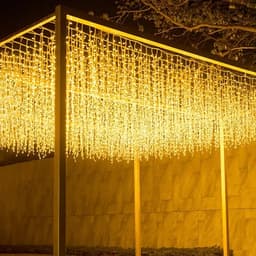
#1 — A full eave line of icicles
GTSYDING icicle lights, 400 LED over 32.8 ft, 80 drops
80 drops over 32.8 ft — one drop every 4.9 in
7.0
/ 10
The icicle set that tells you its drop count. That is the number that decides how it looks, and almost nobody publishes it.
Published specifications
- LEDs
- 400, warm white
- Length
- 32.8 ft (10 m)
- Drops
- 80
- Modes
- 8
- Connectable
- Yes, no set limit published
- Weather
- Waterproof, per the listing
Our scoring
- Published specs
- 8 / 10
- Coverage
- 9 / 10
- Weather tolerance
- 6 / 10
- Serviceability
- 5 / 10
Good
- Drop count and length are both published, so drop spacing is computable before you buy
- 80 drops over 32.8 ft is twice the density of a 60-drop set at the same length
Watch out
- Connectable, but the listing does not say how many sets can join — the figure that plans a long eave
- Drop lengths vary within the set by design, which reads as untidy on a straight fascia
#ad · Price as of October 22, 2026 · How we are funded
Specs from the Amazon listing (ASIN B0FCSLLG51), verified via the Creators API 2026-10-03. Replaces the discontinued 300 LED / 60 drop icicle set (B08JQ6G4R8), whose published three-set connection limit this listing does not state.
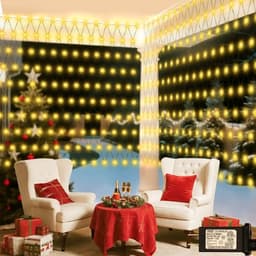
#2 — Two-panel hedge runs
Net lights, 300 LED, 14.8 ft x 5 ft mesh, connectable
14.8 ft x 5 ft, connect two sets max
6.5
/ 10
Nearly identical to our other net pick. Choose on which mesh size fits, and note the two-set connection limit.
Published specifications
- LEDs
- 300
- Mesh size
- 14.8 ft x 5 ft
- Modes
- 8
- Connectable
- Maximum 2 sets end to end
Our scoring
- Published specs
- 8 / 10
- Coverage
- 8 / 10
- Weather tolerance
- 6 / 10
- Serviceability
- 4 / 10
Good
- Publishes its connection limit, which most net lights leave you to discover
Watch out
- Two sets is a hard ceiling — a long hedge needs a second outlet
Specs from the Amazon listing (ASIN B094NBB584), retrieved 2026-09-04.
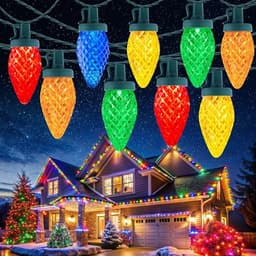
#3 — Covering a long roofline from one outlet
C9 Outdoor String Lights, 150 LED over 114 ft, timer + 8 modes
114 ft on a single connectable run
5.5
/ 10
The pragmatic long-run choice. You trade published weatherproofing detail for length and a built-in timer.
Published specifications
- Length
- 114 ft, 150 C9 LEDs
- Spacing
- Approximately 9 in (114 ft over 150 bulbs — our arithmetic)
- Control
- Built-in timer, 8 light modes
- Weather
- Listed as waterproof; IP rating not published by the manufacturer
Our scoring
- Build
- 6 / 10
- Weather tolerance
- 6 / 10
- Serviceability
- 5 / 10
- Published specs
- 5 / 10
Good
- One box covers a run that would take four or five 25-foot commercial sets
- Timer is built into the string, so you are not also buying an outdoor timer
Watch out
- No published IP rating, which is the number that actually predicts a wet-season failure
- Modes mean a controller in line — one more thing that can fail outdoors
Specs from the Amazon listing (ASIN B0D8Q4J34X), retrieved 2026-09-04.
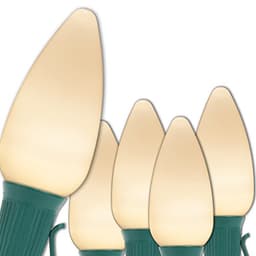
#4 — Rooflines you want to look the same in year five
Wintergreen Lighting C9 OptiCore LED, 25 bulbs / 25 ft, warm white
18 AWG SPT-1 stringer, 12 in spacing
8.3
/ 10
The C9 set built like an installer's stock: heavy stringer, replaceable bulbs, drained sockets. Buy it once for the roofline you re-hang every year.
Published specifications
- Bulb
- C9 OptiCore LED, faceted, replaceable
- Stringer
- 18 AWG SPT-1 commercial wire, green
- Spacing
- 12 in — 25 bulbs over 25 ft
- Socket drainage
- Weep holes for wet-weather use
- Rated wattage per string
- Not published by the manufacturer
Our scoring
- Build
- 9 / 10
- Weather tolerance
- 9 / 10
- Serviceability
- 9 / 10
- Published specs
- 6 / 10
Good
- Commercial 18 AWG stringer instead of the 22 AWG most retail sets use
- Bulbs unscrew individually, so one dead bulb is a bulb, not a string
- Weep-holed sockets are the detail that decides whether a set survives an ice storm
Watch out
- Costs meaningfully more per foot than a big-box set
- Wattage per string is not published, so you cannot pre-compute load from the listing alone
Specs from the Wintergreen Lighting Amazon listing (ASIN B0776ZCHFX), retrieved 2026-09-04.
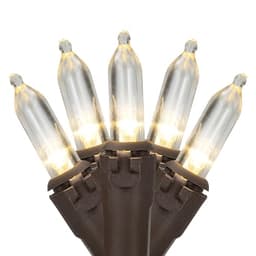
#5 — Trees, shrubs and wrapping — the workhorse string
Northlight LED mini lights, 100 count, 33 ft, warm white on brown wire
100 LEDs, 4 in spacing, 33 ft lighted length
6.5
/ 10
The default mini string. Buy the count you need for the tree, not the count that was on sale.
Published specifications
- Count
- 100 LED mini bulbs
- Spacing
- 4 in
- Lighted length
- 33 ft
- Bulb color
- Warm white
- Wire
- Brown
- Rated wattage per string
- Not published by the manufacturer
Our scoring
- Build
- 7 / 10
- Weather tolerance
- 7 / 10
- Serviceability
- 5 / 10
- Published specs
- 7 / 10
Good
- 4-inch spacing over 33 feet is the density most tree-wrapping guidance assumes
- Brown wire disappears against bark and trunk wraps, where white wire draws a line
- LED draw means you can run many strings on one circuit — see our amp guide
Watch out
- Wattage is not printed on the listing, so you have to read the tag on the string itself
- Brown reads as a visible line against a white railing — that is what the white-wire set is for
Specs from the Amazon listing (ASIN B073WK2J4Z), verified via the Creators API 2026-09-24. Replaces the discontinued green-wire version (B073WJBKPX) from the same Northlight line.
Questions
›How many strings of Christmas lights can I connect together?
As many as the set publishes and no more — commonly three for icicle sets and two for connectable nets. The figure is on the tag attached to the string even where the listing omits it, and it is about the first plug in the chain rather than your breaker.
›Is the connection limit the same as the circuit limit?
No. They protect different things and both apply at once. The series limit protects the first connector in the chain; the circuit limit is the 1,440 W continuous budget of a 15 A breaker, shared with everything else on it.
›Why can I only connect two net light sets?
Because the manufacturer publishes two as the maximum for that set. Nets draw more per set than a plain string of the same length, since a mesh packs 300 LEDs into a small footprint. Run a second feed rather than a third set.
›Can I chain different brands of lights together?
Published maximums describe chains of the same set, so a mixed chain is not covered by any of them — treat the lowest maximum as governing. Mixed brands also tend to show a visible colour-temperature difference along one continuous run.
Sources
- GTSYDING icicle light listing (ASIN B0FCSLLG51) — 400 LEDs, 32.8 ft, connectable, no set limit published
- Connectable net light listing (ASIN B094NBB584) — 14.8 ft x 5 ft, maximum 2 sets end to end
- C9 outdoor string listing (ASIN B0D8Q4J34X) — 150 LEDs over 114 ft on one run
- Wintergreen Lighting C9 OptiCore listing (ASIN B0776ZCHFX) — 25 bulbs over 25 ft
- Northlight LED mini listing (ASIN B073WK2J4Z) — 100 LEDs, 33 ft; no connected maximum in the listing
- Continuous-load convention — Watts = volts x amps at 120 V. The 80 percent ceiling is the standard continuous-load convention for a load running three hours or more. Per-string and per-bulb wattages are the published ratings for those bulb types; the tag on your own set governs.
We have not tested these products. Every figure above comes from a published manufacturer specification or from arithmetic shown on this page, and anything a maker does not publish is printed as unavailable rather than estimated. How that works, and what we will not claim, is set out on how we research.