The best Halloween animatronics, ranked on published movement
Most listings say animated and stop there. The ones that print a motor count or name the moving parts are the ones you can actually compare.
By Sawyer V. · Published
An animatronic is the most expensive thing most people put in a Halloween yard and the hardest to compare, because the listings are written in adjectives. Creepy, terrifying, lifelike — and then, on the specification that decides whether it is worth the money, silence.
That specification is movement: how many motors, and what they move. Five props below, ranked on what each listing actually publishes about motion, the activation method behind it, and the height it does it at.
Wreath & Watt earns a commission on qualifying purchases made through the Amazon links on this page. It costs you nothing and it does not change the order of the picks — here is exactly how we are funded.
Quick picks
| # | Product | Best for | Score | Price |
|---|---|---|---|---|
| 1 |  Jenaai IR-activated skeleton animatronic, 5.3 ftSix motor combinations across arms, torso, head and eyes Jenaai IR-activated skeleton animatronic, 5.3 ftSix motor combinations across arms, torso, head and eyes | The most published movement | 8.5/ 10 | $159.99Amazon #ad · Price as of October 25, 2026 · Disclosure |
| 2 |  Haunted Hill Farm poseable talking witch, touch activatedLife-size, poseable, touch activated, battery Haunted Hill Farm poseable talking witch, touch activatedLife-size, poseable, touch activated, battery | Touch activation and a poseable figure | 5.5/ 10 | |
| 3 |  JOYIN hanging animatronic witch, 72 in, sound activated72 in, sound activated, light-up eyes JOYIN hanging animatronic witch, 72 in, sound activated72 in, sound activated, light-up eyes | A hanging figure that names how it triggers | 6.5/ 10 | |
| 4 |  Presence animated clown, 72 in, motion and sound activated72 in, arms and head named, motion or sound trigger Presence animated clown, 72 in, motion and sound activated72 in, arms and head named, motion or sound trigger | Named moving parts at a published height | 8.5/ 10 | |
| 5 |  Hanging animatronic witch, 72 in, bright eyes72 in hanging figure, nothing else publishedSkip this Hanging animatronic witch, 72 in, bright eyes72 in hanging figure, nothing else publishedSkip this | Skip | 2.8/ 10 | $26.99Amazon #ad · Price as of October 25, 2026 · Disclosure |
Scores are our own weighting of published manufacturer specifications, explained in full on how we research. They are not test results. We have not tested these products.
The picks in full
#1 — The most published movement
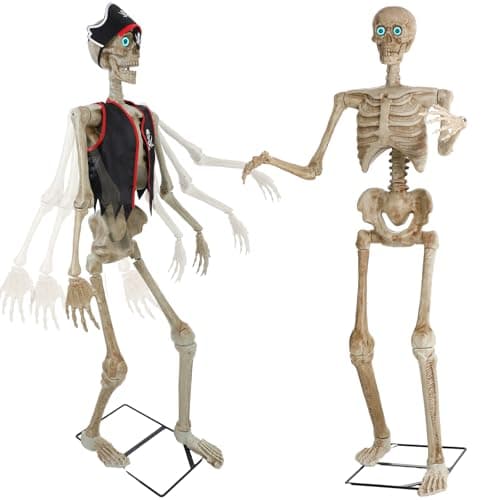
Jenaai IR-activated skeleton animatronic, 5.3 ft
Six motor combinations across arms, torso, head and eyes
8.5
/ 10
The pick on movement, by a distance. Six motors moving four separate body regions is what separates an animatronic from a prop that twitches.
Published specifications
- Height
- 5.3 ft
- Motors
- Six motor combinations
- Moving parts
- Arms, torso, head, eyes
- Head motion
- Turns side to side and nods up and down
- Activation
- Infrared sensor
- Sound
- Spooky sound effects
- Lighting
- LED glowing movable eyeball
- Body
- Full body posable human bones, pirate clothes
Our scoring
- Published articulation
- 10 / 10
- Activation method
- 9 / 10
- Height
- 5 / 10
- Spec completeness
- 10 / 10
Good
- Six published motor combinations is far more articulation than anything else here and the only motor count in the field
- A posable full body means it still works as a static prop when the batteries die mid-October
Watch out
- 5.3 ft is the shortest of this group, so it reads as a person rather than looming over one
- More motors is more to fail, and no listing here publishes a service life
#ad · Price as of October 25, 2026 · How we are funded
Specs from the Amazon listing (ASIN B0D4YVPDH3), verified 2026-09-10.
#2 — Touch activation and a poseable figure
Haunted Hill Farm poseable talking witch, touch activated
Life-size, poseable, touch activated, battery
5.5
/ 10
The porch pick. Touch activated and poseable, for a covered space where a motion sensor would be firing all night.
Published specifications
- Size
- Life-size; no figure published
- Activation
- Touch activated
- Output
- Lights and sound, talking
- Pose
- Poseable
- Power
- Battery
- Use
- Indoor or covered outdoor
- Props included
- Not stated in the listing
Our scoring
- Published moving parts
- 5 / 10
- Scene value
- 4 / 10
- Activation flexibility
- 8 / 10
- Spec completeness
- 5 / 10
Good
- Touch activation is the only trigger here that fires when someone chooses it, which suits a porch where a motion sensor would run all evening
- Poseable, so the figure can lean on a rail or sit on a step rather than standing to attention
- Battery powered, so there is no cord down the path
Watch out
- No published height, where every other animatronic here publishes one
- Sold for indoor or covered outdoor use only — this is not a lawn piece
- No cauldron or props, where the prop it replaces arrived as a scene
Specs from the Amazon listing (ASIN B09D8S48CJ), verified via the Creators API 2026-10-18. Same Haunted Hill Farm life-size poseable talking witch as the listing it replaces (B08GHDSHHV, now Currently unavailable) — same brand, same figure, and the same published set: life-size, poseable, touch-activated lights and sound, battery operated, indoor or covered outdoor. Every spec line below still holds; none was carried over without checking. This slot earlier held the discontinued BOO BOX witch with cauldron (B0D156MS1R), whose published 6 ft height, moving mouth, hand and broom and lit cauldron no live animatronic here carries.
#3 — A hanging figure that names how it triggers
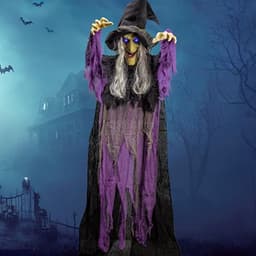
JOYIN hanging animatronic witch, 72 in, sound activated
72 in, sound activated, light-up eyes
6.5
/ 10
Buy it for the trigger. Sound activation is published, the brand is named, and the height is ordinary for this field rather than exceptional.
Published specifications
- Height
- 72 in (6 ft)
- Mounting
- Hanging
- Sound
- Talking
- Lighting
- Light-up eyes
- Use
- Outdoor and indoor
- Moving parts
- Not stated in the listing
- Activation
- Sound activated
Our scoring
- Height
- 6 / 10
- Mounting simplicity
- 8 / 10
- Published articulation
- 5 / 10
- Spec completeness
- 7 / 10
Good
- Publishes its activation method — sound activated — which is one of the three specs this page says define an animatronic and which the listing it replaces withheld
- Hanging mounting means no ground anchoring and no stakes in frozen soil
- A named brand, which is the exception rather than the rule in this field
Watch out
- At 72 in it is no taller than the standing clown here, so hanging it buys you height above head level only if you hang it high
- No published moving parts, which is the one animatronic spec still missing
- A six-foot hanging figure needs a real fixing point, and none is published
Specs from the Amazon listing (ASIN B08BGD1LTF), verified via the Creators API 2026-10-16. Replaces B0DGXKVC3N, the 6.89 ft hanging witch, which Amazon now shows as currently unavailable. No live hanging witch in this field reaches 6.89 ft — the tallest are 72 in — so the slot's height premise could not be carried and has been re-premised on the activation method this listing publishes and the old one did not. The 6.89 ft height and the generic 'scary sounds' claim are NOT on this listing and have been withdrawn.
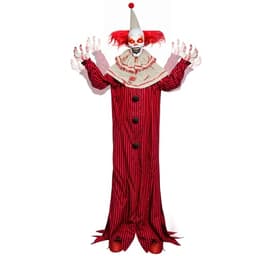
#4 — Named moving parts at a published height
Presence animated clown, 72 in, motion and sound activated
72 in, arms and head named, motion or sound trigger
8.5
/ 10
The pick for anyone who wants to know what will actually move before it arrives. It and the six-motor skeleton are the only two props here that publish a height AND name the parts that move.
Published specifications
- Height
- 72 in (6 ft)
- Activation
- Motion and sound
- Moving parts
- Arms and head, both named
- Lighting
- Red light-up eyes
- Mounting
- Standing
- Use
- Outdoor, yard, patio
- Sound output
- Not stated in the listing
Our scoring
- Activation method
- 10 / 10
- Height
- 8 / 10
- Published articulation
- 9 / 10
- Spec completeness
- 7 / 10
Good
- Names the moving parts — arms and head — which on this page is the specification that separates a comparable prop from an 'animated' one
- 72 in is published, so it can be sized against a doorway or a porch post
- Publishes both triggers, so the same prop works on a walkway on motion or in a crowd on sound
Watch out
- Says it is sound activated but never says it makes a sound, so whether it is silent is unknown
- A clown reads as a specific kind of scary, and it is the look most likely to frighten the youngest trick-or-treaters off the path
Specs from the Amazon listing (ASIN B0D5MJXCZ7), verified via the Creators API 2026-10-25. Replaces the 72 in animated nun (B0D1Y8LPGL), which Amazon now shows as currently unavailable — the second death in this slot after the ELAMAS 72 in witch (B0CSXTPR8J). It holds both halves of what the slot is for, a proximity trigger at a published height, and publishes MORE than the dead listing did: the moving parts are named as arms and head where the nun only claimed to move, and both triggers are listed rather than one. The nun's 'creepy sound' output claim is NOT on this listing and has been withdrawn; the figure is a clown rather than a nun.

#5 — skip this
Hanging animatronic witch, 72 in, bright eyes
72 in hanging figure, nothing else published
2.8
/ 10
Our skip. It is called an animatronic and publishes nothing that moves, on a page where everything else names its trigger.
Published specifications
- Height
- 72 in (6 ft)
- Mounting
- Hanging
- Lighting
- Bright eyes
- Activation
- Not stated in the listing
- Moving parts
- Not stated in the listing
- Sound
- Not stated in the listing
Our scoring
- Height
- 7 / 10
- Activation method
- 1 / 10
- Published articulation
- 1 / 10
- Spec completeness
- 2 / 10
Good
- 72 in is published, and a hanging figure needs no floor space
Watch out
- Sold as animatronic with no published trigger, no published movement and no published sound
- Lit eyes are the only published effect
- The least documented prop on a page where the others publish a trigger and a motion
#ad · Price as of October 25, 2026 · How we are funded
Specs from the Amazon listing (ASIN B091H2GRX3), verified via the Creators API 2026-10-05. Replaces the discontinued 6 ft hanging witch (B0D69Q4BP7), whose published motion activation this listing does not state.
How we ranked these
Published motors or named moving parts first. Then activation method, because a prop that fires at the wrong moment is a prop that does not work. Then height. Nothing here has been seen operating by us; every figure is one the listing prints.
| Prop | Height | Published movement | Activation | Sound |
|---|---|---|---|---|
| Jenaai skeleton | 5.3 ft | 6 motors: arms, torso, head, eyes | Infrared sensor | Yes |
| Haunted Hill Farm witch | Not stated | Poseable; talking | Touch | Covered only |
| JOYIN 72 in hanging witch | 72 in | Not stated | Sound activated | Yes |
| 72 in animated clown | 72 in | Arms and head | Motion and sound | Not stated |
| 72 in hanging witch | 72 in | Not stated | Not stated | Not stated |
One listing in five publishes a motor count. Two name their moving parts. Two publish neither, on a product category defined by movement.
Source: Manufacturer listings on Amazon.com, verified September 2026.
Six motors against one
The Jenaai skeleton publishes six motor combinations driving the arms, the torso, the head and the eyes, with the head turning side to side and nodding. That is the single most specific movement claim in this whole category.
It matters because the difference between a good animatronic and a disappointing one is almost entirely how many independent things move. A prop whose only motion is a head turn is a prop that has one trick, and after a dozen trick-or-treaters everyone on the street has seen it. Six motors across four body regions gives it a sequence.
The arithmetic
- Jenaai: 6 motors across 4 body regions
- BOO BOX: 3 named moving parts (mouth, hand, broom)
- 6 / 3 = 2
- Two listings publish neither a motor count nor a named moving part
Twice the published articulation between the top two, and no basis at all for ranking the bottom two on the spec that defines the category.
Motion, sound, or a button
Activation is the spec that decides whether the prop works on the night, and there are three approaches in this field. Infrared and motion sensors fire when someone approaches, which is what you want on a walkway. Sound activation fires on ambient noise, which is what you want in a crowd and emphatically not what you want beside a busy road.
One prop here publishes both triggers. The animated clown lists motion and sound activation, so the same figure can take the walkway on motion or the crowd on sound, and the Haunted Hill Farm witch publishes touch activation — the right answer on a porch, where a motion sensor fires all evening.
Height, and the difference between standing and hanging
Two of these hang and three stand, and the height numbers mean different things in each case. A standing 72 in prop is at adult eye level, and so is a 72 in hanging one if you hang it at ground level — which is the point most people miss. Nothing in this field now publishes a figure taller than 72 in, so with a hanging prop the height that matters is the height of the fixing, not the height of the figure.
Hanging also solves the problem that eats most Halloween yard displays: anchoring. There is no stake to drive into hard October ground and nothing to blow over — but there is a fixing point overhead carrying the full weight of the prop in wind, which is not a nail in a porch beam. The anchoring principles are on anchoring a yard piece.
Power, and the circuit it shares
An animatronic with motors is a different electrical load from a prop with LEDs, and it is a load that spikes on activation rather than sitting flat. On a display circuit already carrying lights, projectors and an inflatable blower, that spike is where breakers trip.
Work the whole circuit rather than the prop — the 80 percent continuous-load arithmetic is on Halloween yard display power, and the general rule on how many amps. Every outdoor prop needs a GFCI outlet and an outdoor-rated cord, without exception.
Animated is not automatically better
Worth saying on a page selling animatronics: a well-lit static scene often beats a single animated prop, and it always beats a broken one. Motors fail, sensors misfire in rain, and a prop stuck mid-sequence is worse than no prop.
The full argument, including where animation earns its cost, is on animated vs static Halloween decorations. If the yard has children under about six coming through it, family-friendly Halloween decorations is the page to read first — a sound-activated six-foot witch is not a family-friendly prop.
Light it or lose it
An unlit animatronic in a dark yard is a shape that moves. Most of these publish light-up eyes and nothing else, which is atmosphere rather than illumination.
One low, angled light from the side does more for a prop than anything built into it — uplighting from directly in front flattens the figure and washes out the face. The method is on Halloween display lighting.
A six-foot prop is a storage problem in November
This is the part nobody costs in. A 6 ft animatronic does not fold into a tote, its motors do not like damp, and it comes out of the yard on November 1st needing somewhere to go for eleven months.
Keep the original carton if it has one, keep the prop off a concrete floor, and take the batteries out of anything that has them. The category-specific method is on Halloween decoration storage and the damp problem on damp and pest protection.
Questions
›What should I look for in a Halloween animatronic?
A published motor count or named moving parts, and a stated activation method. One listing in five here publishes a motor count. A prop whose only published movement is light-up eyes is a static prop with a sensor.
›Is motion activation or sound activation better?
Motion, for a walkway — it fires on approach. Sound activation fires on ambient noise, which is useful in a crowd and a problem beside traffic. One prop here publishes both, which is the most flexible arrangement.
›How tall should a Halloween animatronic be?
A standing prop at around 72 in is at adult eye level, which is where it works. Every figure here tops out at 72 in, so a hanging prop only gets above head height if you hang it high — the fixing does the work, not the figure.
›Do Halloween animatronics need their own circuit?
Not their own, but they need to be counted. Motors draw a spike on activation rather than a flat load, which is what trips a breaker on a display circuit already running lights and a blower. Use a GFCI outlet and an outdoor-rated cord.
Sources
- Jenaai IR-activated skeleton listing (ASIN B0D4YVPDH3) — 5.3 ft, six motor combinations, arms, torso, head and eyes, head turns and nods, IR sensor, sound effects, LED movable eyeball, posable
- Haunted Hill Farm poseable talking witch listing (ASIN B09D8S48CJ) — Life-size, poseable, touch activated, lights and sound, battery, indoor or covered outdoor
- JOYIN 72 in hanging animatronic witch listing (ASIN B08BGD1LTF) — 72 in, hanging, talking, sound activated, light-up eyes, outdoor and indoor; no moving parts published
- Presence 72 in animated clown listing (ASIN B0D5MJXCZ7) — 72 in, standing, motion and sound activated, moving arms and head, red light-up eyes, outdoor; no sound output stated
- 72 in hanging animatronic witch listing (ASIN B091H2GRX3) — 72 in, hanging, bright eyes; no trigger, movement or sound published
- Articulation comparison — Our arithmetic from the published motor counts and named moving parts
We have not tested these products. Every figure above comes from a published manufacturer specification or from arithmetic shown on this page, and anything a maker does not publish is printed as unavailable rather than estimated. How that works, and what we will not claim, is set out on how we research.