The best C6 Christmas lights, and how they differ from C7 and C9
C6 is the small faceted bulb at roughly three to the foot. That density is the whole reason to buy it, and it is the number most listings refuse to publish.
By Sawyer V. · Published
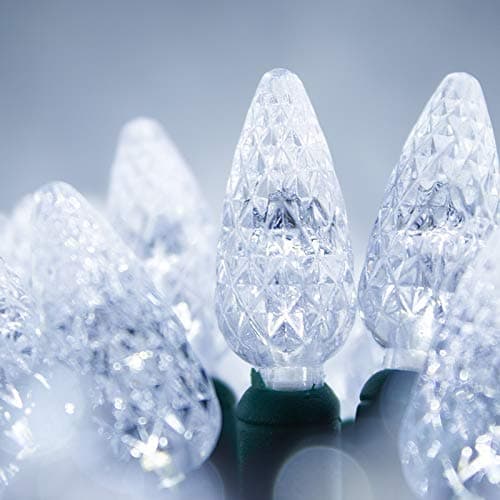
C6 is the small faceted bulb — the strawberry shape, on a short stub of a base, sitting close enough to its neighbor that a string reads as a continuous line of light rather than a row of separate points. It is the format people reach for on a tree, a bush, a handrail or a short porch run, and it is the one most likely to be sold with no useful specification at all.
Everything that matters about C6 comes down to one figure: how far apart the bulbs sit. A listing that publishes both the bulb count and the string length gives you that for free. A listing that publishes only one of them is asking you to guess. Five strings below, ranked on exactly that, with one to skip.
Wreath & Watt earns a commission on qualifying purchases made through the Amazon links on this page. It costs you nothing and it does not change the order of the picks — here is exactly how we are funded.
Quick picks
| # | Product | Best for | Score | Price |
|---|---|---|---|---|
| 1 |  C6 LED string, 70 bulbs / 24 ft, cool white, green wire, commercial grade70 C6 bulbs over 24 ft — about 4 in apart C6 LED string, 70 bulbs / 24 ft, cool white, green wire, commercial grade70 C6 bulbs over 24 ft — about 4 in apart | The only string here that publishes count, length and grade | 7.3/ 10 | $24.99Amazon #ad · Price as of October 10, 2026 · Disclosure |
| 2 |  YULETIME C6 LED string, 100 bulbs / 33 ft, cool white, one-piece100 bulbs over 33 ft, one-piece construction YULETIME C6 LED string, 100 bulbs / 33 ft, cool white, one-piece100 bulbs over 33 ft, one-piece construction | A tree, and weather | 7.3/ 10 | $25.99Amazon #ad · Price as of October 10, 2026 · Disclosure |
| 3 |  FGDECORJOIE C6 LED string, 70 bulbs / 24.8 ft, warm white, connectable70 bulbs over 24.8 ft, connectable, warm white FGDECORJOIE C6 LED string, 70 bulbs / 24.8 ft, warm white, connectable70 bulbs over 24.8 ft, connectable, warm white | Warm white, and joining strings | 7.0/ 10 | $17.99Amazon #ad · Price as of October 10, 2026 · Disclosure |
| 4 |  Wintergreen Lighting C6 LED string, 70 bulbs, multicolor70 C6 bulbs, multicolor; length not published Wintergreen Lighting C6 LED string, 70 bulbs, multicolor70 C6 bulbs, multicolor; length not published | Multicolor from a known name | 5.3/ 10 | $23.99Amazon #ad · Price as of October 10, 2026 · Disclosure |
| 5 |  C6 LED string on a spool, 150 bulbs, warm white on green wire150 bulbs, no published lengthSkip this C6 LED string on a spool, 150 bulbs, warm white on green wire150 bulbs, no published lengthSkip this | Skip | 2.8/ 10 | $49.97Amazon #ad · Price as of October 10, 2026 · Disclosure |
Scores are our own weighting of published manufacturer specifications, explained in full on how we research. They are not test results. We have not tested these products.
The picks in full
#1 — The only string here that publishes count, length and grade
C6 LED string, 70 bulbs / 24 ft, cool white, green wire, commercial grade
70 C6 bulbs over 24 ft — about 4 in apart
7.3
/ 10
The pick. On a page about spacing, the string that publishes the two numbers spacing is made of wins.
Published specifications
- Bulbs
- 70 C6 LED, cool white
- Length
- 24 ft
- Spacing
- About 4 in (24 ft over 70 bulbs — our arithmetic)
- Wire
- Green
- Grade
- Commercial grade, per the listing
- Use
- Indoor and outdoor
- Wattage per string
- Not stated in the listing
- Connected run limit
- Not stated in the listing
Our scoring
- Published figures
- 9 / 10
- Density
- 8 / 10
- Build claims
- 7 / 10
- Run planning
- 5 / 10
Good
- Publishes both the bulb count and the string length, which is the only way to know the spacing before it arrives
- Commercial grade is claimed on a string sold at consumer prices
- 24 ft is a useful unit: it covers a garage front or one side of a porch without a join
Watch out
- No brand named in the listing, so there is nothing to hold the commercial-grade claim to
- Cool white only in this listing, which is a colder look than most house fronts want
- No wattage and no end-to-end limit, so how many you can join is guesswork
#ad · Price as of October 10, 2026 · How we are funded
Specs from the Amazon listing (ASIN B00EZ548OA), verified via the Creators API 2026-09-25.
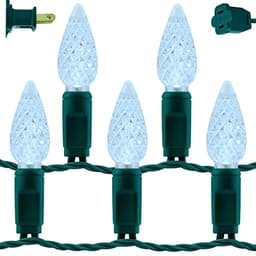
#2 — A tree, and weather
YULETIME C6 LED string, 100 bulbs / 33 ft, cool white, one-piece
100 bulbs over 33 ft, one-piece construction
7.3
/ 10
Best for a tree. Buy in hundreds, and accept that a sealed string is replaced rather than repaired.
Published specifications
- Bulbs
- 100 C6 LED, cool white
- Length
- 33 ft
- Spacing
- About 4 in (33 ft over 100 bulbs — our arithmetic)
- Construction
- One-piece — bulbs are molded to the wire, not replaceable
- Wire color
- Not stated in the listing
- Connected run limit
- Not stated in the listing
Our scoring
- Published figures
- 8 / 10
- Density
- 8 / 10
- Build claims
- 8 / 10
- Run planning
- 5 / 10
Good
- 100 bulbs to a string is the count that makes tree arithmetic simple
- One-piece construction seals the bulb to the wire: nothing to unscrew means no socket for water to sit in
- Publishes count and length, so the spacing works out the same 4 in as the pick
Watch out
- One-piece means one dead bulb cannot be swapped out — the LED is sealed in
- Cool white only in this listing
- Wire color not stated, which matters on a green tree
#ad · Price as of October 10, 2026 · How we are funded
Specs from the Amazon listing (ASIN B09VY2ZJTG), verified via the Creators API 2026-09-25.
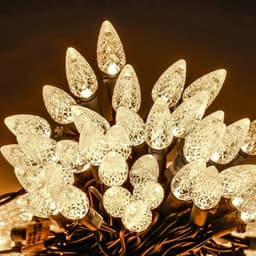
#3 — Warm white, and joining strings
FGDECORJOIE C6 LED string, 70 bulbs / 24.8 ft, warm white, connectable
70 bulbs over 24.8 ft, connectable, warm white
7.0
/ 10
Best warm white. The only string here that says it joins, even if it will not say how many.
Published specifications
- Bulbs
- 70 C6 LED, warm white
- Length
- 24.8 ft
- Spacing
- About 4.3 in (24.8 ft over 70 bulbs — our arithmetic)
- Wire
- Green
- Connectable
- Yes, per the listing
- Use
- Indoor and outdoor, and sold for spring and summer too
- Connected run limit
- Not stated in the listing
Our scoring
- Published figures
- 8 / 10
- Density
- 7 / 10
- Build claims
- 6 / 10
- Run planning
- 7 / 10
Good
- Warm white on green wire is the combination most house fronts actually want
- Connectable is stated, which the other strings here leave you to guess at
- Sold for spring and summer as well as Christmas, so it earns its storage space
Watch out
- Connectable with no published end-to-end limit is half an answer
- The widest spacing here at about 4.3 in, which is a slightly thinner line of light
- No wattage published
#ad · Price as of October 10, 2026 · How we are funded
Specs from the Amazon listing (ASIN B0DGV8957P), verified via the Creators API 2026-09-25.

#4 — Multicolor from a known name
Wintergreen Lighting C6 LED string, 70 bulbs, multicolor
70 C6 bulbs, multicolor; length not published
5.3
/ 10
The multicolor choice, bought on the brand rather than on the numbers. The same company publishes far more about its bigger bulbs.
Published specifications
- Bulbs
- 70 C6 LED, multicolor
- Length
- Not stated in the listing
- Spacing
- Not calculable — the listing publishes no length
- Wire
- Not stated in the listing
- Connected run limit
- Not stated in the listing
Our scoring
- Published figures
- 4 / 10
- Density
- 6 / 10
- Build claims
- 7 / 10
- Run planning
- 4 / 10
Good
- Wintergreen Lighting is the brand behind the C7 and C9 OptiCore strings we rank first on those pages
- The only multicolor option here, and multicolor is most of what C6 is bought for
Watch out
- No published length, so the spacing — the whole point of choosing C6 — cannot be worked out
- No wire color and no run limit published, which the same brand does publish on its C7 and C9 strings
#ad · Price as of October 10, 2026 · How we are funded
Specs from the Amazon listing (ASIN B005T0QEUQ), verified via the Creators API 2026-09-25.
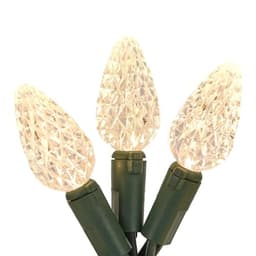
#5 — skip this
C6 LED string on a spool, 150 bulbs, warm white on green wire
150 bulbs, no published length
2.8
/ 10
Our skip. Every other string here tells you either how long it is or how many bulbs are on it; this one gives the count and hides the number that makes it mean something.
Published specifications
- Bulbs
- 150 C6 LED, warm white
- Length
- Not stated in the listing
- Spacing
- Not calculable — the listing publishes no length
- Wire
- Green
- Format
- On a spool
- Connected run limit
- Not stated in the listing
Our scoring
- Published figures
- 1 / 10
- Density
- 5 / 10
- Build claims
- 3 / 10
- Run planning
- 2 / 10
Good
- 150 bulbs is the highest count here, and a spool is genuinely easier to pay out along a gutter
Watch out
- No published length, so on a 150-bulb string the spacing could be 3 in or 8 in and you cannot tell which
- No brand, so there is nobody to ask
- A spool is a bulk format, and bulk is exactly where published spacing matters most
#ad · Price as of October 10, 2026 · How we are funded
Specs from the Amazon listing (ASIN B078G1F5WY), verified via the Creators API 2026-09-25.
How we ranked these
Published count and published length first, because together they give the spacing and spacing is the reason anyone buys C6 instead of C9. Then construction: whether the bulb screws into a socket or is sealed to the wire. Then wire color and bulb color, which are the decisions you cannot change later. Then whatever the listing says about joining strings end to end.
We do not rank on brightness. No C6 listing in this field publishes a lumen figure per bulb, and one C6 bulb is not a product anybody buys on its own; the string is the unit, and the string is what these figures describe.
| String | Bulbs | Length | Spacing (ours) | Construction |
|---|---|---|---|---|
| 70 ct / 24 ft | 70 | 24 ft | About 4 in | Not stated |
| YULETIME 100 ct | 100 | 33 ft | About 4 in | One piece, sealed |
| FGDECORJOIE 70 ct | 70 | 24.8 ft | About 4.3 in | Not stated |
| Wintergreen 70 ct | 70 | Not stated | Not calculable | Not stated |
| 150 ct on a spool | 150 | Not stated | Not calculable | Not stated |
Spacing is our arithmetic — published length divided by published bulb count — not a manufacturer figure. Two of these five publish no length, so their spacing cannot be worked out at all.
Source: Manufacturer listings on Amazon.com, verified September 2026.
What a C6 bulb is, and what no listing will tell you
C6, C7 and C9 are bulb-base and bulb-shape designations, and the numbers run in the direction you would expect: C6 is the smallest of the three, C9 the largest. That is as far as the listings go. Not one C6 string in this field publishes a bulb diameter or a bulb height, and neither do the C7 and C9 strings we rank on their own pages. If you want the physical size of the bulb, you are measuring one in your hand or you are trusting a photograph.
What the listings do publish is the count and the length, and that turns out to be the more useful pair anyway. Bulb size decides how a single bulb looks close up. Spacing decides how the run looks from the sidewalk, which is where every decoration is actually judged.
C6 against C7 and C9, on the figures that exist
This is the comparison people search for, and it is answerable in one line of arithmetic. The C7 and C9 commercial strings we rank on the C7 page and the C9 page publish 25 bulbs over 25 ft, which is a socket every 12 inches. The C6 strings here publish about four inches.
The arithmetic
- C6 pick: 70 bulbs over 24 ft = 288 in / 70 = about 4.1 in apart
- C7 and C9 commercial strings: 25 bulbs over 25 ft = 12 in apart
- 12 / 4.1 = about 3
- A 100 ft roofline in C9 at 12 in: 100 bulbs = four 25 ft strings
- The same 100 ft in C6 at 4.1 in: 1,200 / 4.1 = about 290 bulbs = three 100-count strings
Same run, three times the bulbs. C6 gives a dense, continuous line of small lights; C9 gives a widely spaced row of large ones. Neither is better — they are different looks, and the arithmetic is how you choose between them rather than the photographs.
Two practical consequences fall out of that ratio. First, C6 needs more strings to cover the same distance, so the cost per foot is usually higher than it looks per string. Second, C9 reads from much further away: a big bulb every foot is legible from across a street in a way that three small bulbs per foot is not. If the display is meant to be seen from a passing car, that is the argument for going bigger, and it is worked through on choosing the bulb format first.
The third consequence is electrical, and it runs the other way. Three times the bulbs is not three times the load, because an LED C6 draws a fraction of a watt; but it is still more bulbs on the circuit, and none of these C6 listings publishes a wattage. The C7 OptiCore string on our C7 page publishes 0.8 W per bulb and a 480 W end-to-end limit, which is exactly the kind of figure that lets you plan a run. Work your own total through how many amps a display draws before you add a fourth string to a circuit.
How many strings a tree or a run takes
C6 is bought by the count far more often than by the foot, because most of it goes on trees and bushes rather than along a straight gutter. The site convention for a fully lit tree is 100 lights per vertical foot, and at that density C6 strings add up quickly.
The arithmetic
- A 7.5 ft tree at 100 lights per vertical foot = 750 bulbs
- In 100-count strings: 750 / 100 = 7.5, so 8 strings
- In 70-count strings: 750 / 70 = 10.7, so 11 strings
- A 20 ft porch rail at about 4 in spacing: 240 / 4.1 = about 59 bulbs, so one 70-count string
Buy C6 in hundreds for a tree and in seventies for a rail or a doorway. The 100-count string is three fewer joins on a 7.5 ft tree, and every join is a plug hanging in a branch.
For the tree arithmetic in full, including density by tree height rather than by string, see how many Christmas lights do I need and the lights calculator.
One piece or a socket
The single construction difference worth understanding in C6 is whether the bulb sits in a socket or is sealed to the wire. The YULETIME string publishes one-piece construction, which means the LED is molded into the lens and the lens into the wire. There is no socket, and a socket is where water collects and where corrosion starts on an outdoor run.
The trade is repairability. A socketed string lets you swap one dead bulb; a one-piece string does not, and when a section goes the string is replaced. On modern LED sets that matters less than it used to, because the common failure is a wire or a rectifier rather than a single diode, but it is the honest cost of the sealed design. Our troubleshooting guide covers which failures are worth chasing.
Joining strings, and the limit nobody publishes
One C6 string rarely finishes a job. Joining them is normal and safe within a published limit — and a published limit is exactly what this category does not have. The FGDECORJOIE string is the only one here that says it is connectable at all, and even it gives no maximum. That is a meaningful gap against the commercial C7 and C9 strings, which publish both a wattage per bulb and an end-to-end figure.
In the absence of a published limit, the safe practice is the conservative one: keep joined runs short, use the manufacturer’s own fused plug rather than an adapter, and count the total load yourself. The mechanics of joining, and what the fuse in the plug is actually protecting, are on connecting light strings.
Why the spool set is the skip
The 150-bulb spool publishes a count and nothing else. On a 150-bulb string the spacing could be three inches or eight, and those two strings look nothing alike and cover wildly different distances — somewhere between 37 ft and 100 ft on the same published count. A spool is a bulk format, and bulk is where the length matters most, because you are buying it to run somewhere specific.
The Wintergreen multicolor string has the same missing figure and keeps its place only because it is the one multicolor option here and because the brand publishes far more on its larger bulbs. If you want multicolor C6, it is the one to buy; just measure it when it arrives.
Where C6 fits in the rest of the display
C6 is the close-range format: trees, bushes, railings, doorways, wreaths. The roofline is usually C7 or C9 for the reach, the eaves are usually icicle lights, and the path is its own job on Christmas pathway lights. Before you buy anything, the LED-against-incandescent decision sets the running cost and the number of strings per circuit: LED vs incandescent has that arithmetic in full, and Christmas tree lights covers what goes on the tree itself.
Questions
›What is the difference between C6 and C9 Christmas lights?
Bulb size and, more usefully, spacing. The C6 strings here publish about four inches between bulbs; the commercial C7 and C9 strings publish twelve. That is roughly three times as many bulbs on the same foot of run, so C6 reads as a continuous line of small lights and C9 as a widely spaced row of large ones.
›How many C6 lights do I need for a 7.5 ft tree?
About 750 bulbs at 100 lights per vertical foot — eight 100-count strings, or eleven 70-count strings. The 100-count strings mean three fewer plugs hanging in the branches.
›How far apart are C6 bulbs?
About four inches on every string here that publishes both a count and a length. It is not a figure any of these listings states directly; it is the published length divided by the published bulb count.
›Are one-piece C6 lights better than replaceable bulbs?
Outdoors, a sealed one-piece string has no socket for water to sit in, which is the usual starting point for corrosion. The cost is that a dead bulb cannot be swapped, so the string is replaced rather than repaired.
Sources
- 70-count 24 ft C6 string listing (ASIN B00EZ548OA) — 70 C6 LED, cool white, 24 ft, green wire, commercial grade, indoor and outdoor
- YULETIME 100-count C6 listing (ASIN B09VY2ZJTG) — 100 C6 LED, cool white, 33 ft, one-piece construction
- FGDECORJOIE 70-count C6 listing (ASIN B0DGV8957P) — 70 C6 LED, warm white, 24.8 ft, green wire, connectable
- Wintergreen Lighting 70-count C6 listing (ASIN B005T0QEUQ) — 70 C6 LED, multicolor; no length published
- 150-count C6 spool listing (ASIN B078G1F5WY) — 150 C6 LED, warm white, green wire, on a spool; no length published
- Wintergreen C7 OptiCore listing (ASIN B076HXKGGZ) — 25 C7 bulbs over 25 ft, sockets 12 in apart, 0.8 W per bulb, 480 W end-to-end limit — the C7 and C9 figures used in the comparison
- Spacing and coverage arithmetic — Published length divided by published bulb count; bulbs per 100 ft run; strings per tree at 100 lights per vertical foot — our arithmetic, with every assumption stated
We have not tested these products. Every figure above comes from a published manufacturer specification or from arithmetic shown on this page, and anything a maker does not publish is printed as unavailable rather than estimated. How that works, and what we will not claim, is set out on how we research.