The best Christmas pathway lights, ranked on the numbers that size a walkway
Almost every set is ten markers. What decides the purchase is how tall they stand, how far the run reaches, and how many sets you can link.
By Sawyer V. · Published
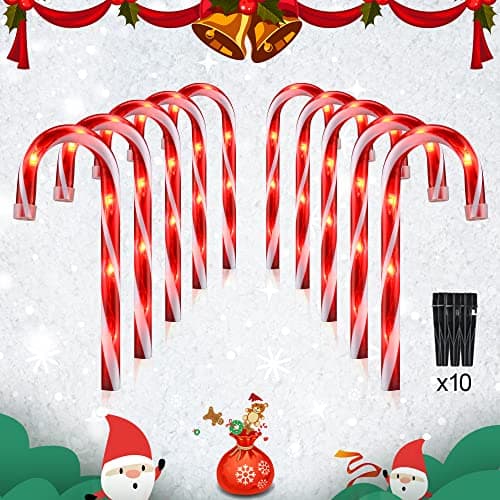
Pathway lights are the one holiday format bought by the box rather than by the foot, and that is exactly why people end up with three markers spare and a dark ten feet at the end of the drive. A set of ten does not cover a path; a set of ten covers about eleven feet.
So this page ranks on the three numbers that decide whether a set fits your walkway: published marker height, published run length, and published linking capacity. Five sets below, with the arithmetic for turning a tape measure into an order.
Wreath & Watt earns a commission on qualifying purchases made through the Amazon links on this page. It costs you nothing and it does not change the order of the picks — here is exactly how we are funded.
Quick picks
| # | Product | Best for | Score | Price |
|---|---|---|---|---|
| 1 |  PerPaiMe candy cane pathway lights, 10 in, set of 1011.3 ft total run for 10 markers — 1.13 ft per marker PerPaiMe candy cane pathway lights, 10 in, set of 1011.3 ft total run for 10 markers — 1.13 ft per marker | The set that publishes its full run length | 8.3/ 10 | |
| 2 |  21 in candy cane pathway markers, 10 pack, 60 LED21 in tall — twice the height of the 10 in field 21 in candy cane pathway markers, 10 pack, 60 LED21 in tall — twice the height of the 10 in field | Height above the snow line | 8.3/ 10 | $29.96Amazon #ad · Price as of October 25, 2026 · Disclosure |
| 3 |  Candy cane pathway markers, 20 in, 12 pack, connectableConnectable, 12 markers at a published 20 in Candy cane pathway markers, 20 in, 12 pack, connectableConnectable, 12 markers at a published 20 in | Long paths built from multiple sets | 5.0/ 10 | |
| 4 |  COOLWUFAN candy cane pathway lights, 17 in, 12 pack12 markers at a published 17 in COOLWUFAN candy cane pathway lights, 17 in, 12 pack12 markers at a published 17 in | The most markers at a published height | 5.0/ 10 | |
| 5 |  Candy cane pathway lights, 8 pack, 48 LED red and green6 LEDs per marker across only 8 markersSkip this Candy cane pathway lights, 8 pack, 48 LED red and green6 LEDs per marker across only 8 markersSkip this | Skip | 3.5/ 10 | $39.99Amazon #ad · Price as of October 25, 2026 · Disclosure |
Scores are our own weighting of published manufacturer specifications, explained in full on how we research. They are not test results. We have not tested these products.
The picks in full
#1 — The set that publishes its full run length
PerPaiMe candy cane pathway lights, 10 in, set of 10
11.3 ft total run for 10 markers — 1.13 ft per marker
8.3
/ 10
Buy this one if you have measured your path, because it is the only set that lets you do the arithmetic before you order.
Published specifications
- Markers
- 10
- Marker height
- 10 in
- Stake length
- 5 in
- Total run length
- 11.3 ft
- Bulbs per marker
- 5
- Ground stakes
- 10 included
- Spacing between markers
- 1.13 ft (11.3 ft over 10 markers — our arithmetic)
Our scoring
- Published run length
- 10 / 10
- Stake spec
- 9 / 10
- Marker height
- 5 / 10
- Spec completeness
- 9 / 10
Good
- The only set here that publishes total run length, which is the number that decides whether it fits your path
- A stated 5 in stake is long enough to hold in soil that has not frozen yet
Watch out
- 1.13 ft between markers is close spacing — a 30 ft path needs three sets, not one
- 10 in is short enough to disappear under two inches of snow
Specs from the Amazon listing (ASIN B09C81C7F5), verified 2026-09-10.
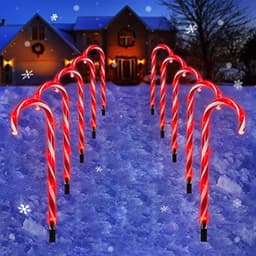
#2 — Height above the snow line
21 in candy cane pathway markers, 10 pack, 60 LED
21 in tall — twice the height of the 10 in field
8.3
/ 10
The pick for anywhere that gets real snow. Everything else here is a decoration; this one is still a path marker in February.
Published specifications
- Markers
- 10
- Marker height
- 21 in
- LEDs
- 60 red
- LEDs per marker
- 6 (60 over 10 markers — our arithmetic)
- Modes
- 8 flashing modes, memory function
- Connection
- End-to-end plug
- Rated LED life
- 30,000 hours
- Weatherproofing
- Waterproof (no IP code stated)
Our scoring
- Marker height
- 10 / 10
- Published LED life
- 9 / 10
- LEDs per marker
- 6 / 10
- Spec completeness
- 8 / 10
Good
- At 21 in these stay visible through the snow depth that buries a 10 in marker
- A published 30,000 hour LED life and a memory function are both rare in this category
Watch out
- 6 LEDs per marker is the middle of this field, not the top — height is what you are buying
- Waterproof with no IP code is a claim, not a rating
#ad · Price as of October 25, 2026 · How we are funded
Specs from the Amazon listing (ASIN B08JQLF564), verified 2026-09-10.
#3 — Long paths built from multiple sets
Candy cane pathway markers, 20 in, 12 pack, connectable
Connectable, 12 markers at a published 20 in
5.0
/ 10
The set to buy when the path is longer than one box. It publishes that it connects; nothing here publishes how far.
Published specifications
- Markers
- 12
- Marker height
- 20 in
- Connection
- Connectable, per the listing
- Maximum linked sets
- Not stated in the listing
- LEDs per marker
- Not stated in the listing
- Total run length
- Not stated in the listing
Our scoring
- Linking capacity
- 6 / 10
- Published height
- 9 / 10
- LED spec
- 1 / 10
- Spec completeness
- 4 / 10
Good
- The only set here that still publishes connectability, which is what lets a drive edge be built out of boxes
- Within an inch of the tallest marker on the page, and it carries two more of them
Watch out
- Connectable with no published limit, so how many boxes can chain is unknown until you try
- No LED count and no run length published, so brightness and reach are both guesses
Specs from the Amazon listing (ASIN B0FG2HQMQK), verified via the Creators API 2026-10-03. Replaces the discontinued VCOKEN set (B09C87866X), whose published 14-set linking limit and 11 ft run length no live pathway listing here carries.
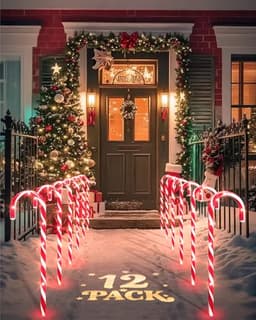
#4 — The most markers at a published height
COOLWUFAN candy cane pathway lights, 17 in, 12 pack
12 markers at a published 17 in
5.0
/ 10
The marker-count pick. Twelve at a published height is a sensible middle of this field, as long as the path is one box long.
Published specifications
- Markers
- 12
- Marker height
- 17 in
- LEDs per marker
- Not stated in the listing
- Total run length
- Not stated in the listing
- Connection
- Not stated in the listing
Our scoring
- Marker count
- 9 / 10
- Published height
- 7 / 10
- LED spec
- 1 / 10
- Spec completeness
- 3 / 10
Good
- Twelve markers rather than ten, which is two more markers of lit path out of one box
- 17 in clears a normal snowfall where the 10 in markers disappear into it
Watch out
- No published LED count, run length or linking limit, so a long path cannot be planned from this listing
- Shorter than the two tall sets here without publishing anything they do not
Specs from the Amazon listing (ASIN B0B5TTFHJ3), verified via the Creators API 2026-10-03. Replaces the discontinued 100 LED set (B098F4X7V5), whose published 10 LEDs per marker no live pathway listing here carries.
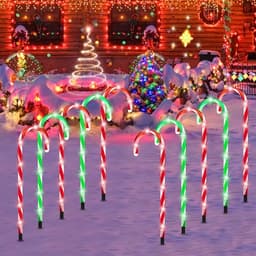
#5 — skip this
Candy cane pathway lights, 8 pack, 48 LED red and green
6 LEDs per marker across only 8 markers
3.5
/ 10
Our skip. Fewer markers than the field at the same published LED density, and none of the dimensions you need to place them.
Published specifications
- Markers
- 8
- LEDs
- 48
- LEDs per marker
- 6 (48 over 8 markers — our arithmetic)
- Color
- Red and green
- Marker height
- Not stated in the listing
- Total run length
- Not stated in the listing
Our scoring
- Marker count
- 4 / 10
- LEDs per marker
- 6 / 10
- Published dimensions
- 1 / 10
- Spec completeness
- 3 / 10
Good
- Red and green is the one genuine color option in a field that is otherwise all red
Watch out
- Eight markers instead of ten means buying two sets to cover what one and a half of the others do
- No published height, no published run length and no stake spec — nothing to plan a path with
#ad · Price as of October 25, 2026 · How we are funded
Specs from the Amazon listing (ASIN B09FHWVB6G), verified 2026-09-10.
How we ranked these
Four criteria, in this order: published run length or height (can you plan with it), published LEDs per marker (is it actually lit), linking capacity (can you extend it), and how complete the specification is overall. No brightness claim here has been measured by anyone; every figure below is one the listing prints.
| Set | Markers | Height | LEDs per marker | Run length |
|---|---|---|---|---|
| PerPaiMe | 10 | 10 in | 5 bulbs | 11.3 ft |
| 21 in, 60 LED | 10 | 21 in | 6 | Not stated |
| 20 in, connectable | 12 | 20 in | Not stated | Not stated |
| COOLWUFAN, 17 in | 12 | 17 in | Not stated | Not stated |
| 8 pack, 48 LED | 8 | Not stated | 6 | Not stated |
LEDs per marker is our arithmetic where the listing gives a total and a count. One set publishes a run length; three publish an LED count.
Source: Manufacturer listings on Amazon.com, verified September 2026.
How many sets your path actually needs
This is the arithmetic nobody does before ordering, and it is why the PerPaiMe set’s published 11.3 ft matters more than any brightness claim on the page. Ten markers spaced along an 11.3 ft run works out at 1.13 ft between them.
The arithmetic
- PerPaiMe: 11.3 ft run / 10 markers = 1.13 ft between markers
- A 30 ft walkway / 11.3 ft per set = 2.65 sets
- Round up: 3 sets, 30 markers, 33.9 ft of run
- A 60 ft driveway edge / 11.3 = 5.3 sets, so 6
A typical front walk takes three sets, not one. Order on the run length, not on the photograph.
Spacing that tight is a deliberate choice by the manufacturers — a candy cane every thirteen or fourteen inches reads as a continuous edge rather than a row of objects. You can spread them further if the wire has slack, but only the sets that publish a run length tell you how much slack there is.
Height is the spec that survives December
Ten inches is the old default in this category, and ten inches is roughly the depth of one decent snowfall. Three sets here now publish something taller — the 21 in set, the 20 in connectable set and the 17 in COOLWUFAN — and any of the three is still doing its job after weather.
If your winters are dry, height buys you nothing and you should rank on LEDs per marker instead. If they are not, this is the one decision on the page that you cannot fix later.
Linking, and the outlet at the end of it
The 20 in set is the only one here that publishes that it connects at all — and it stops there, without a limit. No set in this group now prints a maximum number of linked boxes, which is a real loss: it was the figure that turned a long drive edge into an order.
Where no limit is published, treat the set as standalone and plan a second feed. The load itself is trivial — these are LED markers — but the connector on the end of a light string is rated for a maximum linked load regardless of what you are plugging into it. The method for working that out is on connecting light strings, and the underlying 80 percent rule is on how many amps.
LEDs per marker, and what it actually changes
Three of the five sets publish a figure you can divide: five bulbs per marker on the PerPaiMe set, six on the 21 in set and six on the 8-pack. One bulb between them is not a buying decision, which is why height and marker count carry this page.
The arithmetic
- 21 in set: 60 LEDs / 10 markers = 6 per marker
- 8 pack: 48 / 8 = 6 per marker
- PerPaiMe: 5 bulbs per marker, published
- 6 / 5 = 1.2
Twenty percent between the brightest and the dimmest published marker, and nothing published at all for the other two sets. The LED figure no longer separates this field.
Which matters depends entirely on whether the path has any other light. Alongside a lit porch, five bulbs is enough to mark an edge. On an unlit side path, no seasonal marker here publishes enough to read as lighting rather than decoration — and at that point you should be looking at proper solar or plug-in path lighting instead of a seasonal set.
Stakes, soil and the November install
The PerPaiMe set publishes a 5 in stake, which is the only stake dimension anyone in this field prints. Five inches holds fine in unfrozen soil and holds nothing at all in frozen ground, which is the argument for installing these in November rather than in December.
The same reasoning applies to every ground-anchored piece in a display — the anchoring detail is covered on anchoring a yard piece, and the timing sequence is on the porch plan, September to December.
Where pathway markers fit in a display
They are the ground layer. A finished front elevation has roofline, mid-level, and ground, and pathway markers are the cheapest way to fill the last of those three. Roofline is on the best outdoor Christmas lights, the mid-level on wrapping trees and columns.
Color-match them to the rest of the display before you order. Almost every set in this category is red, which sits well against warm white and badly against cool white — the reasoning is on warm white vs cool white.
Storing ten small stakes without losing three
Pathway sets are the single most commonly lost item in a decoration store, because they are small, they are wired together, and they come apart. Coil them onto a reel or into their own labeled bin rather than loose in the light box — the method is on how to store Christmas lights, and the labeling convention on labeling and inventory.
Questions
›How many pathway light sets do I need for my walkway?
Divide your path length by the set’s published run length and round up. The one set here that publishes it runs 11.3 ft for ten markers, so a 30 ft walk takes three sets. Where no run length is published, assume roughly a foot per marker.
›How tall should Christmas pathway lights be?
Ten inches is the old category default and it disappears under a couple of inches of snow. If you get real winter weather, buy one of the three sets here that publish 17 in or more; in a dry winter, height buys you nothing.
›Can you connect pathway lights end to end?
Some sets, yes. One set here publishes that it connects, without saying how many boxes can chain. Where the listing publishes no limit, treat the set as standalone rather than assuming it will chain.
›Do pathway lights need a GFCI outlet?
Yes. They sit on the ground outdoors, which is the exact scenario a GFCI outlet exists for. Use an outdoor-rated extension cord and keep the connection off the ground.
Sources
- PerPaiMe candy cane pathway lights listing (ASIN B09C81C7F5) — 10 in, set of 10, 5 in stakes, 11.3 ft total length, 5 bulbs per cane
- 21 in candy cane pathway lights listing (ASIN B08JQLF564) — 21 in, 10 pack, 60 red LEDs, 8 modes, memory function, 30,000 hour rated LED life
- 20 in candy cane pathway markers listing (ASIN B0FG2HQMQK) — 12 pack, 20 in, connectable; no linking limit published
- COOLWUFAN candy cane pathway lights listing (ASIN B0B5TTFHJ3) — 12 pack, 17 in; no LED count published
- 8 pack candy cane set listing (ASIN B09FHWVB6G) — 8 pack, 48 LED, red and green
- Spacing and sets-per-path arithmetic — Our arithmetic from the published run length and marker count
We have not tested these products. Every figure above comes from a published manufacturer specification or from arithmetic shown on this page, and anything a maker does not publish is printed as unavailable rather than estimated. How that works, and what we will not claim, is set out on how we research.