The best rotating Christmas tree stands, and why pole diameter decides the buy
Every stand publishes a tree height it fits. That is the figure that matters least. The one that decides whether it works is the pole diameter range, and two of these five do not print it.
By Sawyer V. · Published
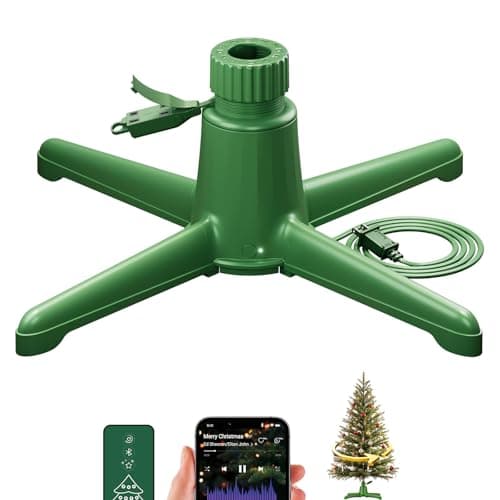
Buy the DG-Direct 9 ft stand: it is the only one here that publishes every figure you need — a 9 ft height limit, a 120 lb weight limit, a 1.25 to 2 in pole diameter range and three light output ports rated at 800 W total. Everything else on this page leaves at least one of those blank, and the one they leave blank most often is the pole range, which is the figure that decides whether the stand will clamp your tree at all.
Two specific cases override that. If your tree is slim or pencil, the 0.8 to 1.5 in pole stand is the only one here that will grip a thin pole — the DG-Direct starts at 1.25 in. And if certification matters more to you than fit detail, the UL certified 7.5 ft stand is the only stand on this page that publishes one, which on a motorized mains appliance carrying 625 W of lighting is a reasonable thing to prioritize.
Wreath & Watt earns a commission on qualifying purchases made through the Amazon links on this page. It costs you nothing and it does not change the order of the picks — here is exactly how we are funded.
Quick picks
| # | Product | Best for | Score | Price |
|---|---|---|---|---|
| 1 |  DG-Direct musical rotating tree stand, 9 ft, 120 lb, 800 W outlets9 ft, 120 lb, 1.25 to 2 in poles, 3 outlets at 800 W DG-Direct musical rotating tree stand, 9 ft, 120 lb, 800 W outlets9 ft, 120 lb, 1.25 to 2 in poles, 3 outlets at 800 W | A 9 ft tree with a full lighting load through the stand | 10.0/ 10 | $89.99Amazon #ad · Price as of October 11, 2026 · Disclosure |
| 2 |  UL certified rotating tree stand, 7.5 ft, 90 lb, 625 W outlets7.5 ft, 90 lb, 3 outputs at 625 W, UL UL certified rotating tree stand, 7.5 ft, 90 lb, 625 W outlets7.5 ft, 90 lb, 3 outputs at 625 W, UL | A 7.5 ft tree, from the only UL-certified stand here | 6.3/ 10 | $69.99Amazon #ad · Price as of October 11, 2026 · Disclosure |
| 3 |  360 degree rotating tree stand, 7.5 ft, 90 lb, 0.8 to 1.5 in poles7.5 ft, 90 lb, 0.8 to 1.5 in poles 360 degree rotating tree stand, 7.5 ft, 90 lb, 0.8 to 1.5 in poles7.5 ft, 90 lb, 0.8 to 1.5 in poles | A slim or pencil tree with a thin pole | 6.0/ 10 | $69.99Amazon #ad · Price as of October 11, 2026 · Disclosure |
| 4 |  HOPOCO rotating tree stand with remote, 9 ft, 120 lb9 ft, 120 lb, remote HOPOCO rotating tree stand with remote, 9 ft, 120 lb9 ft, 120 lb, remote | A 9 ft tree without paying for the music | 3.5/ 10 | $69.99Amazon #ad · Price as of October 11, 2026 · Disclosure |
| 5 |  Casafield 360 degree rotating tree stand, 7.5 ft, 3 built-in outlets7.5 ft, 3 built-in outlets, adjustable Casafield 360 degree rotating tree stand, 7.5 ft, 3 built-in outlets7.5 ft, 3 built-in outlets, adjustable | The cheapest stand here that still has outlets | 2.8/ 10 | $49.99Amazon #ad · Price as of October 11, 2026 · Disclosure |
Scores are our own weighting of published manufacturer specifications, explained in full on how we research. They are not test results. We have not tested these products.
The picks in full
#1 — A 9 ft tree with a full lighting load through the stand
DG-Direct musical rotating tree stand, 9 ft, 120 lb, 800 W outlets
9 ft, 120 lb, 1.25 to 2 in poles, 3 outlets at 800 W
10.0
/ 10
The pick, and the only stand on this page that publishes every figure you need to check it against your tree. Measure the pole, not the tree height.
Published specifications
- Max tree height
- 9 ft
- Max tree weight
- 120 lb
- Pole diameter range
- 1.25 to 2 in
- Light output ports
- 3, rated 800 W total
- Rotation
- 360 degrees, stated silent spin
- Control
- Remote
- Other
- Anti-tilt base, musical
Our scoring
- Published limits
- 10 / 10
- Power budget
- 10 / 10
- Pole range
- 10 / 10
- Spec completeness
- 10 / 10
Good
- The most completely specified stand on this page: height limit, weight limit, pole range, outlet count and a total wattage, all published
- Eight hundred watts across three ports is the highest published power budget here, which is what matters if the tree carries incandescent lights rather than LED
- Publishes a pole diameter range of 1.25 to 2 in, which is the figure that actually decides whether your tree fits — not the height
Watch out
- Rotating stands put the tree's whole weight on a bearing: 120 lb spinning on a motorized base is the one Christmas product where the weight limit is a real limit, not a formality
- The music is a feature nobody keeps on, and it cannot be unbought
- The most expensive stand here
#ad · Price as of October 11, 2026 · How we are funded
Specs from the Amazon listing (ASIN B0FL2KNMJQ), verified via the Creators API 2026-10-11.
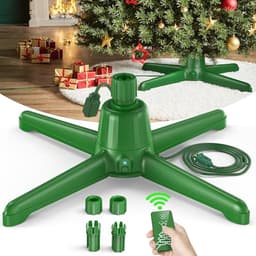
#2 — A 7.5 ft tree, from the only UL-certified stand here
UL certified rotating tree stand, 7.5 ft, 90 lb, 625 W outlets
7.5 ft, 90 lb, 3 outputs at 625 W, UL
6.3
/ 10
Buy it for the UL certification, which nothing else here publishes. Then measure your tree pole, because this listing will not tell you whether it fits.
Published specifications
- Max tree height
- 7.5 ft
- Max tree weight
- 90 lb
- Light outputs
- 3, up to 625 W
- Certification
- UL certified
- Control
- Remote
- Rotation
- 360 degrees
- Pole diameter range
- Not stated in the listing
Our scoring
- Published limits
- 8 / 10
- Power budget
- 9 / 10
- Pole range
- 1 / 10
- Spec completeness
- 7 / 10
Good
- The only stand on this page that publishes a UL certification, which on a motorized mains appliance carrying 625 W of lighting is the figure most worth having
- Six hundred and twenty-five watts across three outputs is a real lighting budget — by the arithmetic on this site an LED tree needs tens of watts, so this is ample
- Publishes both a height and a weight limit
Watch out
- Publishes no pole diameter range, which is the figure that decides fit — a stand can be rated for a 7.5 ft tree and still not clamp your particular pole
- No brand published, which is an odd pairing with a UL claim
- Ninety pounds is the lower weight limit on this page, which rules out some heavily-decorated 7.5 ft trees
#ad · Price as of October 11, 2026 · How we are funded
Specs from the Amazon listing (ASIN B0DB8F7JJG), verified via the Creators API 2026-10-11.
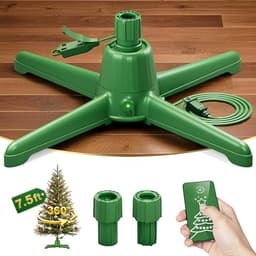
#3 — A slim or pencil tree with a thin pole
360 degree rotating tree stand, 7.5 ft, 90 lb, 0.8 to 1.5 in poles
7.5 ft, 90 lb, 0.8 to 1.5 in poles
6.0
/ 10
The stand for a slim or pencil tree, and the only one here that fits one. Check whether it has outlets before you buy, because the listing does not say.
Published specifications
- Max tree height
- 7.5 ft
- Max tree weight
- 90 lb
- Pole diameter range
- 0.8 to 1.5 in
- Rotation
- 360 degrees
- Light outputs
- Not stated in the listing
- Certification
- Not stated in the listing
- Control
- Not stated in the listing
Our scoring
- Published limits
- 8 / 10
- Power budget
- 1 / 10
- Pole range
- 10 / 10
- Spec completeness
- 5 / 10
Good
- The only stand here that goes down to a 0.8 in pole, which is the range slim and pencil trees actually use — the 1.25 in minimum on the DG-Direct will not grip them
- Publishes the pole range, the height limit and the weight limit, which is the set of three that decides fit
- A narrower pole range usually means a smaller, lighter base, which suits a slim tree in a corner
Watch out
- Publishes no light output ports at all, so a tree on this stand may need its own cord routed off the rotating base — which is the thing a rotating stand is supposed to solve
- No certification published and no brand
- The 1.5 in upper limit rules out most full 7.5 ft trees, whose poles are thicker
#ad · Price as of October 11, 2026 · How we are funded
Specs from the Amazon listing (ASIN B0FL6NR5YM), verified via the Creators API 2026-10-11.
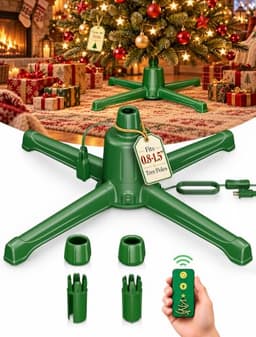
#4 — A 9 ft tree without paying for the music
HOPOCO rotating tree stand with remote, 9 ft, 120 lb
9 ft, 120 lb, remote
3.5
/ 10
The cheaper route to a 9 ft rating, bought with two unknowns. If your tree pole is a standard 1.25 to 1.5 in it will probably be fine, and probably is doing some work in that sentence.
Published specifications
- Max tree height
- 9 ft
- Max tree weight
- 120 lb
- Control
- Remote
- Rotation
- 360 degrees
- Pole diameter range
- Not stated in the listing
- Light outputs
- Not stated in the listing
- Certification
- Not stated in the listing
Our scoring
- Published limits
- 8 / 10
- Power budget
- 1 / 10
- Pole range
- 1 / 10
- Spec completeness
- 4 / 10
Good
- The same published height and weight limits as the DG-Direct at a lower price, from a brand with a name on it
- Nine feet and 120 lb is the top of the domestic range, so it covers any full-size artificial tree on weight
- A remote without the musical function, which is the feature most owners turn off anyway
Watch out
- Publishes neither a pole diameter range nor any light output, which are the two figures that make a rotating stand usable
- No certification published
- On the published specification alone there is no way to confirm it will clamp your tree
#ad · Price as of October 11, 2026 · How we are funded
Specs from the Amazon listing (ASIN B0H7L93P8W), verified via the Creators API 2026-10-11.
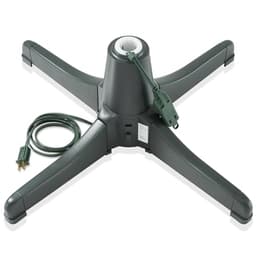
#5 — The cheapest stand here that still has outlets
Casafield 360 degree rotating tree stand, 7.5 ft, 3 built-in outlets
7.5 ft, 3 built-in outlets, adjustable
2.8
/ 10
The budget pick, and the gaps are the weight limit and the outlet rating. Fine for a light, LED-lit 7.5 ft tree; not what you want under a heavily decorated one.
Published specifications
- Max tree height
- 7.5 ft
- Electrical outlets
- 3, built in
- Rotation
- 360 degrees
- Base
- Adjustable revolving
- Max tree weight
- Not stated in the listing
- Outlet wattage
- Not stated in the listing
- Pole diameter range
- Not stated in the listing
Our scoring
- Published limits
- 3 / 10
- Power budget
- 4 / 10
- Pole range
- 1 / 10
- Spec completeness
- 3 / 10
Good
- The lowest published price of any stand here that still publishes built-in outlets, which is the feature that keeps the light cord from winding around the base
- A named brand at the budget end of the category
- Publishes the outlet count, which two of the five stands here do not
Watch out
- Publishes no weight limit, which on a rotating stand is the figure that decides whether the bearing survives a loaded tree
- Publishes no wattage for the three outlets, so the lighting budget is unknown — the other outlet-equipped stands publish 625 W and 800 W
- No pole diameter range either, so fit is unverifiable before it arrives
#ad · Price as of October 11, 2026 · How we are funded
Specs from the Amazon listing (ASIN B0CZ4MXZ62), verified via the Creators API 2026-10-11.
This is not the tree stand page
A rotating stand is a motorized base that clamps the center pole of an artificial tree and turns it. It has nothing to do with the stand a real tree needs, which is a water reservoir with a trunk clamp and is ranked on trunk diameter and water capacity on Christmas tree stands.
You cannot put a real tree on a rotating stand: a cut trunk is irregular, heavy and needs water, and nothing in this category is built for any of that. If you have a real tree, that page is the one you want. The real-versus-artificial decision itself is on real vs artificial Christmas tree.
| Stand | Max height | Max weight | Pole range | Outlets | Certification |
|---|---|---|---|---|---|
| DG-Direct 9 ft, musical | 9 ft | 120 lb | 1.25 to 2 in | 3, 800 W | Not stated |
| UL certified 7.5 ft | 7.5 ft | 90 lb | Not stated | 3, 625 W | UL |
| 7.5 ft, thin pole | 7.5 ft | 90 lb | 0.8 to 1.5 in | Not stated | Not stated |
| HOPOCO 9 ft | 9 ft | 120 lb | Not stated | Not stated | Not stated |
| Casafield 7.5 ft | 7.5 ft | Not stated | Not stated | 3, not rated | Not stated |
This is the best-specified category in this expansion round: every stand publishes a height limit and four publish a weight limit. Pole diameter, the figure that actually decides fit, is published by two.
Source: Manufacturer listings on Amazon.com, verified via the Creators API October 2026.
Why pole diameter beats the height rating
A stand rated “up to 7.5 ft” is telling you about the mass it can spin, not about whether your tree will physically go into it. What decides that is the diameter of the tree’s center pole, and the ranges published here do not overlap as much as you would expect:
The arithmetic
- Thin-pole stand: 0.8 to 1.5 in
- DG-Direct: 1.25 to 2 in
- Overlap between the two: 1.25 to 1.5 in only
- A slim or pencil tree pole below 1.25 in fits only the thin-pole stand
- A full 9 ft tree pole above 1.5 in fits only the DG-Direct
Two stands, both sold as rotating Christmas tree stands, with only a quarter of an inch of genuine overlap. Measure your tree's pole with a tape before you order anything on this page — and if a listing does not publish a range at all, you are guessing.
The practical method: take the tape to the bottom section of the tree pole, measure the outside diameter, and check it sits inside the published range with room at both ends. Tree pole diameter generally tracks tree size and build quality, and the sizes themselves are on tree size and tip count, with the slim case on slim and pencil Christmas trees.
The weight limit, which is the one limit that is real
Most Christmas product weight limits are conservative formalities. This one is not, because the tree’s entire mass sits on a bearing that a small motor then turns, continuously, for weeks. Exceed it and the failure is not cosmetic — it is a stalled motor or a tilting tree.
The limits here are 90 lb and 120 lb, and they are easier to approach than people think, because the figure is the tree plus everything on it:
The arithmetic
- A 7.5 ft artificial tree is commonly 40 to 60 lb assembled
- Lights: a few pounds
- Ornaments: a heavily decorated tree adds 10 to 20 lb, and glass adds more than shatterproof
- A tree collar or skirt and a stand cover add a few more
- Total on a heavily dressed 7.5 ft tree: plausibly 60 to 80 lb against a 90 lb limit
Our estimate from the tree weights in this category and the published stand limits. A 90 lb stand under a heavily decorated 7.5 ft tree has less headroom than the headline figure suggests, which is the argument for the 120 lb stands if your tree carries a lot of glass.
If your tree is the kind that carries heavy ornaments, the tree itself matters as much as the stand — that is covered on artificial Christmas trees for heavy ornaments, and the ornament weight question on shatterproof vs glass ornaments.
The outlets, which are the point of the whole thing
A rotating stand with no outlets is close to useless, because a tree that turns winds its own light cord around the base. The built-in outlets rotate with the tree, so the cord stays still relative to the pole and only the stand’s own cord leaves the base.
Three stands here publish outlets and two of those publish a wattage: 800 W and 625 W across three ports. Both are ample for LED lighting by the arithmetic used on this site — a 100-socket LED C9 line is about 58 W, and a fully lit 7.5 ft LED tree is still tens of watts. The figures only become a constraint with incandescent lighting, which is exactly where they would matter most. The comparison is on LED vs incandescent and the draw arithmetic on how many amps Christmas lights draw.
Who should skip a rotating stand
Three cases. If the tree stands in a corner or against a wall, rotation achieves nothing — nobody sees the back, which is the entire benefit. If the tree is heavily decorated with glass, a continuously turning base is an ongoing risk to every ornament on it, and the honest answer is that a decorated tree is better off still. And if the tree is a flat-back or quarter tree, it is designed to have a front, so turning it is working against the product — flat-back Christmas trees covers those.
Where a rotating stand genuinely earns its place is a tree in the middle of a room, a bay window seen from both inside and outside, or a tree with a children’s side and an adults’ side. In those cases it does something no other accessory does.
Noise, and the one claim worth looking for
A motor turning 60 lb for six weeks in a living room is a noise question, and most listings do not address it. One stand here publishes a “silent spin” claim, which is marketing language rather than a decibel figure — nobody in this category publishes a decibel figure, so there is nothing to compare.
What we can say is structural rather than measured: a stand with a published anti-tilt base and a higher weight rating is carrying the load on a wider bearing, and a wider bearing under the same load generally runs quieter than a narrow one. That is reasoning, not a measurement, and we are flagging it as such. If silence matters, the mitigations are a rug under the stand and running the rotation on a timer rather than continuously.
The problem nobody mentions: the skirt
A rotating stand and a conventional tree skirt do not work together, and no listing in this category says so. A skirt laid on the floor stays still while the tree turns above it, so the pole and the stand’s rotating collar drag across the fabric for six weeks. At best the skirt creeps round and bunches; at worst the stand’s drive is rubbing cloth continuously.
The arithmetic
- A tree skirt sits on the floor and cannot rotate with the tree
- A tree collar sits around the stand and also cannot rotate, but it does not touch the moving part
- A stand cover supplied with the rotating stand rotates with it, which is the only clean answer
- Presents stacked against the base have the same problem, in reverse
Our conclusion: plan the base covering before you buy the stand. A collar that clears the stand's diameter is the usual answer, a supplied rotating cover is the best one, and a loose fabric skirt is the combination to avoid.
The collar route is the one most people end up on, and it needs a diameter check rather than a guess: the collar has to clear the stand’s base, not the tree’s pole. That arithmetic — collar internal diameter against stand width — is already published on Christmas tree collars, and the skirt-versus-collar decision in general is on tree skirt vs tree collar.
The presents point is not a joke. A tree that turns will push anything stacked against its base slowly around the room, and the things most likely to catch are the ones leaning on the collar. If the tree is rotating, presents want to sit clear of the base rather than against it — one more reason a rotating stand suits a tree in the middle of a room rather than one in a corner where the floor space is already tight.
Assembling it in the right order
A rotating stand changes the order of work, because the stand has to be level and plugged in before any of the tree is on it, and neither is easy to fix afterwards.
The arithmetic
- 1. Position and level the stand on the bare floor, with its own cord already run to the outlet
- 2. Confirm it turns freely, loaded with nothing, before the tree goes near it
- 3. Fit the bottom tree section and clamp the pole; check the published pole range fits
- 4. Build the rest of the tree, then shape the branches
- 5. Light the tree, plugging the strings into the stand's own outlets, not into the wall
- 6. Fit the collar or the supplied rotating cover last
Step 5 is the one that gets skipped and it is the whole point of the outlets: a string plugged into the wall instead of the stand will wind itself around the base on the first rotation. Our sequence, not a manufacturer instruction — none of these stands publishes one.
Levelling is worth the extra minute. A rotating base that is out of level puts the tree through a small wobble on every turn, which is the thing that loosens a pole clamp over six weeks and makes a 120 lb rated stand feel unsafe at 70 lb. On carpet, a thin board under the stand spreads the load and stops it sinking unevenly. The tree assembly and shaping half of this is on tree assembly and shaping.
Model years, and why last year’s is often the same stand
Two listings in this category put a model year in the title — one says “2026 Upgrade” and another “2025 Upgrade” — and the published specifications either side of that line are frequently identical: the same 7.5 ft height limit, the same 90 lb weight limit, the same three light outputs. Nothing in either listing says what the upgrade was.
That is worth knowing because the year in the title is doing pricing work rather than describing a difference. Compare the published figures rather than the model year, and if the figures match, the older listing is the same stand. Where the year does matter is certification: the UL claim on this page sits on the stand that names a model year, and a certification is a figure rather than a label, so that one is worth the newer listing.
Questions
›What size pole does a rotating Christmas tree stand fit?
It varies more than the height ratings suggest, and it is the figure that decides fit. The two stands on this page that publish a range cover 0.8 to 1.5 in and 1.25 to 2 in — only a quarter inch of genuine overlap. Measure the outside diameter of your tree’s bottom pole section before ordering.
›Can you use a rotating stand with a real Christmas tree?
No. A rotating stand clamps the straight center pole of an artificial tree. A cut trunk is irregular, much heavier and needs a water reservoir, and nothing in this category provides any of that.
›How much weight can a rotating Christmas tree stand hold?
Ninety to 120 lb on the stands here, and unlike most decoration weight limits this one is real — the whole tree sits on a bearing a motor turns continuously for weeks. Remember the figure is the tree plus everything on it: a heavily decorated 7.5 ft tree can plausibly reach 60 to 80 lb.
›Do rotating tree stands have outlets?
The good ones do, and it is the point: built-in outlets rotate with the tree so the light cord does not wind around the base. Three of the five stands here publish outlets, two of them with a rating — 800 W and 625 W across three ports, both ample for LED lighting.
›Are rotating Christmas tree stands worth it?
Only if the tree is seen from more than one side — in the middle of a room, or in a bay window viewed from inside and out. Against a wall or in a corner, rotation achieves nothing. Skip it for a heavily glass-decorated tree, and for a flat-back tree, which is designed to have a front.
Sources
- DG-Direct musical 360 degree rotating tree stand (ASIN B0FL2KNMJQ) — Fits 9 ft, 120 lb trees, 1.25 to 2 in poles, 3 light output ports rated 800 W, anti-tilt base, remote, stated silent spin
- UL certified rotating Christmas tree stand, 7.5 ft (ASIN B0DB8F7JJG) — Up to 7.5 ft and 90 lb, 3 light outputs up to 625 W, UL certified, remote; pole range not published
- 360 degree rotating tree stand, 0.8 to 1.5 in poles (ASIN B0FL6NR5YM) — Up to 7.5 ft and 90 lb, fits 0.8 to 1.5 in poles; outlets and certification not published
- HOPOCO rotating Christmas tree stand with remote (ASIN B0H7L93P8W) — Up to 9 ft and 120 lb, remote; pole range, outlets and certification not published
- Casafield 360 degree rotating Christmas tree stand (ASIN B0CZ4MXZ62) — Up to 7.5 ft, 3 built-in electrical outlets, adjustable revolving base; weight limit, outlet wattage and pole range not published
- Loaded tree weight estimate — Ours, from typical assembled artificial tree weights in this category plus lighting, ornaments and a collar, compared against the published 90 lb and 120 lb stand limits
- Lighting load cross-check — The LED draw figures used across this site: a 100-socket LED C9 line is about 58 W at the one published 0.58 W per bulb figure, well inside both published outlet ratings
We have not tested these products. Every figure above comes from a published manufacturer specification or from arithmetic shown on this page, and anything a maker does not publish is printed as unavailable rather than estimated. How that works, and what we will not claim, is set out on how we research.